
Camilla Called Kate ‘Too Common’ to Marry William
A new biography claims Queen Camilla objected to Kate Middleton marrying Prince William, calling her ‘too common’ and criticizing her working-class roots.
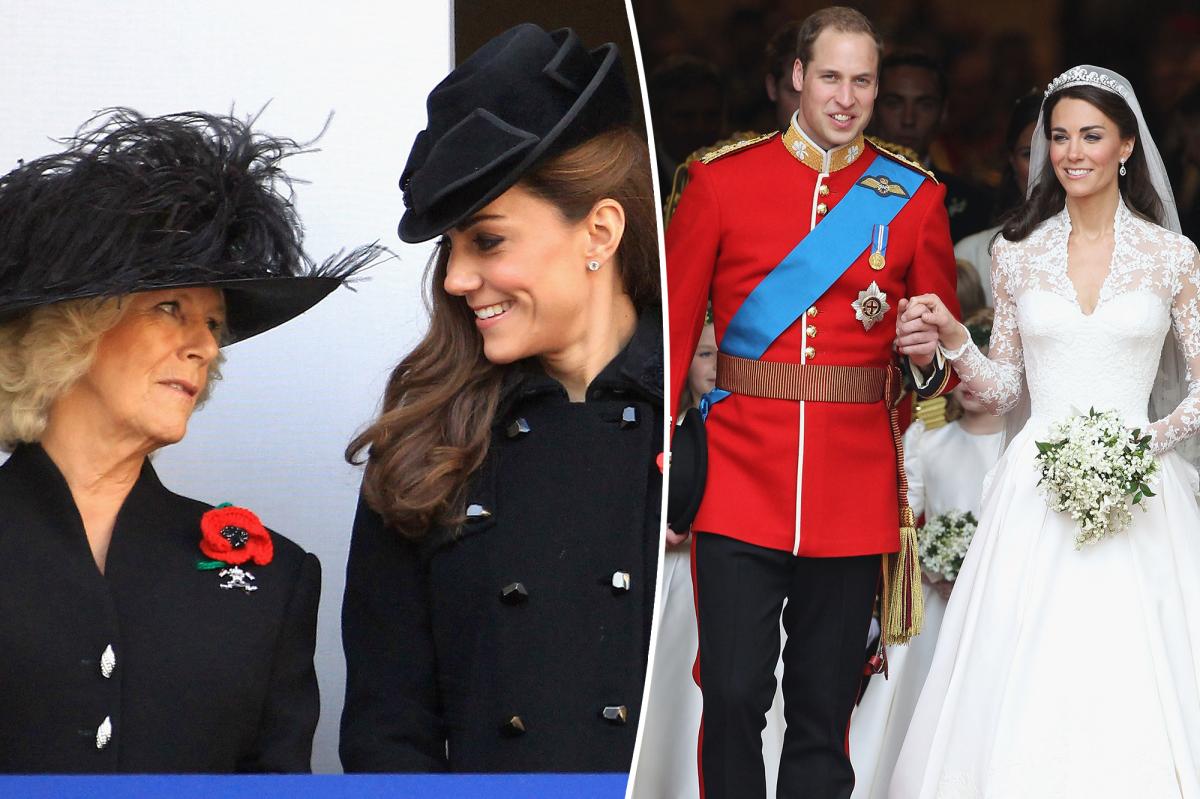
- A new biography claims Queen Camilla once called Kate Middleton “too common” to marry Prince William
- Author Christopher Andersen says Camilla “did object” to Kate’s working-class roots and lack of aristocratic blood
- Camilla allegedly viewed Kate’s mother Carole as a “gauche opportunist” and someone who knew how to scheme
- William reportedly erupted when Camilla asked Kate to change the spelling of her name from Catherine to Katherine
- Andersen says the rivalry hasn’t fully disappeared, but Camilla softened after both she and Kate faced cancer diagnoses in their families
Before Kate Middleton became the Princess of Wales — before the wedding watched by billions, before three children, before a cancer diagnosis that made the whole world hold its breath — she had to survive Queen Camilla.
That’s the portrait painted in “Kate!”, the new biography from royal author Christopher Andersen, which landed last week and is already stirring up a fresh round of palace intrigue. According to Andersen, Camilla was once one of Kate’s “fiercest critics” — and actively objected to the match between her stepson and the woman who would eventually become one of the most admired royals in the world.
“She did not think she was up to snuff, as it were,” Andersen told Fox News Digital. “She was below the salt. She had no aristocratic blood.”
The objection, Andersen writes, was rooted in something Camilla took seriously: bloodlines. Camilla herself is the granddaughter of a baron and a descendant of the Stuart royal line, which ruled England from 1603 to 1714. Her great-grandmother, Alice Keppel, was King Edward VII’s mistress — a connection Andersen says Camilla “had always taken immense pride in.” She had spent her entire life moving in royal circles. Kate, by contrast, was the daughter of former British Airways employees who went on to build a successful party supply business.
To Camilla, that gap was disqualifying. Andersen writes that she preferred an aristocrat with “homegrown blue blood” over “a descendant of coal miners whose mother had grown up in public housing and once worked as a flight attendant.”
The ‘Waity Katie’ Years Were Rougher Than Anyone Knew
Kate and William met at the University of St. Andrews in Scotland in 2001, and what followed was nearly a decade of on-again, off-again courtship — the stretch the tabloids gleefully dubbed the “Waity Katie” years. Andersen argues that those years weren’t just about William’s reluctance. The palace itself, he claims, wasn’t exactly rolling out the welcome mat.
“The palace didn’t really want her,” Andersen said. “People like Camilla didn’t want her because they felt that she was too common to be the wife of a future king. And, of course, the press was vicious in England, portraying her family as a bunch of louts.”
Camilla, according to the book, had long championed the “highborn beauties with hyphenated names” who circled William — the same way she and Baroness Tryon had once handpicked Lady Diana Spencer for Prince Charles. She saw herself, Andersen writes, as “the mistress of a king, not a queen” — a woman who understood how these things were supposed to work.
Her suspicion extended to Kate’s mother, Carole Middleton, whom she allegedly viewed as a “gauche opportunist.” A former mistress of Charles told Andersen that Camilla’s approach to potential rivals was characteristically calculating: “It’s really all about keeping your friends close and your enemies closer. It’s her way of keeping her eye on you.”
A St. James’ Palace staffer put it more plainly: “Maybe she felt threatened by Kate, or perhaps more by William and Kate as a team.”
The Name-Change Request That Made William Fume
One episode from the book stands out as a window into just how tense things got. After Kate and William married in April 2011, Camilla and Charles each had a royal monogram — interlocking Cs beneath a crown. The concern, Andersen writes, was that a third royal cypher also featuring a C would be “overkill.” The solution proposed? That Kate change the spelling of her name from “Catherine” to “Katherine.”
William did not take it well.
“Offended by yet another command essentially aimed at placating Camilla, a fuming William replied on his wife’s behalf,” Andersen writes. The request was “insulting,” William told his father — not just to Kate but to her entire family. The suggestion was dropped.
Even after the wedding, Andersen says, the sniping didn’t stop. “There was a lot of sniping from the sidelines, much of it coming from Camilla’s camp,” he said. “During the first few years of William and Kate’s marriage, Kate got a lot of criticism fed to the press for not working as hard as the rest of the royal family.”
But Kate, by most accounts, simply refused to give anyone ammunition. “She somehow, as the Brits like to say, never put a foot wrong,” Andersen told Fox News Digital. “And today, as a result, she’s pretty much universally admired.”
Cancer Changed Things — But the Competition Never Fully Went Away
The book’s most surprising claim may be about what finally softened Camilla’s stance: cancer. When King Charles was diagnosed in early 2024 and Kate revealed her own cancer diagnosis shortly after, Andersen says something shifted between the two women — or at least between Camilla and her feelings about her daughter-in-law.
“Charles and Kate were always fond of each other, but in the wake of being told that they had cancer, they really bucked up each other’s spirits,” Andersen explained. “Camilla recognizes that and has said that Kate is really the one who can make Charles laugh, and she appreciates that. They’re always hugging and kissing, laughing and joking. They’re very, very close. And Camilla is grateful for all that Kate has done to lift her husband’s spirits.”
Kate announced she was in remission in January 2025. Andersen notes she has since scaled back her royal schedule — “she has good days, she has bad days” — prioritizing her health and her three children: Prince George, 12, Princess Charlotte, 11, and Prince Louis, 8.
Still, Andersen isn’t suggesting all is perfectly harmonious behind palace walls. “There’s still competition,” he said. “That is really what makes the whole show. That’s how the monarchy functions: this competition among all the competing camps. Their staffs are constantly feeding information to the press, constantly trying to grab the spotlight for their particular royal.”
Buckingham Palace declined to comment on the book, with a spokesperson telling Fox News Digital: “We don’t comment on such books.” Reps for Kensington Palace also did not respond to requests for comment.
“It’s just astounding,” Andersen said of Kate, “that she’s been able to not only survive all this, but also flourish within the royal family.”
Filed in

Comments
0