
Cannes 2026 Opens With ‘The Electric Kiss’ to Mixed Reviews
Pierre Salvadori’s 1920s romantic comedy ‘The Electric Kiss’ opened the 2026 Cannes Film Festival to a divided critical reception. Here’s what reviewers said.
- ‘The Electric Kiss’ opened the 2026 Cannes Film Festival out of competition on May 12
- Director Pierre Salvadori’s 1920s-set romantic comedy stars Anaïs Demoustier, Gilles Lellouche, Pio Marmaï, and Vimala Pons
- Critics were largely underwhelmed, calling it overlong and tonally scattered — though the cast earned praise
- The film’s original premise came from director Rebecca Zlotowski, who gave Salvadori the idea while he was acting in her 2019 film
- Salvadori described opening Cannes as “a joy accompanied by an immense terror” after 30 years in the industry
Pierre Salvadori’s The Electric Kiss — La Vénus Électrique in French — opened the 2026 Cannes Film Festival on Monday night to the kind of reception that has become almost a Cannes tradition: polite applause, a winning cast, and critics quietly wondering how this ended up in the opening slot.
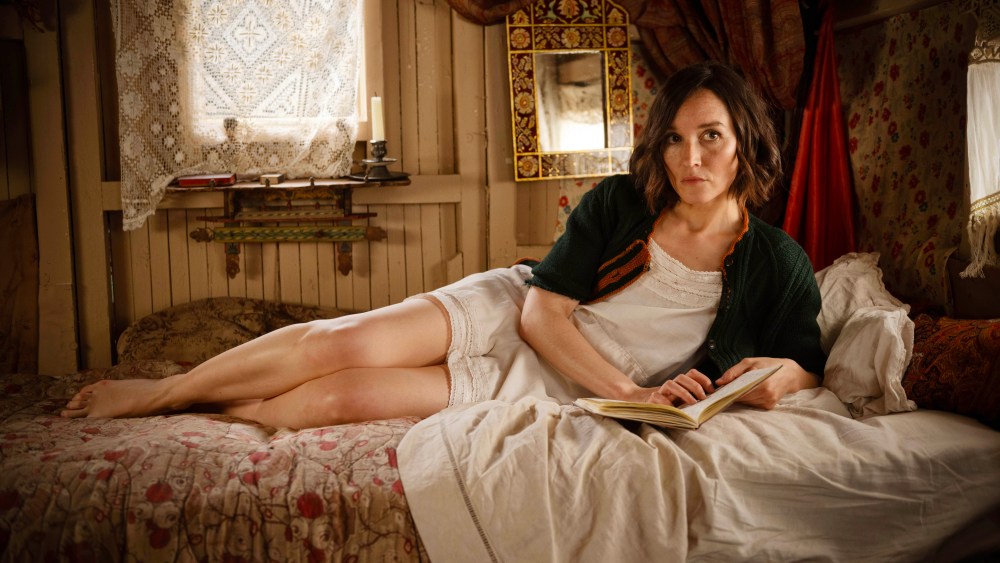
Set in Paris in the late 1920s, the period romantic comedy follows Suzanne (Anaïs Demoustier), a carnival performer known as “Venus Electrificata” who delivers mild electric shocks to paying customers willing to kiss her on stage. Desperate to escape her near-indentured servitude to the carnivale’s sleazy barker Titus (Gustave Kervern), she stumbles into a lucrative side hustle: convincing grieving widower and celebrated painter Antoine Balestro (Pio Marmaï) that she can channel the spirit of his late wife Irène (Vimala Pons). Antoine’s art dealer Armand (Gilles Lellouche), initially furious at the deception, quickly becomes her co-conspirator when he realizes the fake séances are getting his best client back to the easel. From there, the film spirals into a dual-timeline romantic tangle — present-day con job layered over flashback love story — that critics found charming in parts and exhausting overall.
https://youtube.com/watch?v=rUiTrexQKkQ%3Ffeature%3Doembed
What the Critics Said
The most generous take came from Deadline, which called it “a sweetly old fashioned kind of movie” and “a crowd pleaser that could work nicely for audiences, international and domestic, seeking a little escape.” The review praised cinematographer Julien Poupard’s visual design, production designer Angelo Zamparutti’s period work, and composer Camille Bazbaz’s score, concluding that while the film may not be “electric cinema itself,” it does the job as a festival opener.
IndieWire was more measured, giving the film a C and acknowledging that it “peaks early” — specifically in the scenes where Demoustier and Lellouche are scheming together in close-up. “Of all contemporary Gallic stars, Lellouche and Demoustier already feel slightly out of time, their features recalling both silent-era performers and screwball archetypes,” the review noted, comparing the effect to “witnessing a pair of Al Hirschfeld caricatures suddenly brought to life.” The problem, per IndieWire, is that the film introduces a fourth major character and a second narrative strand that throws off the whole geometry. “If three’s a party, four’s a crowd.”
The Hollywood Reporter was blunter, calling it “bland, middlebrow entertainment” and noting that Demoustier’s pixie-ish quality creates an “unfortunate Amelie adjacency that does the new film no favors.” The twin plotlines, the review argued, “don’t hold together structurally,” and what should be a gathering momentum of romance and deception instead becomes “a tedious muddle.”
Variety was the harshest of all, calling The Electric Kiss possibly “the worst festival opener I’ve seen in a decade” — a pointed statement given Cannes’ own checkered history with opening-night selections, a list that includes Woody Allen’s Café Society, the much-derided Final Cut, and last year’s Leave One Day. The review took particular aim at Pio Marmaï’s painter, calling him “a quaintly uninteresting sap” and arguing that the film’s overly lush cinematography makes it look “like it was shot through a filter of rosé.”
The consistent thread across all four reviews: the cast is likeable, the period design is lovely, and the core idea has genuine charm. The execution is where things fall apart. At 122 minutes, The Electric Kiss is simply too long for the kind of breezy screwball confection it wants to be — and too scattered in tone to work as anything weightier.
Five Writers, One Overcrowded Script
Part of the tonal inconsistency may trace back to the film’s unusually crowded writing credits. Rebecca Zlotowski (A Private Life) and Robin Campillo (BPM) share story credits alongside Benjamin Charbit (The Beast) and longtime Salvadori collaborators Benoît Graffin — five voices feeding into a single romantic comedy, and critics noticed the seams.
Salvadori has been open about the film’s unusual origin. He first heard the premise from Zlotowski while acting a small role in her 2019 film The Summoning — the one starring Natalie Portman and Lily-Rose Depp. “She told me it was the story of a young woman, a fake psychic, who makes a young man believe she can put him in contact with his deceased wife, and in the process falls in love with him,” Salvadori recalled to Deadline. He was immediately hooked. “I loved the paradox of someone manipulating someone but at the same time falling in love with that person as they steal from them.”
Zlotowski didn’t want payment for the idea. “Rebecca said, ‘Ideas belong to those who take them on,’” Salvadori recounted. He put her and Campillo in the credits anyway.
The decision to set the story in 1928 was deliberate. Salvadori wanted to tap into the era’s genuine obsession with spiritualism — séances, clairvoyants, and the belief that the dead could communicate with the living were mainstream preoccupations across Europe and the U.S. at the time. “It needed to be set in that era, otherwise my character would come across as too gullible, almost naive, bordering on stupid,” he said. He even pointed to Thomas Edison as an example of the craze’s reach — the inventor reportedly built a machine intended to communicate with the afterlife.
Salvadori’s Lubitsch Dream
Salvadori has long cited Ernst Lubitsch as the filmmaker who changed his life. “The first filmmaker who liberated me and broadened my horizons was Lubitsch. It was after seeing Heaven Can Wait that I suddenly understood what directing was, what it was all about,” he told Deadline. He sees The Electric Kiss as having the DNA of Lubitsch’s 1932 classic Trouble in Paradise — another con-artist love story built on deception and desire.
Whether the finished film lives up to that lineage is where critics diverge. Variety noted that “Hollywood artists like Lubitsch and Wilder were magicians who knew how to lure in an audience,” while Salvadori “has conceived The Electric Kiss as a film about fake magic, yet there’s no spirit of real magic underlying the fakery.” IndieWire was more forgiving, crediting Salvadori with at least knowing what he was reaching for, even if the ensemble of screenwriters pulled the result in too many directions at once.
For Salvadori, opening Cannes at all — out of competition, in the Grand Théâtre Lumière — is its own milestone. After 30 years and ten features, this is his first time in Official Selection. “It’s a joy accompanied by an immense terror and fear, that will only come to an end at 10.30pm,” he said days before the premiere. He was also candid that he didn’t want to be in competition: “This is a film for a party, a celebration… it’s a film that talks about my love for cinema.”
The cast is stacked with familiar French faces. Marmaï has worked with Salvadori twice before, on In The Courtyard and The Trouble With You. Demoustier is a first-time collaborator — Salvadori says he met her on a jury and was struck by “her quickness, her intelligence, her mischievousness.” And Lellouche’s art dealer character, Armand, is reportedly inspired by Salvadori’s real-life producer and decades-long collaborator Philippe Martin, whose company Les Films Pelléas produced the film. “There has always been this dimension of friendship and work, and sometimes a lot of tension,” Salvadori said of their relationship. “An unbreakable friendship, almost a brotherhood.”
The festival runs through May 24. Whether The Electric Kiss turns out to be the low bar that makes everything else look better — as Cannes openers so often do — remains the question. Salvadori, at least, seems at peace with whatever comes next. He wanted a party. He got the biggest screen in France.
Filed in

Comments
0