
Léa Seydoux Stuns Cannes in ‘Gentle Monster’
Léa Seydoux stars in Marie Kreutzer’s Cannes competition drama about a woman unraveling after her husband’s arrest for child pornography charges.
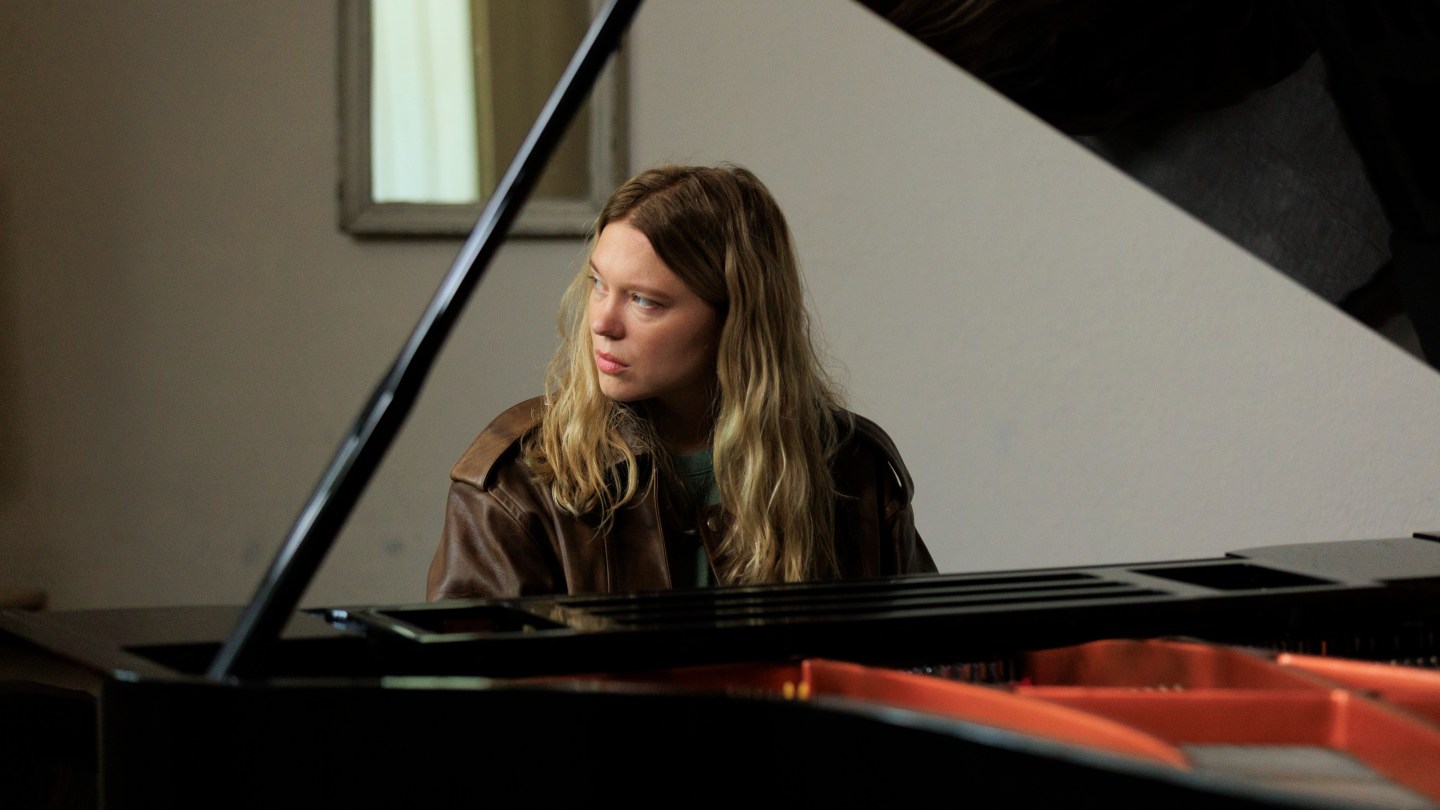
- Léa Seydoux stars in Gentle Monster, world premiering in competition at the 2026 Cannes Film Festival
- The film follows a woman whose husband is arrested for distributing child pornography — and her painful reckoning with what she didn’t see
- Director Marie Kreutzer was partly inspired by a real-life scandal involving her Corsage collaborator Florian Teichtmeister
- Catherine Deneuve appears in a supporting role as Seydoux’s French mother
- The film left multiple Cannes attendees in tears and is already generating serious awards buzz
There’s a moment early in Gentle Monster when Léa Seydoux, playing a pianist named Lucy, sits at her baby grand and quietly dismantles The Cure’s “Boys Don’t Cry” — pulling it apart note by note, never quite closing the gap between the song and her own unraveling life. It’s the kind of scene that tells you everything about the film you’re in: precise, emotionally devastating, and in no hurry to let you off the hook.
The Austrian writer-director Marie Kreutzer’s follow-up to her acclaimed period drama Corsage world premiered Friday night in the competition program of the 2026 Cannes Film Festival, and it left more than a few people in the audience in tears. Given the subject matter — a woman whose husband is arrested for distributing child pornography on the dark web — that emotional response is, on its face, unexpected. But Kreutzer is too careful and too smart a filmmaker to let this become a sensationalist ordeal. What she’s made instead is something quieter and more lasting: a film about what we choose not to see in the people we love.
What ‘Gentle Monster’ Is Actually About
Lucy (Seydoux) and her husband Philip (Laurence Rupp), an Austrian documentary filmmaker, have just settled into a rambling farmhouse in the Bavarian countryside with their young son Johnny (Malo Blanchet) when the police arrive one morning with warrants to seize Philip’s computers and hard drives. He’s been active in an online chat group where men share footage of children being abused — going by the handle GentleMonster_87, of all things. Philip leans on his work as a filmmaker to explain the research. Lucy wants to believe him. The evidence, drip by drip, makes that harder.
What makes the film so unsettling — and so effective — is that Kreutzer never truly centers Philip. He’s almost a ghost in his own story, a cipher the audience watches Lucy trying to reconcile with the man she’s been in love with for years. The question isn’t really whether he did it. It’s what Lucy does with knowing.
Seydoux is extraordinary here — raw nerves, steely and broken at once, the kind of performance that doesn’t announce itself but accumulates until you realize you’ve been holding your breath. Cinematographer Judith Kaufmann, who also shot Corsage, keeps the camera close on her face, long handheld takes that create an urgent, almost claustrophobic intimacy. The film shares real DNA with Anatomy of a Fall — the same collision of emotional chaos and cold legal machinery, the same sense of a family home turned irrevocably into a crime scene — but it carves out its own territory entirely.
Lucy is isolated in ways that compound her crisis. She’s not fluent in German, far from her mother, dependent on Philip, and as her very French, somewhat distant mother Eloise — played by Catherine Deneuve in a small but impactful role — pointedly observes, Lucy has done the one thing worse for a female artist than having children: she moved to the countryside.
The Parallel Story That Gives the Film Its Shape
Running alongside Lucy’s story is that of Elsa Kühn (Jella Haase), the detective leading the investigation into Philip. Where Lucy turns inward, Elsa looks squarely at the worst of things — collecting evidence, building cases, blowing up families in service of a greater moral good, then getting up the next morning and doing it again. The two women circle each other with a mutual bemusement that mirrors the audience’s own unsettled feelings. Elsa can’t fathom how Lucy could will herself to stay. Lucy can’t understand how anyone could devote their life to staring into the abyss.
The parallel isn’t just thematic. Elsa’s elderly father (Sylvester Groth) has dementia, and his disinhibition has led to him touching his female caretaker inappropriately — a problem Elsa doesn’t want to confront any more than Lucy wants to confront hers. Kreutzer doesn’t let anyone fully off the hook. Editor Ulrike Kofler draws out these uncomfortable echoes with a deft, unhurried hand.
The film’s music, overseen with real care, does a lot of work throughout. Lucy’s concert performances — off-kilter interpretations of songs written or performed by men, including The Cure and George Michael’s “Freedom,” arranged by the French singer-songwriter Camille — underscore her displacement and her art’s strange relationship to her life. Elsa, by contrast, moves through the world to female rap. Coldplay’s “Yellow,” sung by Camille, plays over the closing credits in a moment that lands harder than it has any right to.
Why Kreutzer Made This Film — and Why It Was Personal
The origins of Gentle Monster are rooted in something Kreutzer has been sitting with for years. During COVID, she read a piece of journalism about child sexual abuse material online that she describes as haunting — so explicit she couldn’t finish it in a single sitting. “I just felt that the only thing I could do was to tell a story about this issue,” she told THR. “It’s not about the creepy guy behind the bushes. Statistically speaking, it has to be someone we know.”
The project took on an additional layer of complexity when her Corsage collaborator, Austrian actor Florian Teichtmeister, was caught up in a real-life child pornography case and ultimately sentenced to two years in prison. Kreutzer had already been developing Gentle Monster when the story broke — she’d had a research call with a police investigator on a Friday, and heard the first rumors about Teichtmeister the following Monday. “It was so crazy,” she said. “In the middle of that whole scandal and shit storm, I thought maybe I cannot make Gentle Monster anymore, because everyone will always make that connection. It didn’t take me very long to realize that I might have to make it even more.”
She also consulted a child protection organization about whether Corsage should be pulled from circulation given Teichtmeister’s involvement. The response stuck with her: that pulling the film would be “a very Austrian solution” — brushing the ugly side under the rug rather than confronting it.
As for the title: it came from a pair of sunglasses. Gentle Monster is a Korean eyewear brand, and Kreutzer spotted the name on a pair sitting on her desk while she was writing the script. “I just saw the little writing, and thought, ‘This is the perfect title,’” she said. They checked, got clearance, and the rest followed.
Seydoux, Deneuve, and Getting the Cast Right
Landing Léa Seydoux for the lead came, Kreutzer says, from a post-Corsage shift in how she approached casting — adopting the American practice of “general meetings” with actors, building relationships without an immediate project in mind. Lucy was already written as a multilingual character, French and German and English woven through her daily life, and Seydoux fit that architecture perfectly. “Léa is just excellent,” Kreutzer said simply.
Getting Catherine Deneuve for the role of Lucy’s mother followed a similar path. The French icon appears in only a handful of scenes, but her presence lands — there’s something fitting, almost poetic, about Deneuve playing the mother of a woman trying to hold herself together while the ground shifts beneath her.
Safeguarding young Malo Blanchet, who plays Johnny, was a priority throughout production. An intimacy coordinator, mental health support for the crew, and careful communication with Malo’s parents about what the child should and shouldn’t know about the material were all part of the process. “We were extremely careful with everything,” Kreutzer said.
The hardest scenes to shoot, she admits, were the concert performances — technically demanding, full of extras, requiring a kind of parallel production logic that left her feeling, for once, like she couldn’t direct her way out of it. “I just had to rely on everyone else,” she said. “That was the most stressful part.”
Gentle Monster is Kreutzer’s first film in Cannes’ main competition — Corsage debuted in the Un Certain Regard section in 2022. She’s clear-eyed about what that means for this particular film. “People did that with Corsage; they will not do that with Gentle Monster,” she said of the repeat viewings her previous film inspired. “It’s important to tell these difficult stories. I knew it would be harder to get the love and attention for this film, so I’m even happier that it gets to be presented in this very special place.”
She’s right that it’s not an easy watch. But there’s a reason the lights came up at Cannes and people were crying. Gentle Monster asks the question that most of us spend our lives hoping we’ll never have to answer: what do you do when the person you love turns out to be someone you didn’t know at all?
Filed in

Comments
0