
Léa Seydoux Confronts the Unthinkable in Cannes Drama ‘Gentle Monster’
Léa Seydoux stars in Marie Kreutzer’s haunting Cannes drama about a woman unraveling the truth about her husband’s darkest secret.
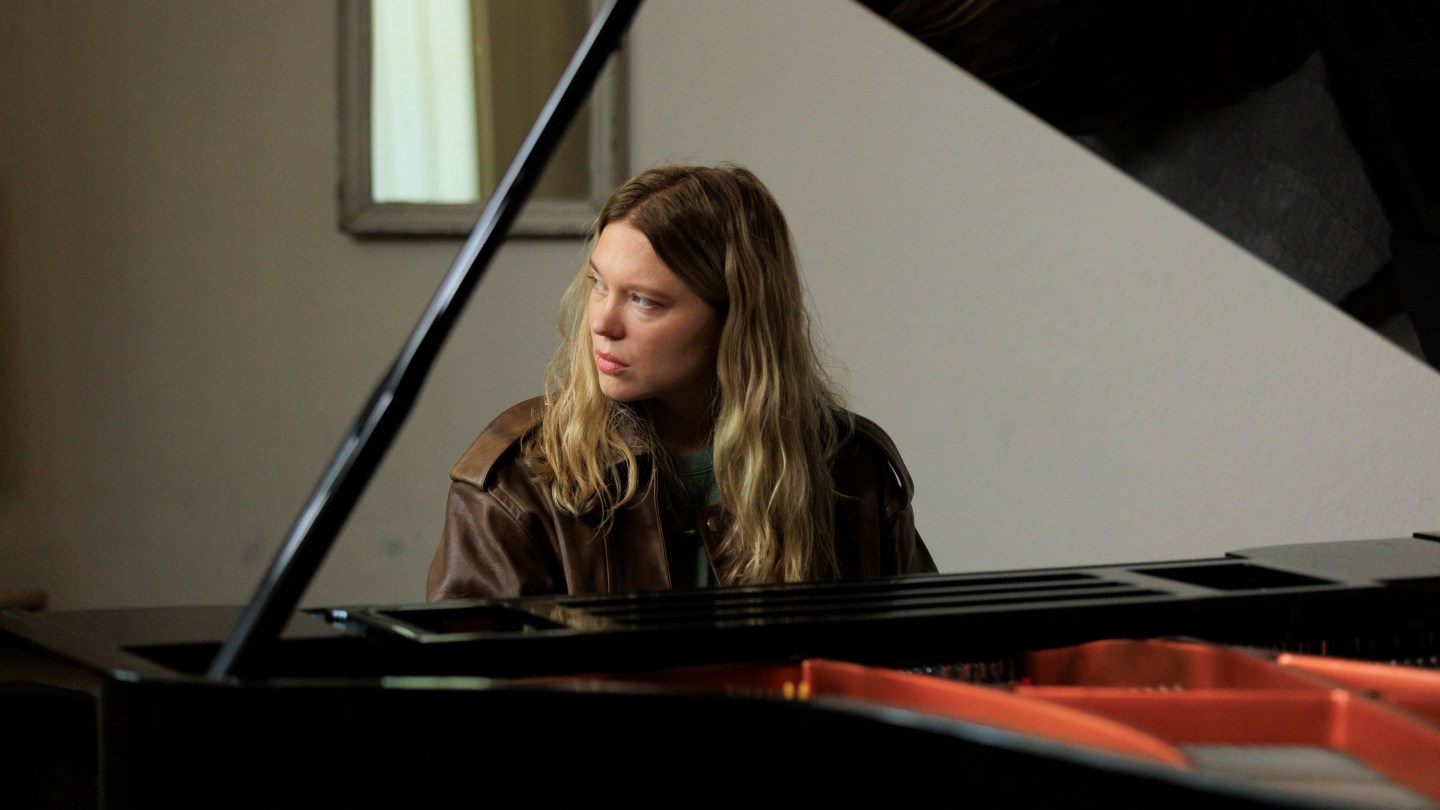
- Léa Seydoux stars in Marie Kreutzer’s Gentle Monster, premiering in competition at the 2026 Cannes Film Festival
- The film follows a woman whose husband is arrested for possession and distribution of child sexual abuse material
- Kreutzer’s previous film Corsage starred Florian Teichtmeister, who later pleaded guilty to possessing over 76,000 child pornography files
- Catherine Deneuve appears in a supporting role as Seydoux’s character’s mother
- The film is currently seeking U.S. distribution after its Cannes debut
There’s a moment early in Gentle Monster when Léa Seydoux sits at a piano and plays a deconstructed cover of Charles & Eddie’s neo-soul classic “Would I Lie to You?” — and everything that follows turns that rhetorical question into something unbearable. Austrian writer-director Marie Kreutzer’s latest film, which world premiered in the competition program of the 2026 Cannes Film Festival, is one of the most quietly devastating things to screen on the Croisette in years. More than a few attendees reportedly left in tears.
The setup is almost achingly ordinary. Lucy Weiss (Seydoux) is a French avant-garde pianist — a Jacob Collier-like performer known for dismantling famous pop songs written by men, from The Cure’s “Boys Don’t Cry” to George Michael’s “Freedom” — who has uprooted her life to follow her Austrian husband Philip (Laurence Rupp) to a farmhouse in the Bavarian countryside after his burnout panic attacks become too much to manage in Munich. They assemble a trampoline for their young son Johnny (Malo Blanchet). They talk about ditching their phones for a landline. They make love on a mattress on the floor because they haven’t gotten around to buying a proper bed yet. They are, in every visible way, a normal creative-class family.
Then the police knock on the door.
A special unit from Munich’s child sex crimes division, led by investigator Elsa Kühn (Jella Haase), arrives early one morning to seize Philip’s computers, phones, and hard drives. He is arrested for distributing child pornography through a dark web chat group, where he operated under the handle GentleMonster_87. On those devices, investigators find tens of thousands of images. Some are violent. Some Philip appears to have made himself. Some feature their son.
What Kreutzer does next is where the film becomes something genuinely singular. Rather than center Philip — who remains, deliberately, more cipher than character — she locks the camera almost entirely on Lucy. On Seydoux’s face. On the slow, grinding work of a woman trying to reconcile the man she loves with the evidence piling up around her.
A Performance Built on Implosion
Seydoux has never been more precisely calibrated than she is here. This isn’t a performance of screaming accusations or dramatic confrontations. It’s the opposite — an implosion. Lucy doesn’t rage at the people who doubt Philip. She quietly, methodically begins to doubt herself for believing his rationalizations. He was collecting material for a documentary. He uploaded footage of Johnny to earn trust from the online community. He was acting as a fence for content because he felt emasculated by Lucy’s greater success. Each explanation arrives like a small mercy, and each one eventually collapses.
“There is no ‘off button’ for pedophilia,” someone explains to Lucy at one point. The film’s most wrenching observation is that there isn’t one for love, either.
Kreutzer, who also wrote the script, has spoken about approaching the material by asking herself a simple question: what would I do? “I basically wrote it as if it were happening to me,” she told The Hollywood Reporter. “The worst thing for me, of course, is if something happened to my kid. But right after that, it would be that my partner did something horrible. This is where the story and the plot came from.”
That intimacy of perspective shows. Lucy isn’t rendered as naive or foolish — she’s rendered as human. She reacts with a horrified kind of relief when Philip first claims he circulated the material “for the money.” When that story, too, falls apart, the film doesn’t editorialize. It just watches her absorb it.
The Shadow of a Real Scandal
It’s impossible to watch Gentle Monster without knowing what happened after Kreutzer’s previous film, Corsage — the acclaimed feminist period drama that earned Austria’s submission for the international Oscar and debuted in Un Certain Regard. Its male lead, Florian Teichtmeister, was later arrested and pleaded guilty to possessing more than 76,000 child sexual abuse files across 22 devices, more than half depicting children under 14. He received a suspended sentence that outraged many Austrians, and Corsage was temporarily pulled from cinemas.
Kreutzer is careful to note that her work on Gentle Monster predates that scandal — its origins trace to a newspaper article she read during COVID about a pedophile ring in North Rhine-Westphalia, a piece of journalism so explicit she couldn’t finish it in a single sitting. But the Teichtmeister case collided with the project in a way that was, by her own description, surreal. “I literally had a one-and-a-half-hour research phone call with a police investigator on a Friday, and on Monday, I heard about these rumors for the first time,” she said. “It was so crazy.”
She briefly considered abandoning the film. Then she reconsidered. “If I don’t make the film for that reason, wouldn’t that be wrong?” When she consulted someone at a child protection organization about whether Corsage should be pulled from circulation, the response stuck with her: that would be, she was told, “a very Austrian solution” — just brushing it under the rug.
So she kept going. And Gentle Monster is neither a penitent film nor a self-exculpatory one. It doesn’t make pleas for sympathy, and it doesn’t render Philip as the kind of monster anyone could spot at a distance. That, Kreutzer has said, is precisely the point. “We all do know victims, and we all do know perpetrators. We just don’t know who they are.”
The title itself came from an unexpected place. Kreutzer spotted the name “Gentle Monster” — a Korean sunglasses brand — sitting on her desk while writing the script. “I just saw the little writing on the glasses and thought, ‘This is the perfect title.’”
Two Women, Parallel Blind Spots
Running alongside Lucy’s story is a subplot following Elsa Kühn, the investigator building the case against Philip. Jella Haase plays her as someone who has seen so many men like Philip that she’s developed a kind of professional armor — brisk, unsentimental, openly impatient with Lucy’s attempts to find alternate explanations. Off the clock, though, Elsa is dealing with her own uncomfortable reality: her elderly father (Sylvester Groth), whose dementia has stripped away his inhibitions and left him repeatedly groping his live-in carer (Patrycja Ziółkowska). Elsa pays the carer more money to put up with it. She looks away.
The parallel is deliberate, and critics are divided on how effectively it lands. Some find it a meaningful inversion — a woman whose job is to stare unflinchingly at abuse choosing, at home, the same kind of willful blindness she scorns in Lucy. Others find it a clumsy equivalence that flattens a more complex story. What’s clear is that Kreutzer isn’t letting anyone entirely off the hook, and the two women’s wary circling of each other — Lucy unable to comprehend how someone could devote their life to looking into the abyss, Elsa unable to fathom how Lucy could will herself to stay — mirrors the audience’s own unsettled position.
Catherine Deneuve appears in a small but pointed role as Lucy’s mother, delivering what may be the film’s most quotable line: for a female artist, she observes dryly, there are only two things worse than having children — and one of them is moving to the countryside. It lands differently once the police arrive.
A Film That Refuses to Resolve
Cinematographer Judith Kaufmann — who also shot Corsage — frames the story in muted, naturalist widescreen that lets the beauty of the Bavarian countryside exist alongside the encroaching dread. The world doesn’t stop being gorgeous just because Lucy’s is collapsing. Long handheld takes hold close on Seydoux’s face when the film needs urgency; wider shots let the landscape swallow her when it needs to convey isolation. Production designer Myrna Wolf captures the specific texture of a family mid-move — the untended garden, the rooms with too little furniture, the mattress on the floor — in a way that makes the domestic disruption feel viscerally real before the legal one arrives.
The music, arranged by the mononymic French singer-songwriter Camille, does serious thematic work throughout. Lucy’s performances — her act of taking apart songs written by men and remaking them in her own voice — function as the film’s emotional spine. She’s fascinated, she explains, by the fact that men are more honest about their feelings in music than in life. Deconstructing Philip’s alibis turns out to be a different kind of performance entirely. Camille’s version of Coldplay’s “Yellow” plays over the closing credits, its lyrics about bleeding yourself dry for love landing with a weight the song has never quite carried before.
Kreutzer was meticulous about protecting young Malo Blanchet during production, working closely with his parents and bringing on an intimacy coordinator who also flagged the need for on-set mental health support for crew members who might have their own histories with the subject matter. “Statistically speaking, there must be people on the team who have experienced these kinds of things,” Kreutzer noted.
Gentle Monster doesn’t offer resolution, and it doesn’t pretend to. It ends not with a shattering revelation but with a slow crumbling — Lucy’s illusions giving way piece by piece until there’s nothing left to hold. Whether that restraint reads as truthfulness or frustration may depend on what you came looking for. What it unquestionably offers is one of the year’s most committed performances, a filmmaker working at the height of her craft on material that clearly cost her something, and a question that lingers long after the lights come up: at what point do you finally see what was always there?
Gentle Monster is currently seeking U.S. distribution.
Filed in

Comments
0