
How Netflix’s ‘Remarkably Bright Creatures’ Changes the Book
Netflix’s Remarkably Bright Creatures makes one big change from Shelby Van Pelt’s novel — and it affects the emotional heart of the story.
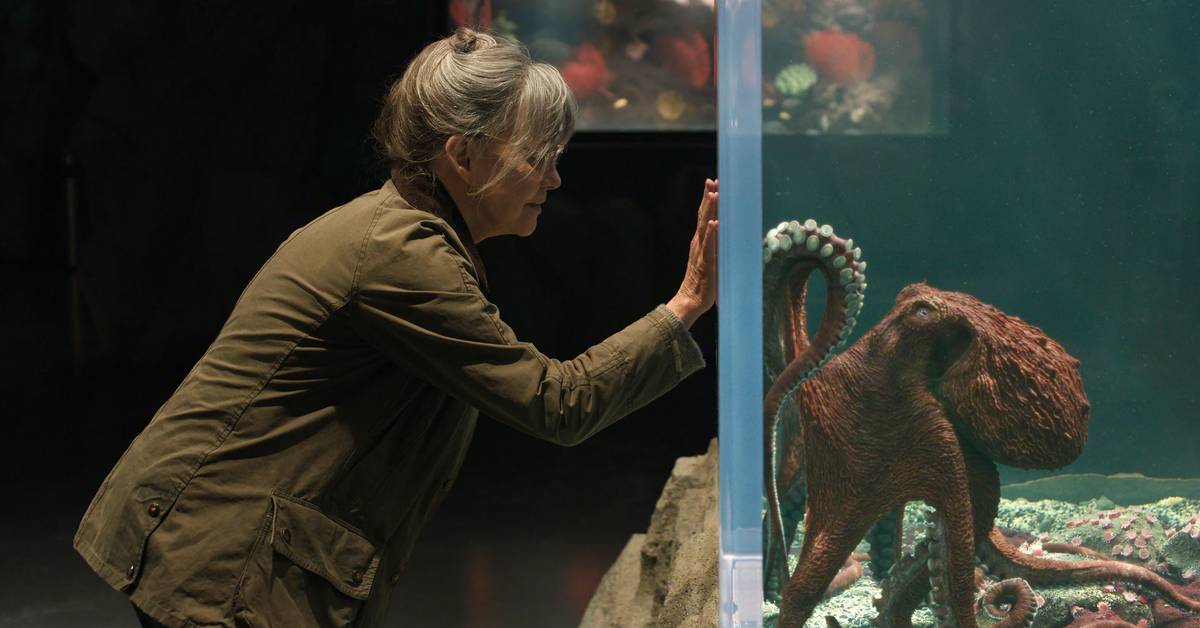
- Netflix’s Remarkably Bright Creatures debuted at No. 1 on the platform and is already an emotional hit with viewers.
- The film compresses Tova and Cameron’s backstories, fast-tracking their meeting and softening the novel’s slow-burn emotional setup.
- Marcellus the octopus — one of the book’s three narrators — has a significantly reduced role in the adaptation.
- Author Shelby Van Pelt says the film captures her grandmother, who inspired Tova, with an “uncanny” resemblance — and she even has a cameo.
- Despite the changes, the film holds the warmth and message of Van Pelt’s bestselling novel, backed by powerhouse performances from Sally Field, Lewis Pullman, and Alfred Molina.
Netflix’s Remarkably Bright Creatures is already making people cry on TikTok, and for good reason. The adaptation of Shelby Van Pelt’s beloved 2022 novel — starring Sally Field, Lewis Pullman, and Alfred Molina as the voice of a very wise giant Pacific octopus — debuted at No. 1 on Netflix’s top 10 film rankings after premiering May 8. But fans of the book have noticed something: the movie they’re watching isn’t quite the one they read.
The biggest departure isn’t a plot twist or a rewritten ending. It’s subtler than that — and in some ways, more significant. Netflix’s version of Remarkably Bright Creatures rushes Tova and Cameron into each other’s orbits far sooner than Van Pelt’s novel does, and that choice quietly reshapes the emotional architecture of the entire story.
The Book’s Slow Burn Was the Whole Point
Van Pelt’s novel is a deliberate, patient thing. Readers spend a long stretch getting to know Tova Sullivan and Cameron separately — watching them move through their lives, their losses, their daily rituals — before their worlds collide. That distance matters. By the time they finally connect, you feel the necessity of it.
In the book, Tova’s story begins with the death of her brother and the complicated grief that leads her to Charter Village, the senior living home. Cameron, meanwhile, is first introduced at his aunt’s house — the woman who helped raise him — where he stumbles across his late mother’s belongings. He’s a mess. He can’t hold a job. His girlfriend kicked him out. He’s directionless in the most relatable, painful way.
The film essentially skips all of that. When audiences meet Cameron, he’s already in Washington state, already searching for Simon Brinks, the man he believes to be his father. The groundwork — the full portrait of just how lost he is — has been cleared away to get to the heart of the story faster. And while that makes for a tidier two-hour watch, it costs the film something real. You need to see Cameron at his lowest to understand why Tova, and yes, a giant octopus, could change his life.
What Happened to Marcellus
Then there’s the octopus.
Marcellus — the great Pacific octopus at the center of Van Pelt’s story — is one of three distinct narrators in the novel, and arguably the most memorable. His chapters offer something the human storylines can’t: a perspective entirely outside human grief, wise and observational and oddly comforting. Readers fell hard for him. At a recent sold-out event at Gonzaga University’s Myrtle Woldson Performing Arts Center, one audience member told Van Pelt simply, “I want more Marcellus. I need more Marcellus.”
The film gives Marcellus Alfred Molina’s voice — a genuinely inspired piece of casting, given that Molina famously played Doc Ock in Spider-Man 2 — and the CGI rendering of the octopus is breathtaking. But his presence is actually smaller on screen than it is in the book. The third perspective that made Van Pelt’s novel so structurally unusual gets compressed into something closer to a cinematic pet role. His wisdom is still there, but quieter. The character of Ethan, too, was minimized in order to focus the film’s energy on Tova and Cameron’s relationship.
Van Pelt, for her part, has spoken warmly about the adaptation. She told the Spokesman-Review crowd that Netflix came to her in 2024 wanting to finance the film, and that Field was on board from the very beginning — she’d read the book and wanted in. The author also shared something remarkable about the production’s attention to detail: the creative team gave Field’s Tova an “uncanny” resemblance to Van Pelt’s grandmother Anna, the real-life inspiration for the character, right down to her hair and clothing. “It was like seeing a ghost of my grandmother,” Van Pelt said. “They just nailed it.”
She even has a cameo — look for her in the audience during an open-mic night bar scene.
What the Film Gets Right
None of this is to say the adaptation fails. It doesn’t. The performances alone are worth the watch. Field is outstanding — warm, guarded, quietly heartbreaking. Pullman captures Cameron’s messy vulnerability in a way that feels completely lived-in. And Molina’s voice-over work anchors every scene Marcellus appears in.
Director Olivia Newman, who previously adapted Where the Crawdads Sing, and screenwriter John Whittington clearly understood what made Van Pelt’s novel resonate. The film’s gentleness is intentional. Hollywood Reporter chief film critic David Rooney noted that “its gentle sense of humor and depth of feeling are enough to sweep you away on a wave of emotion” — and that tracks with the TikTok reaction videos that have been flooding the platform since the film dropped.
Kassie Evashevski, the manager at Anonymous Content who helped shepherd the project from manuscript to screen — and who also represents Pullman, Chen, and Molina — put it simply: “It’s not that often, but sometimes, there are blessed journeys from book to screen, and this is one of them. It’s really been a fairytale experience.”
The novel itself has sold roughly four million copies, spent more than 64 weeks on the New York Times bestseller list, and was a Jenna Bush Hager book club pick. Van Pelt wrote it as her debut, returning to fiction in her 30s after years away from writing — she’d spent her childhood filling notebooks with Little House on the Prairie fan fiction, growing up in Tacoma not far from the Point Defiance aquarium that inspired the book’s fictional Sowell Bay Aquarium.
Her next book, she told the Gonzaga crowd, is about halfway done. It follows a “messy” family and a cat. “They’ve been so much fun to write because they’re such a disaster,” she said.
As for Remarkably Bright Creatures — the film trades the novel’s slow devastation for something warmer and more immediately accessible. For some viewers, that’s exactly what they needed. For readers who fell apart somewhere around chapter twelve, there may be a quiet ache at what didn’t make it to screen. But the core of what Van Pelt built — the idea that grief doesn’t have to be faced alone, even if your companion happens to have nine brains — comes through intact.
“Hope can rise out of anything,” the story seems to say. Even from the bottom of a tank.
Filed in

Comments
0