
Lukas Dhont’s ‘Coward’ Gets 13-Min Cannes Ovation
Lukas Dhont’s queer WWI romance ‘Coward’ earned a 13-minute standing ovation at Cannes — and it all started with a photo of a soldier in a sandbag skirt.
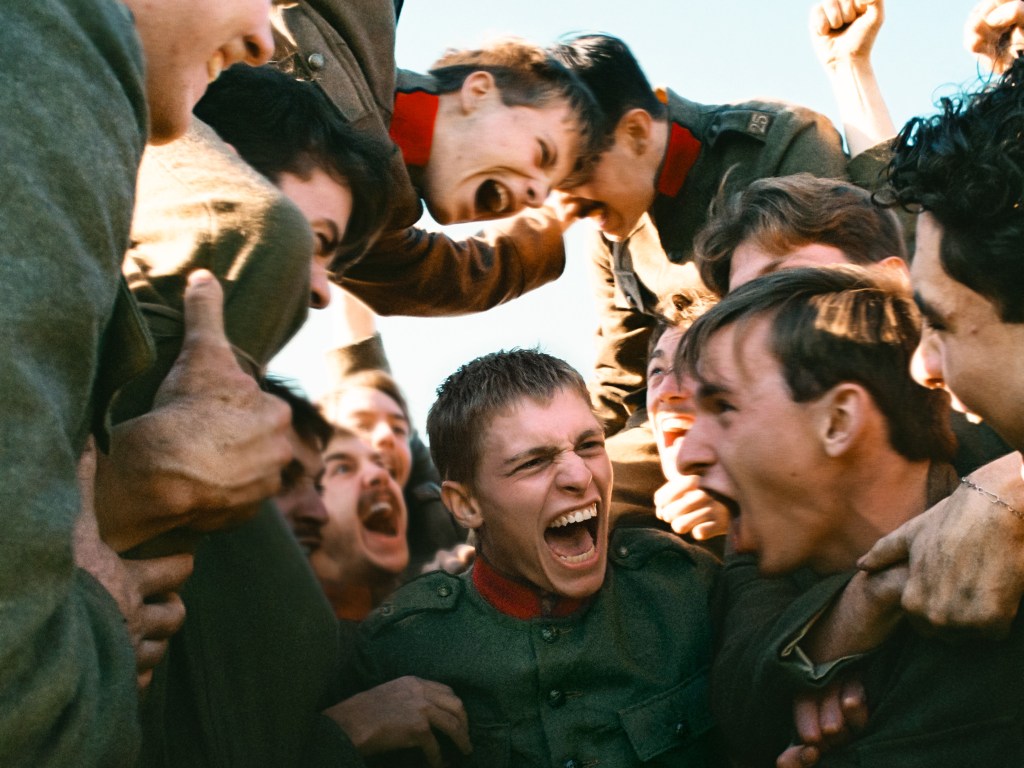
- Lukas Dhont’s WWI queer romance Coward received a 13-minute standing ovation at its Cannes world premiere
- The film was inspired by a real photograph of a Belgian soldier cross-dressed behind the frontlines during WWI
- Newcomer Emmanuel Macchia stars alongside Valentin Campagne in the two-hander romance
- MUBI has acquired the film for the UK, Ireland, Germany, Austria, Italy, Spain, Turkey, Latin America, Australia, and New Zealand
- Critical reception has been divided, ranging from comparisons to Casablanca to charges of emotional artificiality
When the lights came up on Coward at the Grand Théâtre Lumière Thursday night, the Cannes audience didn’t move. For 13 minutes, they stood and applauded — one of the biggest crowd responses to any film in this year’s competition. Director Lukas Dhont, visibly moved, told the room that everyone should share “love, not war.”
It’s a line that cuts right to the heart of what Coward is. Set at the height of the First World War, the film follows Pierre, a young Belgian farmer’s son newly arrived at the front, and Francis, the flamboyant ringleader of a makeshift theatre troupe performing for soldiers behind the trenches. As the violence rages on, the two men find each other — and the film quietly, insistently asks what it actually means to be brave.
The answer Dhont arrives at is not what the war genre has traditionally offered.
A Photograph That Changed Everything
“It’s based on a black-and-white photograph I found four years ago of a young man right behind the frontlines dressed up in a sandbag skirt performing for the other soldiers,” Dhont told Deadline earlier in the festival. “And I thought that it was something so modern in that picture, even though it was black and white, but seeing this young man cross-dressed, smiling in front of all these other men really inspired me to create something.”
At the film’s press conference, he elaborated on what that image meant to him personally. Growing up in Belgium — where WWI cemeteries are woven into the landscape, where school trips to the trenches are a rite of passage — he thought he knew the war. Then he saw a photo he’d never been shown.
“They had turned sandbags into skirts, and they were having fun. To me, that was the ultimate picture of resistance. It was an act of liberation,” he said. “I grew up with the First World War. When you go to school, you learn about it and visit the trenches, but I had never seen those particular images. That’s when I realized that the memory has a kind of politics about it. There are certain images of the war that you are shown.”
That realization became the engine of the film. Dhont discovered that throughout many wars, across many armies, soldiers waiting to fight created small performances for one another. “We have pushed those images to the front, and we have forgotten and made those images of softness and of expression rather invisible,” he told Reuters.
He wanted to push them back into the light.
What the War Film Has Always Got Wrong
Dhont is direct about his frustration with the genre. “This genre of film, for me, has always been a genre in which men are given a very limited space to exist in, and where their value is measured on their ability to hurt and destroy and not necessarily intimately be there for one another,” he said at the press conference. “I think the most tragic part of it is that male friendship, male bonding, has too often been used as a tool to destroy.”
Coward, co-written with Angelo Tijssens, deliberately moves away from trench-based misery to reimagine the front as a place of romantic possibility — and, crucially, of queer desire that the war itself, paradoxically, helped make possible. “These men live in a time where their love had to be unspoken, had to be incredibly silent,” Dhont said. “But weirdly enough, the war at that time brought them together.”
The film’s title carries its own weight. “We named this film Coward because that fear is a topic, but I think also the film questions, what does it actually mean to be brave — not only in relationship to another, but also in relationship to ourselves, in choosing the truest parts of ourselves; in choosing to express ourselves, even when the world around us expects us to behave or to act in a certain way,” Dhont said.
Two Newcomers at the Center
Emmanuel Macchia, in his screen debut, plays Pierre — a farmer’s son drafted to haul shells and retrieve the wounded, quiet and wide-eyed amid the bravado of his unit. Valentin Campagne plays Francis, the troupe’s gaunt, willowy ringleader, a tailor by trade who transforms parachute cloth and hessian sacks into elaborate drag costumes and stages full revues for his fellow soldiers.
Dhont found Macchia by visiting agricultural schools in Belgium. “He was so soft speaking and so tender, and he just moved me,” the director recalled. “He just carries this film, with so much maturity also.”
Variety’s review describes Macchia as “a gently stoic, aptly unformed presence with a stolid sadness in his trudging gait, who can go from boy to man with a slight shift in the light,” and calls his first kiss with Campagne “among the most purely romantic gestures the movies have seen in a minute.” Deadline’s Pete Hammond went further, comparing the romance to Casablanca, Brief Encounter, and The Way We Were — “a classic movie love story for the ages.”
The Wrap noted that Coward is “all but certain to be Belgium’s Oscar submission” — which would make it a successor to Close, Dhont’s 2022 film that earned an Academy Award nomination for Best International Feature Film. MUBI, which also released Close, has already acquired Coward for the UK, Ireland, Germany, Austria, Italy, Spain, Turkey, Latin America, Australia, and New Zealand. Lumière will distribute in Benelux; Diaphana Distribution in France.
The Critics Aren’t All Singing
The audience in the Lumière gave it 13 minutes. The critics? More complicated.
Variety called it Dhont’s “most satisfying film to date,” praising cinematographer Frank van den Eeden’s work and the chemistry between the two leads as something “visible almost entirely in the different ways their bodies move and balance each other: one still, one quicksilver.” The Wrap framed it as a corrective to historical erasure — “a clear product of its moment,” arguing for queer inclusion “on rah-rah terms” rather than as counterculture.
The Hollywood Reporter was considerably less convinced. Critic David Rooney called the film “self-conscious” and “grandiose,” writing that it “reeks of manneristic affectation and phoniness” and that the leads have “minimal chemistry.” He compared it unfavorably to Oliver Hermanus’ Moffie and Elegance Bratton’s The Inspection as more textured explorations of queer men in the military.
It’s a split that echoes the reception to both Girl and Close — films that drew serious acclaim alongside criticism that Dhont manipulates difficult subject matter for emotional effect. Whether Coward lands as a transcendent wartime love story or a beautifully lit exercise in feeling depends, it seems, entirely on how much you surrender to it.
The Palme d’Or jury will make their call at Saturday’s closing ceremony. Dhont already has a Grand Prix on his shelf from Close in 2022, and a Caméra d’Or from his debut Girl in 2018. This is his third time competing at Cannes, and by the sound of that 13-minute ovation, the crowd at the Grand Théâtre Lumière had already made up their minds.
“For me, the reason to make a film about the past is to say something about the present,” Dhont said at the press conference. Given everything, it’s hard to argue with the timing.
Filed in

Comments
0