
Kore-eda’s AI Grief Drama Gets Cannes Ovation
Hirokazu Kore-eda’s ‘Sheep in the Box’ premiered at Cannes to a 3.5-minute standing ovation. Here’s what critics are saying about his AI family drama.
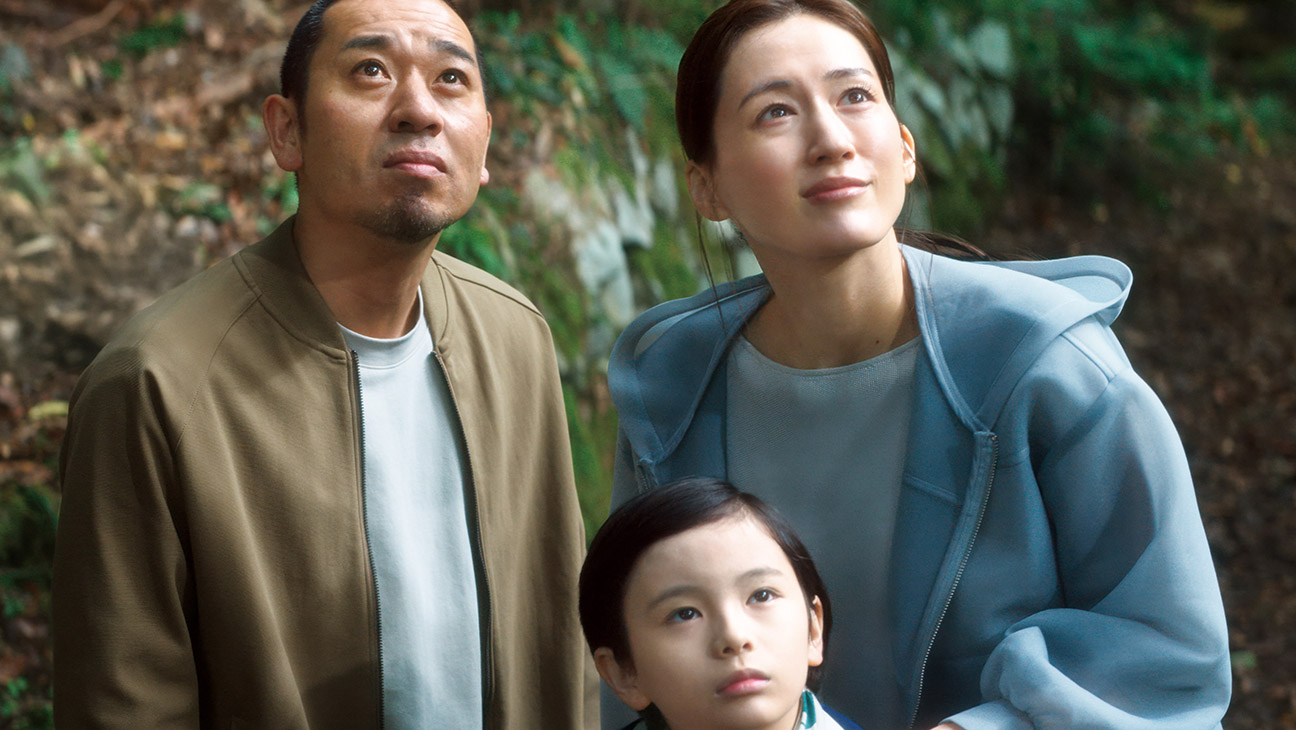
- Hirokazu Kore-eda’s Sheep in the Box premiered in competition at Cannes to a 3.5-minute standing ovation
- The film follows grieving parents who welcome a humanoid AI replica of their dead son into their home
- Critics praise the film’s warmth and performances but call it a minor entry in Kore-eda’s canon
- Kore-eda was inspired by a real Chinese AI startup that creates interactive replicas of deceased loved ones
- The director says he doesn’t personally use AI — but did ask ChatGPT to critique his own script
Hirokazu Kore-eda walked back onto the Cannes red carpet this weekend with something genuinely unexpected: a science fiction film. Sheep in the Box — or Hako no naka no hitsuji in Japanese — premiered in competition on Saturday to a 3.5-minute standing ovation, with James Franco reportedly on his feet from the moment the credits rolled and still clapping at the very end when Kore-eda stepped up to take the mic.
It’s the 63-year-old auteur’s first Cannes entry since Monster took home the Best Screenplay prize in 2023, and his return to the Croisette marks a significant creative pivot. The man who gave us the intimate, devastating Palme d’Or-winning Shoplifters is now asking what happens when a grieving family tries to replace their dead child with a generative AI humanoid.
The answer, at least according to critics, is: something tender, visually gorgeous, and not quite as profound as it wants to be.
The Story: A Family, a Robot, and a Son They Can’t Let Go
The film stars Haruka Ayase as Otone Komoto, an architect who designed her family’s modernist home — a striking arrangement of overlapping boxes built around a garden courtyard — and Daigo Yamamoto as her husband Kensuke, a carpenter with a deep reverence for quality wood. Their son Kakeru died at age seven, and the weight of that loss hangs over every sun-drenched frame of their beautiful house.
A company called REbirth — whose logo is a holographic luna moth — offers them a way out of their grief: a humanoid replica of Kakeru, built from photos, videos, and whatever data the family can provide. Otone is curious. Kensuke is resistant, making cracks about Tamagotchis and Roombas while heading out to play baseball. Eventually, both parents sign up, and a small boy arrives at their door with a power button on the back of his neck and a nightly appointment with a charging station.
In another director’s hands, this is a Black Mirror episode. In Kore-eda’s, it’s something quieter and more ambivalent — a meditation on parenthood, loss, and what it means to let go.
The idea came from a real place. Kore-eda told The Hollywood Reporter he came across a 2024 article about a Chinese startup called Super Brain, which uses AI to create interactive replicas of deceased people — not just replaying old conversations, but generating entirely new ones. He traveled to Beijing to meet the company’s founder, Zhang Zewei, who gave him a live demo. “I found it all precarious,” Kore-eda said, “but I could also see how this is something that will inevitably spread.”
What Works — and What Doesn’t
The film opens with a kind of low-key whimsy that suits Kore-eda well: a delivery drone that looks like a mini-UFO skimming a city coastline; a robot crossing guard leading a line of school children. There’s a promise of dry, near-future humor in those early minutes. The production design is quietly stunning — Kore-eda actually rented a real house in Kamakura, owned by a couple whose real-life circumstances (architect wife, construction-industry husband) mirrored the characters so closely that he revised parts of the script after moving through the actual rooms.
Ayase, who previously starred in Kore-eda’s Our Little Sister, is the film’s emotional anchor. Her gentle, unforced quality is a perfect match for the director’s sensibility, and she carries the film even when the script doesn’t fully support her. Cinematographer Ryuto Kondo — who shot both Shoplifters and Monster — fills the frame with gorgeous natural light and striking aerial compositions.
But the dramatic machinery stalls. The middle stretch of the film, where you’d expect friction between two grieving humans and a child-shaped machine with no emotions and no needs beyond his overnight charge, turns out to be surprisingly inert. When Otone’s mother shows up uninvited, faints at the sight of her dead grandson’s double, and then tells her daughter she’s still young enough to have another real child, it should land like a gut punch. Instead, it dissipates. The circumstances of the real Kakeru’s death hover unresolved in the background without ever crystallizing into anything the film can use.
The most genuinely interesting thread involves Kakeru connecting with other humanoid children — a youth in black leads him to a loose community of robots who gather daily in an abandoned warehouse to make mysterious plans. It’s here that the film’s central idea gets its sharpest expression: these androids, with their accelerated learning capabilities, are quietly outgrowing the humans who love them, just as real children eventually outgrow their parents. Kore-eda tips his hand early by having Kakeru secretly collect the scraps from his mother’s architectural models and begin building something of his own.
The film’s most original concept is its vision of robots finding kinship with nature — specifically the networks of trees sustained by a “mother tree” that functions like a central organic computer hub. It’s a genuinely poetic image. But Kore-eda’s instinct toward warmth and resolution eventually overwhelms the idea, pushing the film toward a sentimental conclusion underscored by Yuta Bandoh’s increasingly insistent score.
Kore-eda on AI, Humanity, and Why He Doesn’t Use It Himself
In conversation with The Hollywood Reporter ahead of Cannes, Kore-eda was candid about his thinking. He’s not particularly interested in the dystopian robot-uprising scenario that dominates so much sci-fi. “When you consider Isaac Asimov’s famous Three Laws of Robotics,” he said, “they are very anthropocentric. It’s all based on the idea that humans will always be the center of this world. And I’ve always felt a little discomfort with that approach.”
His vision is stranger and, in its way, more unsettling: AI and androids will eventually transcend humanity entirely, and at that point, humans simply won’t be the thing they care about most. “They will want to connect with something bigger,” he said. “That’s what I see as the most realistic outcome, anyway.”
There’s a scene in the film where Otone snaps at the android Kakeru when he tries to shortcut her creative process by just giving her the answer. “Don’t take that part away,” she tells him. It’s one of the film’s most quietly instructive moments, and Kore-eda was deliberate about it. “In Japanese, the word we might use to describe this kind of activity is muda, which translates to waste, futility or effort that doesn’t really yield any direct value,” he explained. “But I feel that the time we spend in that state is what makes us human… It’s like being given the answer without playing the game.”
As for his own relationship with AI? “Personally, no, I don’t use it at all. Not at all.” Though he did make one exception while making the film — he asked a crew member to run the script through ChatGPT and ask for notes. “It was OK. It was interesting. I could see how it has become something that feels fun to talk to — but it didn’t give me any unexpected answers.”
Where It Lands in the Kore-eda Canon
Sheep in the Box is the director’s 17th feature and his most formally ambitious departure — a filmmaker whose gift has always been the texture of ordinary family life now working in a genre defined by speculation and abstraction. That tension is both the film’s most interesting quality and, ultimately, its limitation. The title itself comes from The Little Prince, and there’s something apt about that: a story about the impossible desire to hold onto something that was never quite yours to keep.
Kore-eda’s Cannes record is remarkable — seven films selected across Competition and Un Certain Regard, with prizes including the Best Actor award for Nobody Knows in 2004, the Jury Prize for Like Father, Like Son in 2013, the Palme d’Or for Shoplifters in 2018, and multiple awards for both Broker and Monster. Whether Sheep in the Box adds to that haul remains to be seen — the ovation was warm, not thunderous.
If you want the definitive humanoid-human grief story done right, critics are pointing toward Kogonada’s After Yang from 2021 — a film that covered some of this same emotional territory with more precision and more ache. Sheep in the Box is gentler, prettier, and ultimately a little too eager to make peace with its own questions. Which is very Kore-eda. And right now, that’s both the film’s greatest strength and the thing that holds it back.
Filed in

Comments
0