
Stephen Colbert’s Late Show Finale: A Perfect Goodbye
Stephen Colbert ended The Late Show with Paul McCartney, Jon Stewart, a wormhole, and 1,800 episodes worth of joy. Here’s how it all went down.
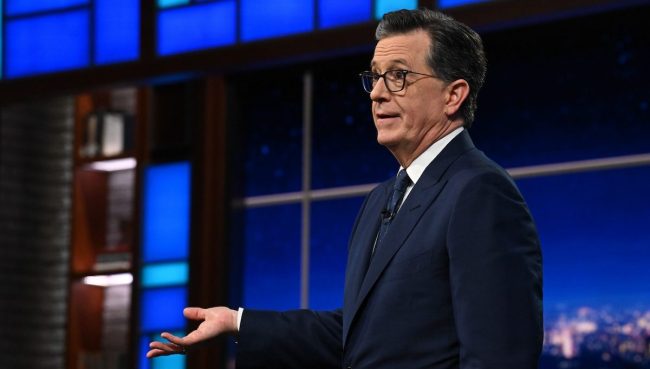
- Stephen Colbert hosted the final episode of The Late Show on May 21, ending CBS’s 33-year late-night franchise
- Paul McCartney was the surprise final guest, closing the show by literally turning off the lights at the Ed Sullivan Theater
- Jon Stewart, Strike Force Five, Bryan Cranston, Paul Rudd, Ryan Reynolds and others made cameo appearances throughout the night
- CBS canceled the top-rated late-night show amid its parent company Paramount’s pending acquisition by a Trump donor’s son
- Colbert’s next move is writing a screenplay for a Peter Jackson Lord of the Rings film
“We call this show The Joy Machine,” Stephen Colbert said in the opening seconds of his final episode. “Because to do this many shows, it has to be a machine. But the thing is, if you choose to do it with joy, it doesn’t hurt as much when your fingers get caught in the gears.”
On Thursday night, after 11 years and roughly 1,800 episodes, The Late Show with Stephen Colbert aired for the last time. CBS’s decision to cancel the top-rated show in its time slot — a move widely linked to the network’s parent company Paramount navigating a politically charged acquisition — left Colbert, his staff, and millions of viewers with nearly 10 months to brace for an ending nobody really felt ready for. And yet, when the night came, Colbert put on exactly the kind of show he always put on. That was, entirely and deliberately, the point.
A Regular Show, With a Few Interruptions
Colbert opened by insisting he wanted to do a regular episode — not something big and ceremonial — because every episode of The Late Show had always been special to him. The universe, and a parade of famous friends, had other ideas.
Bryan Cranston was the first celebrity in the audience to volunteer himself as Colbert’s final guest, and the first to be politely turned down. Paul Rudd arrived next, bearing five bananas as what he called a “customary” retirement gift — a gag that got a callback when Ryan Reynolds presented the same offering to bandleader Corey Bernhard. Tim Meadows invoked his decades-long friendship with Colbert in hopes of landing the coveted guest chair, while Tig Notaro seemed genuinely unaware there was even a reason to want it. “It’s your last show?” she deadpanned.
In between interruptions, Colbert played it completely straight. He rattled off jokes about the day’s headlines, delivered one last “First Draft” segment, and dropped a piece of Ed Sullivan Theater trivia that landed perfectly: “Backstage, Elvis used the bathroom and didn’t die.” He ran a “Meanwhile” segment that was, characteristically, both verbose and unhinged — a ship-themed declaration of love for his staff and crew that somehow also included a Peanuts copyright lawsuit. When the band noodled a melody that sounded suspiciously like Vince Guaraldi’s iconic theme, Colbert looked at the camera and said, “Oh no! I hope this doesn’t cost CBS any money!” It was a genuinely funny troll of his soon-to-be former employer, and one of the night’s most satisfying moments.
Paul McCartney, a Signed Photo, and the Beginning of the End
The final guest had been teased as a major surprise, though The Late Show‘s own social team somewhat undermined the reveal by announcing it before the broadcast began. Still, Paul McCartney sitting down at the Ed Sullivan Theater — the same stage where the Beatles made American history in 1964 — carried genuine weight.
McCartney brought a gift: a signed photograph of that legendary Beatles performance. The inscription, Colbert jokingly claimed, read “Colbert is better than The Beatles.” Before they got into conversation, McCartney reflected on what America meant to him when he first arrived. “The land of the free, the greatest democracy, that is what it was,” he said. “And still is, hopefully.” On the subject of his iPhone: “I hate cookies. I bought you. I don’t want you to change.” Even when Colbert asked about McCartney’s earliest memories of music — questions the man has surely fielded a thousand times — there was something genuinely warm about the exchange. Colbert’s interviews were always like this: personal, unhurried, and entirely his own.
McCartney would stay until the very last moment of the night.
The Wormhole, Jon Stewart, and Strike Force Five
Throughout the episode, a strange green glow and an intermittent hum had been appearing behind Colbert’s desk. Eventually, he couldn’t ignore it anymore. He threw to commercial, walked backstage, and discovered an inter-dimensional wormhole — brought on, as Neil deGrasse Tyson explained before being immediately swallowed by it, by two contradictory realities existing simultaneously: The Late Show is the No. 1 rated show in late night, and The Late Show is also canceled.
Jon Stewart appeared next, “on behalf of Paramount,” to push his friend toward the future. “The hole’s here, you can’t ignore it,” Stewart told him. “The only choice you have now is how you choose to walk through it.” Then came Strike Force Five — Seth Meyers, John Oliver, Jimmy Kimmel, and Jimmy Fallon — with their own words of encouragement, before the wormhole broke containment and started pulling in the audience.
It was peak Late Show: big, silly, and sneakily sincere all at once.
Hello, Goodbye
When Colbert returned from a real commercial break, he was in an empty void — a single light bulb, a chair, and the quiet. Then Elvis Costello began singing “Jump Up,” joined by former Late Show bandleader Jon Batiste and current leader Louis Cato. It felt, for a moment, like the show might end there — without its signature live musical closing number.
Then the lights came back on. McCartney, Costello, Cato, Batiste, and Colbert stood in front of the live studio audience and sang “Hello, Goodbye” — which also happened to be the episode’s title. Colbert’s family, guests, and crew flooded the stage in a moment reminiscent of the Colbert Report finale. Before they could finish, the pre-taped sketch resumed: Colbert stood in the theater’s basement, the voices still singing above him, and let McCartney pull the lever to shut down the Joy Machine.
The wormhole swallowed the building whole. A snow globe appeared. Colbert’s dog Benny sniffed it, then was ushered along. And that was that.
What’s Actually Being Lost
The circumstances of the cancellation have hung over the show’s final weeks like a storm cloud. Paramount is in the process of being acquired by Skydance Media, led by David Ellison — son of Oracle billionaire Larry Ellison, a prominent Trump donor. The deal required federal regulatory approval. Colbert had been among the most consistent — if not always the sharpest — critics of the Trump administration on television. When the cancellation was announced, Trump rushed to Truth Social to gloat: “I absolutely love that Colbert got fired.” Paramount maintained the decision was purely financial. On the show’s penultimate episode, Bruce Springsteen called Colbert “the first guy in America who lost his show because we got a president who can’t take a joke,” and named Ellison and his father from the stage.
Colbert, for his part, largely let others carry that fight. He didn’t go out guns blazing. He didn’t spend his finale burning down the house. He did what he always did: he put on a good show.
That choice — to resist the pull of the dramatic exit in favor of one more night that looked and felt like the previous 1,800 — is actually the most revealing thing about who Stephen Colbert is. His greatest asset was never his political sharpness, or his celebrity rapport, or even his comedy chops, impressive as all of those were. It was his sincerity. He was the host people went to when they wanted to talk about grief. Nick Cave opened up about losing two sons. Andrew Garfield wept over his mother’s death. Dua Lipa turned the tables and asked Colbert about his Catholic faith. He’d been open for years about the plane crash that killed his father and two brothers when he was 10 years old, and how he eventually came to “love the thing that I most wish had not happened.” His guests knew he would meet their pain with understanding, not a hunt for a revealing quote.
When the Los Angeles Times assembled a list of his most memorable moments, the first four fell under the heading “Emotional conversations about grief and faith.” Imagine trying to do that for almost any other host.
The day the show ended was also the last day of CBS News Radio, shuttered after nearly a century on the air. The Ed Sullivan Theater goes dark. A 33-year franchise is over. Colbert’s next chapter, at least, sounds like him: he’s writing a screenplay for a Peter Jackson Lord of the Rings film — a fitting escape, as one observer put it, for TV’s chief Tolkien nerd. He even closed his finale with a nod to Tennyson’s “Ulysses,” a poem he once convinced Helen Mirren to read to him on air.
“We love doing the show for you,” he said early in the evening. “But what we really, really love is doing the show with you.”
He meant it. He always meant it. That’s exactly what we’ll miss.
Filed in

Comments
0