
Mixtape Review: A Coming-of-Age Game That Hits Different
Beethoven & Dinosaur’s Mixtape is a music-drenched coming-of-age story about three teens on their last night of high school. Here’s our full review.
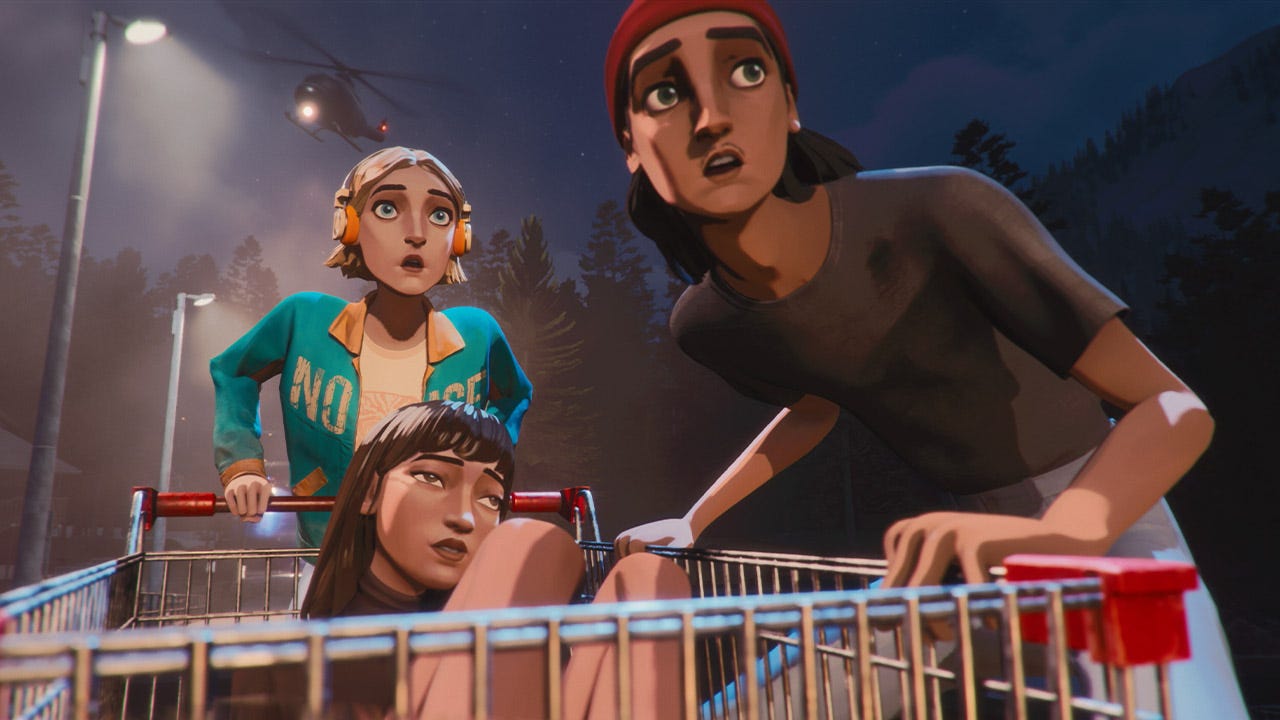
- Mixtape, developed by Beethoven & Dinosaur and published by Annapurna Interactive, released May 7, 2026 on PC, PS5, Xbox Series X/S, and Switch 2
- The three-hour narrative game follows three friends — Rockford, Slater, and Cassandra — on their last night of high school
- Its 28-song licensed soundtrack spans Joy Division, The Smashing Pumpkins, Devo, Portishead, Silverchair, and more
- IGN called it one of 2026’s very best games; others found the light gameplay a dealbreaker
- Mixtape is available on Xbox Game Pass at no additional cost
Some games announce exactly what they are within the first five minutes. Mixtape, the new narrative adventure from Australian developer Beethoven & Dinosaur, does it in about thirty seconds — the moment Stacey Rockford kicks off her skateboard to Devo’s “That’s Good” and the world opens up around her in a blur of color and motion and pure, uncomplicated joy. You either feel it immediately, or you don’t. There is very little middle ground here.
That’s the thing about Mixtape. It’s not trying to be everything to everyone. It’s a three-hour interactive memory, a coming-of-age story told through keepsakes and flashbacks and 28 carefully chosen songs, built around three teenagers standing at the edge of the rest of their lives. Rockford, aspiring music supervisor, always wearing headphones with orange earpieces, is leaving for New York. Cassandra, the rebellious softball star with a controlling cop for a father, is heading to college. Slater is just… sticking around, man. It’s their last night together, and Beethoven & Dinosaur — the same team behind 2021’s The Artful Escape — has made a game out of what that actually feels like.
A Soundtrack That Does the Heavy Lifting
The music here isn’t decoration. It’s architecture. Rockford is an aspiring Hollywood music supervisor, and the game leans fully into that conceit — every memory, every chapter, every emotional beat is paired with a song chosen the way a real music obsessive would choose it. Not always the obvious hit. Not always the song you know. That’s the point.
You can walk around Rockford’s bedroom and get treated to album-by-album analysis in the style of Patrick Bateman — though, as IGN noted, “with far less violent undertones.” The opening skate to Devo’s “That’s Good” sets a high-energy pace. The Smashing Pumpkins’ scuzzy “Love” arrives like a burst of explosive angst. And then there’s John Paul Young’s “Yesterday’s Hero,” a deep cut that many players will be hearing for the first time, deployed so perfectly in context that it immediately lodges itself in your brain.
The full Mixtape soundtrack spans Joy Division, The Cure, Portishead, Silverchair, Siouxsie & The Banshees, Roxy Music, Iggy Pop, Alice Coltrane, and more — 28 licensed tracks in total, plus additional instrumental pieces. It’s the kind of playlist a music-obsessed teenager would actually make, which is exactly the point. For players who live and breathe this stuff, the game operates on an entirely different frequency. Even for those who don’t — one reviewer admitted he barely knew any of the songs — the music still works, landing the emotional tone of each scene with precision.
The one legitimate frustration: you have to keep moving through a chapter to hear the songs play out. There’s no way to just sit in a scene and let a track breathe. For a game so fundamentally about music, that’s a strange design choice.
What You’re Actually Playing
Let’s be honest about what Mixtape is as a game. It’s light. Deliberately, committedly light. The 30 chapters across its roughly three-hour runtime include skateboarding through suburbs, skipping stones, painting a door, designing slushies, taking photos, and renting movies. One chapter has you toilet-papering the principal’s house. Another has you escaping a party raid by hurtling downhill in a shopping cart. One memorable sequence involves controlling a pair of tongues — one on each analog stick — navigating a first kiss through brace-caged teeth, with a button labeled “That’s Enough” appearing almost immediately on screen.
That’s the register Mixtape operates in. Funny, strange, emotionally precise, mechanically minimal. If you want complex systems or meaningful player agency, this isn’t it. Men’s Journal gave it a 7.5, calling it a quintessential “your mileage may vary” title and noting that “the best it ever does with its gameplay is presenting something clever.” That’s fair. The gameplay is in service of mood, not challenge.
But for players willing to meet it on its own terms, that simplicity becomes a feature. Each small mechanic exists to make you feel something specific — headbanging in rhythm to Silverchair’s “Freak” blasting from a car radio, or hitting home runs as Cassandra while fireworks spray across the night sky and the high school field transforms into a professional stadium. The game knows exactly what it’s doing.
The Moment That Will Break You
There’s a sequence roughly two-thirds through the game — set to B.J. Thomas’s “Most of All” — that several reviewers flagged independently as the game’s emotional peak. Cassandra has just betrayed Rockford. Rockford, bereft, is lifted into the air and floats low and high through the town, drifting past toppled books and pig balloons (a quiet nod to old Pink Floyd concerts). She can be steered, somewhat, but ultimately she goes where the wind takes her. It’s a beautiful piece of game design — floating as a metaphor for grief, for the loss of control, for the way life intervenes no matter how certain you felt about your plans. When Thomas sings “I miss you, baby, most of all,” it lands.
IGN, which called Mixtape one of 2026’s very best games, described it as “a masterfully constructed dose of new memories hinged brilliantly on how they remind us of our own.” Their reviewer — who was born too late to be a teenager in the ’90s and grew up thousands of miles from Northern California — played the three-hour game three full times. “Familiarity is at the core of nostalgia,” they wrote, “and I can see myself treating Mixtape like one of those comfort films you pop on every couple of years.”
That’s probably the most useful thing to know about this game. It’s not really about the ’90s. It’s not really about Northern California, or the unnamed town the characters call “The Big Suck,” or any specific cultural touchstone. It’s about the universal experience of not realizing you’re living through something important until it’s already becoming a memory. You don’t know which car ride, which song, which stupid adventure will be the one you return to for the rest of your life. Mixtape understands that the past isn’t powerful because it was perfect. It’s powerful because it was temporary.
Style to Match the Substance
Visually, Mixtape commits fully to its aesthetic. The animation has a handcrafted, slightly stuttered quality — Spider-Verse-adjacent, painstakingly constructed — that makes every scene feel like a memory being replayed rather than a moment being lived in real time. It mixes in grainy live-action stock footage, music-video editing rhythms, and fourth-wall breaks. Different scenes get stamped with different visual styles. It never feels inconsistent because the inconsistency is the point: this is how memory actually works, filtered and exaggerated and half-mythologized by the people who lived it.
The writing matches. Slater and Cassandra are excellent foils for Rockford — their dynamic has an instant, lived-in quality, the kind of sarcasm-fuelled shorthand that only exists between people who have known each other long enough to stop performing. Referring to a T. rex as “the Barry Manilow of dinosaurs” is one of many genuinely funny lines that land without trying too hard. The dialogue occasionally slips into a kind of scripted cleverness that real people don’t quite talk in, but it’s rarely jarring enough to break the spell.
Cassandra, in particular, gets some standout scenes — though her character arc shifts a bit abruptly in places. Slater is exactly who you think he is from the moment you meet him, which is its own kind of comfort.
Mixtape is available now on PC, PS5, Xbox Series X/S, and Nintendo Switch 2, and is included with Xbox Game Pass. For a certain kind of player — the kind who still has songs permanently attached to old versions of themselves — it’s going to feel like it was made specifically for them. It kind of was. But the beauty of it is that you don’t need to be exactly that person to feel it working on you. You just need to have had a last night of something, once, that you didn’t fully appreciate until it was already gone.
Filed in

Comments
0