
Mortal Kombat II Ending Explained: What’s Next
Mortal Kombat II is in theaters and its ending sets up a wild third film. Here’s what happened, who died, and what writer Jeremy Slater says comes next.
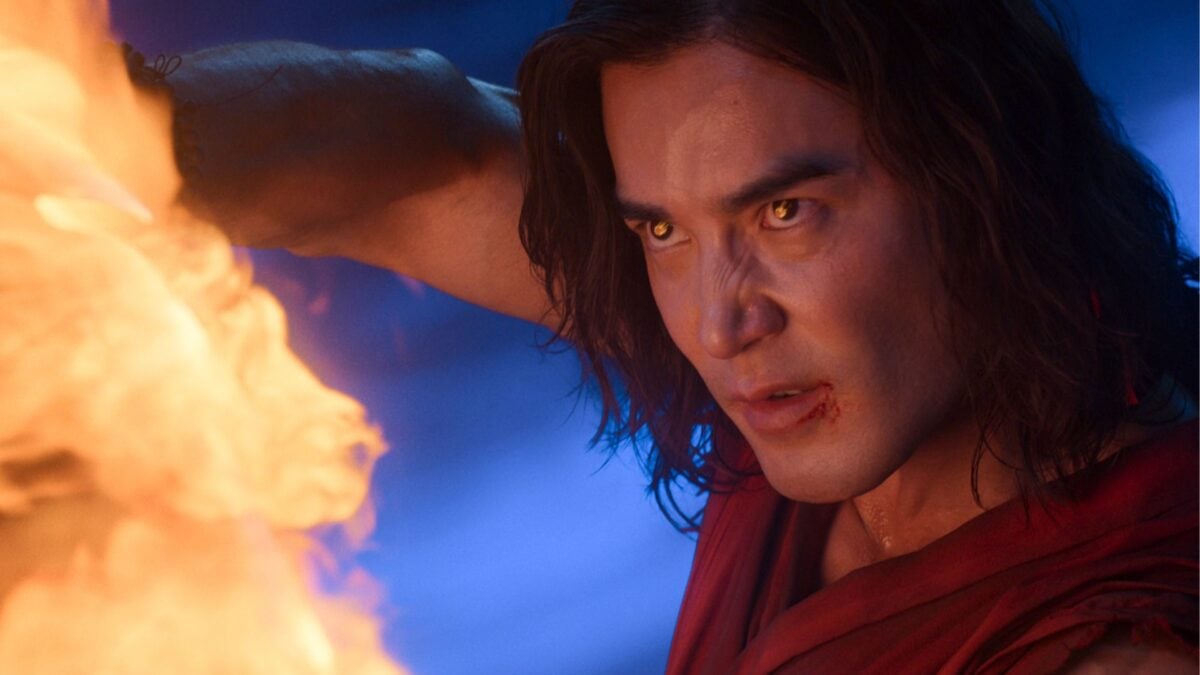
- Mortal Kombat II is now in theaters, with Earthrealm winning the tournament after Kitana kills Shao Kahn
- Liu Kang, Jax, and Cole Young all die — but surviving heroes set off for Netherrealm to bring them back
- There is no post-credits scene; the third film is teased entirely through the story itself
- Writer Jeremy Slater is already working on Mortal Kombat III and says some deaths were planned as “the first part of a larger puzzle”
- The film holds a 73% on Rotten Tomatoes, with Josh Lawson’s Kano and Karl Urban’s Johnny Cage drawing the most praise from critics
Mortal Kombat II has finally arrived in theaters, and if you’ve just walked out of the arena and your brain is still processing what happened to Liu Kang — you’re not alone. The sequel to 2021’s pandemic-era surprise hit doesn’t do anything subtle with its ending. It kills off multiple major characters, sets the surviving heroes on a mission straight into hell, and leaves you with a very clear picture of where Mortal Kombat III is headed. No post-credits tease required.
Here’s everything that went down, with full context from the people who made it — and yes, major spoilers from this point forward.
How the Tournament Ends — and Who Doesn’t Make It Out
The film’s central conflict is the tournament itself, something the 2021 original notoriously failed to deliver on. This time, director Simon McQuoid and new screenwriter Jeremy Slater built the entire sequel around it: Earthrealm versus Outworld, with the fate of the planet on the line. Shao Kahn (Martyn Ford) needs ten consecutive victories to claim a realm as his own, and he’s already gobbled up every other corner of the universe.
Earthrealm’s champions — Liu Kang (Ludi Lin), Jax (Mehcad Brooks), Sonya Blade (Jessica McNamee), Cole Young (Lewis Tan), and newly recruited washed-up action star Johnny Cage (Karl Urban) — ultimately win. But the cost is brutal.
Cole Young has his skull crushed by Shao Kahn’s hammer (followed, because this is a Mortal Kombat movie, by an acid bath). Kung Lao, brought back as a revenant under Kahn’s control, dies again after an epic Blue Portal showdown with Liu Kang, who drags his former friend onto his own spinning hat. Jax is impaled on the pointy end of Kahn’s war-hammer. And then Liu Kang himself goes out the same way — but upon death, the powerful Shaolin warrior ascends to Fire God status, promising to bring Kung Lao’s spirit back from the Netherrealm as flames consume him.
The final battle comes down to Shao Kahn versus Sonya Blade, who is defeated but not killed. She manages to free Kitana (Adeline Rudolph), who had been imprisoned after Kahn discovered her betrayal. Kano, Scorpion, and a newly powered-up Johnny Cage — who finally accepts his destiny and unlocks his abilities — destroy the amulet held by Bi-Han (Joe Taslim), also known as Noob Saibot, which had been giving Kahn his immortality. Cage delivers the final blow with a Shadow Kick. Kitana finishes the man who murdered her father by slicing through his head with her bladed fans.
With Kitana now serving as queen of Edenia, the surviving heroes — Sonya, Johnny Cage, Baraka, Kano, and Raiden — set off for Netherrealm with a captive Quan Chi, determined to resurrect their fallen friends. And yes, the movie leaves open the possibility that even Cole Young might be coming back. Maybe.
One thing you won’t find: a post-credits scene. Instead, the film closes with a credits sequence set to the classic “Techno Syndrome” by Belgian duo The Immortals — the iconic tune from the original 1995 film that fans have been waiting to hear again.
What Jeremy Slater Is Saying About Mortal Kombat III
Slater, who also created the underrated Exorcist TV series and wrote Marvel’s Moon Knight, came to this project with no involvement in the first film — a fresh set of eyes that proved deliberate. He’s already deep into writing the third installment, and in a conversation with io9, he was candid about what those deaths actually mean for the franchise’s future.
“It’s sort of baked into the DNA of Mortal Kombat as a franchise,” Slater explained. “If you know how to do the fatalities, every one of these matches ends with one of your favorite characters getting his spine ripped out or his skull smashed or something like that. And then the next time you put in a quarter, they’re all alive again.”
He was also refreshingly honest about his own motivations. “I’m as guilty of that as anybody because I was like, ‘I’m not going to write this movie unless you let me bring Kano back.’ Josh Lawson was my favorite thing about the first movie, hands down.”
But Slater is careful to say that death still carries weight within the story, even if the franchise’s DNA provides a get-out-of-jail-free card. “For the characters, death is still real. It still matters. And so you have to approach it and treat it with severity. When characters die in this movie, it’s painful for the survivors, and we want it to be shocking for the audience. We want it to be a little bit of a gut punch.”
Then came the tease. “Some of these characters and actors, we have big plans for them in the future, and just because some of them met a bad ending in this movie, it doesn’t mean that’s the last time you’re going to see them in a Mortal Kombat… Some of those deaths were because we do have bigger plans for some of those characters down the road, and that their deaths in this movie is the first part of a larger puzzle.”
He didn’t name names, but Liu Kang is the obvious read. His death is the most emotionally loaded moment in the film, and it’s directly tied to the mechanics of how Kung Lao can be saved. The Netherrealm mission in part three seems to orbit entirely around him — an Orpheus-in-hell structure that would be genuinely mythological territory for a franchise that has mostly stayed closer to the arcade.
Slater also confirmed he’s paying attention to how audiences are responding now that the film is out. “For a very long time, I’ve been writing and developing Mortal Kombat III sort of in a vacuum. And now that fans are seeing [part two] and responding to it, we can see tonally what’s working. We can see, in terms of the characters, who are they responding to, who are they going to want to see more of in a part three,” he said. “In the same way that we took the lessons from one to make two even better, I want to take the lessons from two and make three the best one yet.”
The Cole Young Question
Cole Young’s death — skull crushed, acid bath, done — reads like more than just a plot beat. It feels like an acknowledgment. The character, invented for the 2021 film and not from the games at all, was deeply divisive with the fan base, who took issue with him being the POV hero over beloved canonical characters. His exit in the sequel is so gruesome, and so early, that it landed more like a wink to the audience than a genuine narrative gut punch.
Director Simon McQuoid addressed the situation directly in an interview with LA Weekly, separating the character from the actor. “I would work with Lewis [Tan] again in a heartbeat,” McQuoid said. “It was just unfortunate that he was the guy who was portraying this new character.” He added that conversations about Cole’s future are ongoing, saying: “Lewis is not wrong” when it comes to teasing future plans, but that it’s “way too early to sort of divulge anything.”
The fan consensus seems to be exactly what McQuoid described: everyone likes Lewis Tan. Nobody embraced Cole Young. Whether a Netherrealm resurrection can change that math is a question for part three.
What the Critics Are Saying
Mortal Kombat II is sitting at 73% on Rotten Tomatoes, making it one of the highest-rated video game movies ever made — behind only Sonic the Hedgehog 3 and the micro-budget Werewolves Within. The reviews, predictably, are split along a pretty clear fault line: fans of the games are having a blast, and critics without that context are bouncing off the lore.
That divide became briefly dramatic when producer Todd Garner took to X/Twitter to call out reviews he felt were unfair, saying some critics clearly had “no idea what the fans want or ANY of the rules / canon of Mortal Kombat.” His sharpest example: “One reviewer was mad that a guy ‘had a laser eye!’” — a reference to Kano’s signature ability, which has been part of the character since 1992. Garner later clarified that his frustration was specifically directed at reviewers who objected to foundational elements of the IP itself, saying those critics were “dead in the water going in.” Not everyone agreed — critic Griffin Schiller pushed back publicly, arguing that “films should be reviewed on how they function as films, not as a piece of fan service.”
Garner also got some blowback from the Mortal Kombat fan community itself, who reminded him that the first film invented Cole Young and the concept of Arcana — neither of which came from the games. His response to that particular criticism? “Fair.”
Among the reviews themselves, the throughline is consistent: Karl Urban’s Johnny Cage and Josh Lawson’s returning Kano are the film’s biggest assets. IGN gave it an 8 out of 10, calling it a big win and noting that between Kano and Cage, “the pop culture wisecracks flow” in this adaptation of “colorful weirdos beating the s#!t out of each other.” Collider rated it 7 out of 10, calling it a “bloody good time” and suggesting Lawson’s Kano should be considered the definitive version of the character. Empire gave it 3 out of 5, acknowledging shallow characters but calling it “a lot of dumb fun.”
On the other end, the Chicago Tribune’s Katie Walsh gave it 1.5 out of 4 stars, calling it “astonishingly stiff” and arguing it lacks the cheesy charm of the original. Mashable’s Kristy Puchko called it an “ugly, nonsensical mess” — though even she gave Kano credit as the only character who refuses to take any of it seriously.
The Houston Chronicle offered perhaps the most accurate summary of the experience for general audiences: it “starts out dumb but gradually becomes kind of awesome — and a little bit smarter,” with fight choreography that grows increasingly impressive as the film finds its footing.
How They Fixed What the First Film Got Wrong
Slater came into this project with a specific mandate: figure out what the first film did right, double down on it, and quietly fix everything else. The 2021 original had to prove that an R-rated martial arts fantasy movie could find an audience — and it did, mostly on streaming, where it put up massive numbers despite a limited theatrical release during the pandemic. But the fan base was vocal about what didn’t work: the invented concept of Arcana, the absence of an actual tournament, and the prominence of Cole Young over characters people had been playing for decades.
“We’re very careful in the movie to never contradict the idea of arcana,” Slater told io9. “But that word is also never mentioned in the movie very deliberately.” He compared it to midichlorians in Star Wars — sometimes you don’t need to explain the mechanism. You just need to enjoy the result.
He also made a point of bringing Mortal Kombat creator Ed Boon into the process far more meaningfully than the first film did. Rather than Googling iconic stages or fan-requested fatalities, Slater could go directly to the source. “He can say, ‘Yeah, they’ve been begging for this for 30 years,’” Slater said. Boon even appears in the film as a bartender — a cameo that, according to McQuoid, drew audible cheers from the preview audience. The director told LA Weekly he’d happily have Boon pop up in every future installment, Stan Lee-style.
The decision to delay the film from October 2025 to May 2026 also paid off. Slater was initially disappointed — “This is a summer movie,” he said — but acknowledged that the extra time allowed the visual effects, particularly the Netherrealm sequences, to be finished properly. “You look at those Netherrealm sequences, and they look so much cooler than they did a year ago.”
Now, with the movie in theaters and fan response rolling in, Slater says he finally has the data he needs to shape part three. “I want to take the lessons from two and make three the best one yet,” he said. “That is the ultimate goal.”
The surviving heroes are headed to Netherrealm. Liu Kang is waiting. And if Slater gets his way, the best Mortal Kombat movie is still to come.
Filed in

Comments
0