
Remarkably Bright Creatures Review: Sally Field Shines on Netflix
Sally Field and Lewis Pullman anchor Netflix’s warm, heartfelt adaptation of Shelby Van Pelt’s bestseller — with an octopus voiced by Alfred Molina stealing scenes.
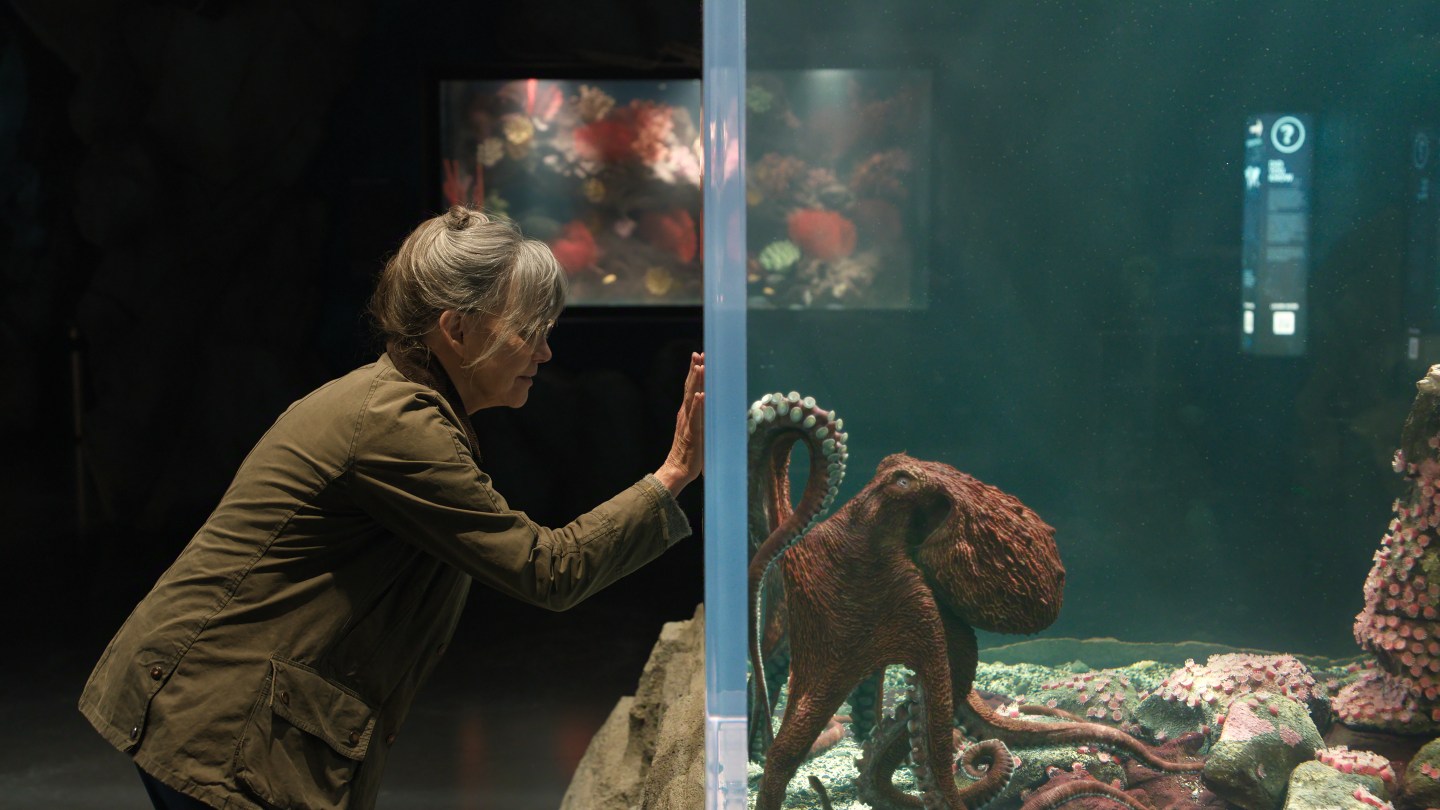
- Remarkably Bright Creatures, adapted from Shelby Van Pelt’s 2022 bestseller, is now streaming on Netflix
- Sally Field stars as a grieving widow who bonds with a wise octopus named Marcellus, voiced by Alfred Molina
- Lewis Pullman co-stars as a lost young musician searching for his unknown father in a small Pacific Northwest town
- Director Olivia Newman made the film after losing her home in the 2025 California wildfires, giving her a deep personal connection to the story’s themes of grief and rebuilding
- Critics largely praise the performances while noting the film’s crowd-pleasing sentimentality and an underused octopus narrator
Sally Field hasn’t lost a single watt of her power. That’s the first thing you need to know about Remarkably Bright Creatures, Netflix’s warm and quietly moving adaptation of Shelby Van Pelt’s beloved 2022 novel, which sold over two million copies largely on word of mouth and the universal appeal of a grumpy, emotionally perceptive octopus. The film, which began streaming May 8, is the kind of movie that doesn’t get made nearly enough — a gentle, character-driven drama built around people well past their forties, anchored by performances so lived-in and honest that the CGI sea creature sharing the screen with them barely registers as strange.
Field plays Tova, a widow in the fictional Pacific Northwest enclave of Sowell Bay who has been quietly falling apart for decades. Her husband is gone. Her son Erik disappeared in a boating accident thirty years ago — an event the town has always quietly assumed was a suicide. She takes the night shift cleaning job at the local aquarium less out of financial need and more because the sea creatures don’t ask her how she’s doing. Her deepest relationship, it turns out, is with Marcellus — an aging Giant Pacific Octopus who, in the film’s most delightful conceit, is not only extraordinarily intelligent but narrates the entire story via Alfred Molina’s dry, wry, warmly imperious voice-over. Molina, who of course played the eight-armed villain Doc Ock in the Spider-Man films, brings a world-weary humanity to the role that makes you forget, most of the time, that you’re listening to a mollusk.
The Odd Couple at the Heart of It All
Into Tova’s carefully managed solitude drives Cameron Cassmore, played by Lewis Pullman — Bill Pullman’s son, and someone who looks and sounds so much like his father that watching him feels like a gentle trip back to the 1990s. Cameron is broke, aimless, living out of his late mother’s battered camper van, and convinced that his unknown father lives somewhere in Sowell Bay and might be a wealthy local. His van breaks down. Tova sprains her ankle in an octopus-related incident she can’t exactly explain. Friendly grocer Ethan (a lovelorn, big-hearted Colm Meaney) suggests Cameron fill in for her at the aquarium. From there, the shape of the story becomes clear almost immediately.
That’s both a strength and a mild limitation of Remarkably Bright Creatures. The film doesn’t traffic in surprises. The surrogate mother-son dynamic between Tova and Cameron is as inevitable as the tides — she scolds him about chipping gum off floors; he fixes things around her house; they help each other prepare for dates with their respective love interests. Tova is pursued with gentle, terrified devotion by Ethan, while Cameron is charmed by Avery (Sofia Black-D’Elia), the sharp-tongued owner of a paddleboard shop. The central mystery — what really connects these two lost people — will be obvious to most viewers well before the film chooses to reveal it. And yet. The actors rush in and make you care anyway.
Field is simply extraordinary. There are moments in this film where the camera cuts to another actor’s reaction while she’s performing, and you can see that they aren’t acting at all — they’re just watching her, genuinely moved. Pullman matches her with a magnetism that operates just beneath the surface: Cameron is a bit of a mess, a flaky dreamer who’s never held a proper job, and yet Pullman makes him easy to root for. He does his own guitar playing and singing, and is convincing enough that you believe he was once in a pretty good band. His best line in the film lands quietly: “She makes me wanna be on time.”
The supporting cast fills out Sowell Bay with the kind of warmth that makes you want to move there. Kathy Baker, Joan Chen — Twin Peaks alumni — and Beth Grant play Tova’s circle of friends, known as the Knit-Wits, who gather ostensibly to knit but really to gossip and gently push Tova back toward the living. Black-D’Elia makes such a snappy impression as Avery that her limited screen time becomes a genuine disappointment. When Cameron marvels that someone “like my age” owns her own business, she deadpans: “That feels like a you issue.”
The Octopus Problem (And Why It’s Not Really a Problem)
The film’s trickiest challenge was always going to be Marcellus. In Van Pelt’s novel, the octopus gets his own chapters — a full interior life rendered in prose that makes the whimsy feel earned. On screen, translating that into a consistent voice-over narration while keeping him visually present is a tightrope walk, and director Olivia Newman largely pulls it off by making a smart, counterintuitive call: she doesn’t overdo it. Rather than forcing Marcellus into every scene, she sprinkles him throughout, letting Molina’s narration do the connective tissue work without straining the suspension of disbelief past its breaking point.
The CGI, led by Chris Ritvo of Untold Studios, is impressively convincing — Marcellus has real heft and texture and personality, and his occasional escapes from his tank (to explore the aquarium, snack on some fellow residents, and meddle in human affairs) are among the film’s most purely enjoyable sequences. Still, multiple critics have noted the same thing: Marcellus disappears from the narrative for long stretches, and the film occasionally loses something when he does. As one reviewer put it, the poor creature is “happily disappeared from the narrative for a good chunk of the film’s runtime, and no one really seems to miss him.”
The film is also not shy about its sentimentality. Composer Dickon Hinchliffe — best known for Peaky Blinders — is deployed regularly to smooth over moments of discomfort, and the script occasionally states its themes so plainly (Marcellus at one point muses that while he merely wants to escape his tank, “I suspect that what Tova needs to escape lies somewhere deeper”) that you wish it trusted the audience a little more. The puzzle pieces of the plot lock together in your mind well before the film assembles them on screen, and the resolution ties everything up with a neatness that real grief rarely allows.
But here’s the thing: Remarkably Bright Creatures doesn’t need to be remarkable to work. It needs to be honest and warm and well-acted, and it is all three. Cinematographer Ashley Connor finds a sweet spot between Pacific Northwest reality and gentle enchantment — the overcast grays of the coastline, the fog, the drizzle — that grounds the story without making it feel heavy. Newman’s direction is unshowy but confident, and the film’s sense of community in Sowell Bay makes the stakes of Tova’s potential departure to a retirement home feel genuinely consequential.
The Director Who Lived the Story
What makes Remarkably Bright Creatures resonate even more once you know it: Newman — whose previous adaptation was Where the Crawdads Sing — lost her own home in the 2025 Eaton fire while preparing to make this film. Netflix moved her, her jazz-musician husband Steve Lehman, and their two children to Vancouver just two days after the fire destroyed their Altadena house and everything in it. The film’s unit production manager outfitted the family with winter clothes, since they’d arrived with almost nothing — some pajamas, school supplies, a board game, and a bottle of whiskey.
Four days before preproduction began, Newman was touring waterfront properties for location scouts, lingering on the objects inside other people’s homes — pot holders, spatulas, the ordinary accumulation of a life — and being quietly undone by all of it. “I’m being reminded over and over again of everything I’ve lost,” she recalled. “You’ll see a pot holder, and you’ll be like, ‘Oh, my God, I just replaced our pot holders, and I loved them.’”
And yet she stayed. “I remember the day after the fire, being on the phone with my manager and saying, ‘I cannot lose this job,’” Newman said. Field, who lives in the Pacific Palisades and watched her neighbors’ homes burn while her own survived, was also shaped by the fires. “Both Livi and I were gobsmacked,” Field said. “My house still remained. The two houses to the left of me, the two houses to the right of me, the three houses in front of me… gone.”
That shared experience created a bond between director and star that seems to have found its way into the film. Newman has said that watching Field perform Tova’s most vulnerable scenes would sometimes leave her too wrecked to call cut. “I could feel how lost she was. It was how I was feeling at the same time.”
Van Pelt, for her part, has described the moment Sally Field was cast as surreal. “The character of Tova is sort of based on my grandmother, and the two look very similar,” she said. “She was just the perfect person to play that character.” Van Pelt — a Tacoma native who taught herself to write fiction after burning out on a career in economics and finance — spent years watching videos of octopuses escaping their tanks online before the idea for Marcellus clicked into place. She was involved throughout production, sitting in on script read-throughs, spending a week on set, and even appearing as an extra.
The book, which has now sold over two million copies, found its audience the old-fashioned way: one reader telling another. The film feels built on the same principle. It doesn’t ask you to be dazzled. It asks you to sit with these people — a woman who has been swaddling herself in solitude like a ratty old cardigan she can’t bear to throw out, a young man who has never had a father or a home, and an octopus with three hearts and not enough time left to use them — and feel something.
Most viewers will. Field’s third-act monologue, in which Tova finally cracks open her deepest wounds, is a stunner. By all accounts, it has been clearing out theaters. If this is the kind of movie Netflix wants to own Mother’s Day weekend with, consider the mission accomplished.
Filed in

Comments
0