
Sally Field on the Octopus, Her Son, and Why She’s Not Done Yet
Sally Field opens up about Remarkably Bright Creatures, keeping the octopus a secret, and a rainy Vancouver moment with her son she’ll never forget.
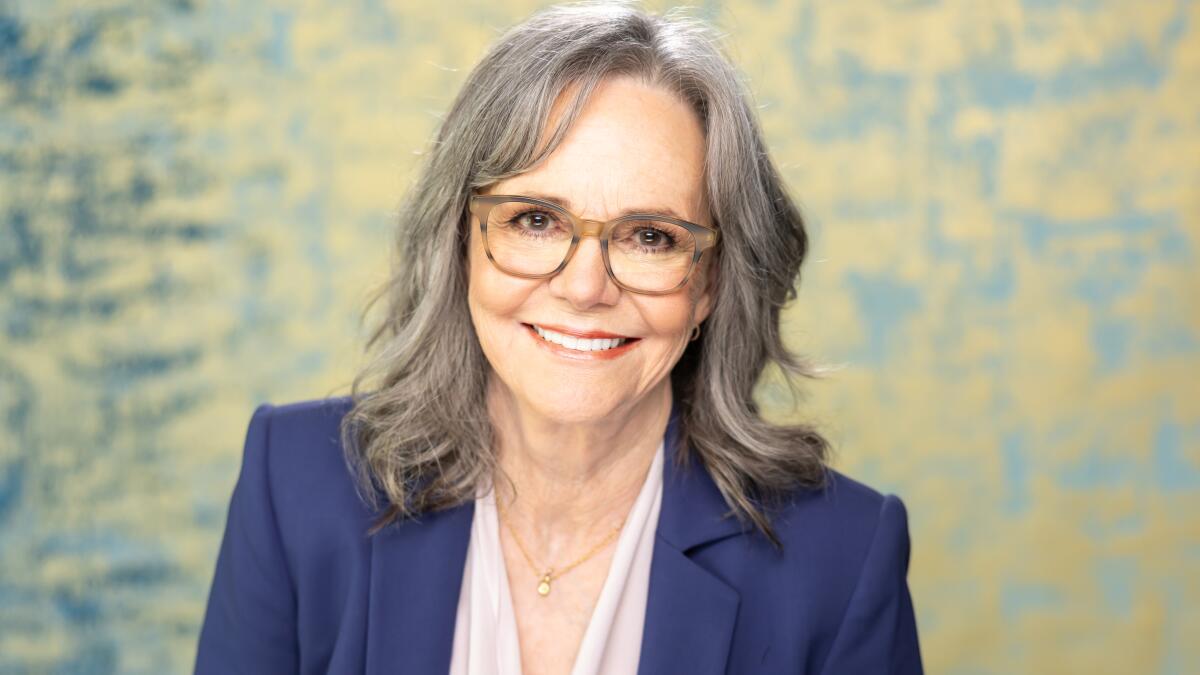
- Sally Field stars as Tova, a grieving widow who befriends a Giant Pacific octopus, in Netflix’s Remarkably Bright Creatures, streaming now
- The film was brought to Field in early galleys by a production company co-founded by her own son, Peter Craig
- Alfred Molina voices Marcellus the octopus, whose CGI form was inspired by a real octopus named Agnetha at the Vancouver Aquarium
- Field and co-star Lewis Pullman improvised much of their on-screen relationship — Field says she knew he was the one the moment he walked in the room
- Reviews are mixed but warm toward the performances, with critics agreeing Field and Pullman are the film’s beating heart
Sally Field has kept a lot of secrets in her career. She’ll keep this one too. Ask her how the octopus in Remarkably Bright Creatures was brought to life on screen — whether there was a real one, a puppet, pure CGI, some combination of all three — and she won’t budge. “I won’t say,” she told the LA Times. “It’s extraordinary what these guys did, but I won’t say so much because it spoils the magic.”
It’s a fitting answer for a movie that runs entirely on magic. Based on Shelby Van Pelt’s bestselling 2022 novel — which spent more than 64 weeks on the New York Times bestseller list and has sold four million copies — Remarkably Bright Creatures tells the story of Tova, a 70-something widow working nights as an aquarium cleaner in a small Pacific Northwest town, and the cranky, wise Giant Pacific octopus named Marcellus she talks to while she mops. Voiced by Alfred Molina, Marcellus narrates the whole film, and his last act on Earth, as he puts it, will be to help “the cleaning lady and the juvenile” — the juvenile being Cameron (Lewis Pullman), a scruffy, directionless musician who blows into town looking for the father he never knew.
The film is streaming now on Netflix, and it arrives with a genuinely unusual behind-the-scenes story: the production company that brought it to Field, Night Owl, was co-founded by her oldest son, Peter Craig.
A Family Affair From the Very Beginning
“It was brought to me in galleys before it had been published by a new production company called Night Owl, by Bryan Unkeless and Peter Craig,” Field explained. “And oddly enough, the Peter Craig part of the production company is my oldest son. It’s their first project. I read the first two chapters and said, ‘Yes, yes, I want to do this.’”
Craig — also a writer and showrunner in his own right — was shooting another project in Philadelphia during much of the Vancouver production, so Field didn’t get to see him on set as often as she would have liked. But she used him as a sounding board throughout, calling him when something felt off about a scene or a monologue needed fine-tuning before she’d bring it to director Olivia Newman.
One visit, though, she’ll carry with her forever. They were shooting what she describes as one of the most emotionally critical scenes in the film — on a pier, in pouring rain, about 32 degrees — and Field had been holding onto an enormous amount of emotion for hours, too far from the trailers to even get warm between takes. When they finally wrapped that portion of the scene, she walked up the ramp toward the car. And coming down the ramp, dripping wet, was Peter.
“Down the ramp came my son Peter, dripping wet, running to wrap his arms around me,” she said. “I will hold that memory forever.”
The Octopus, the Chemistry, and the Improv
Marcellus, for the record, is a CGI creation — a spectacular one, according to everyone who’s seen the film — loosely based on a real Giant Pacific octopus named Agnetha who lives at the Vancouver Aquarium and even appears briefly on screen. Van Pelt has said that from the beginning, Alfred Molina’s voice felt inevitable for the character: “It was just very clear from the beginning that this is what he sounds like. This is his attitude. A curmudgeon.” The name itself is a mash-up of the Stoic philosopher Marcus Aurelius, which tells you everything about the energy Molina brings to the role.
Field, for her part, was working against an empty tank for most of her scenes — or something approximating one. “Whether there’s a total octopus there all the time or none whatsoever, all of acting is imagining,” she said. “In that way, it’s nothing new.” She and Lewis Pullman have apparently discussed the specifics between themselves and agreed to keep it quiet. The magic, they’ve decided, is better left intact.
What Field is happy to talk about is Pullman himself, and the warmth in her voice when she does is unmistakable. She’d worked with his father, Bill Pullman, at the Old Vic in London in All My Sons, and Lewis had apparently come to see the play — though they never actually met. When he walked into the audition room for Remarkably Bright Creatures, Field knew almost immediately.
“I read with several other actors for the role of Cameron, and then he walked in, and it was it,” she said. “I didn’t say it, but looked at Livy, the director, like, ‘Okay, this is him.’” The two launched straight into improvisation, and a significant amount of what made it into the final film is exactly that — Field as Tova, Pullman as Cameron, just playing.
“He made everything work for me and made it just joyful,” she said. “Even if the scenes weren’t joyful, it was just so gratifying to be with him. I don’t think there are a lot of them like Lewis.”
What the Film Is Really About
Newman, who previously directed Where the Crawdads Sing, co-wrote the screenplay with John Whittington and shot the film almost entirely in Vancouver — Deep Cove standing in for the fictional Washington town of Sowell Bay, with one night of shooting at the actual Vancouver Aquarium for the larger tanks. The production leans into the Pacific Northwest atmosphere, and Field, who has now filmed in Vancouver multiple times, says the city has genuinely claimed a piece of her heart. “I wish Canada would adopt me,” she said. “I’ll do anything.”
Van Pelt, who grew up near Tacoma and wrote the novel during the early months of the pandemic as a kind of homesickness cure, has an executive producer credit on the film and even appears in it briefly — as a bar patron watching Cameron play. She says seeing Field on set was unexpectedly emotional: Tova was written as an homage to her grandmother, and Field’s wardrobe, hair, and the way she carried herself reminded Van Pelt of her so strongly that she had to take a moment to collect herself.
“It was a little strange, because I was like, ‘That’s her, that’s the character, and my grandma Anna is there in her,’” Van Pelt said.
The film has drawn mixed reviews. Variety called it a “melodrama of distinctly average intelligence” and noted that the script’s emotional machinery is heavily telegraphed, while the New York Times was blunter, calling it “bland and sluggish” while still acknowledging that Field can wring emotion from even the most unlikely circumstances — including, yes, a tearful monologue delivered to a mop bucket. Deadline was considerably warmer, calling it “a warm and rather wonderfully old fashioned movie winner” and predicting “there won’t be a dry eye in the house.” The AP landed somewhere in the middle: two and a half stars, respectable and heartfelt, the kind of movie where the tissues will be nearby whether you planned for it or not.
What most reviews agree on is that Field and Pullman are doing the heavy lifting, and they’re doing it well. Field’s “neurotic, kvetching energy” and Pullman’s “drawlingly laidback presence” spark off each other in ways that make the film’s more contrived elements easier to swallow. The supporting cast — Joan Chen, Kathy Baker, Beth Grant, Colm Meaney as a cheerful ex-Deadhead shopkeeper — is largely underused, and a romantic subplot involving Sofia Black-D’Elia could probably have been cut without anyone noticing. But the core relationship between Tova and Cameron, two people filling a grief gap for each other without quite understanding why, is exactly what Field came to this project to explore.
“It’s very hard to find really complicated stories about complicated women that aren’t some sort of romance or other,” she said. “So as I’ve gotten older, it’s certainly gotten nothing but harder. It takes a lot of time and effort to find a project that you want to do — one that talks about older women and what it is to be older. Whether you’re male or female, you’re facing loss as an older person. How do you move on? Where do you live? If you’re alone, what now?”
Why She Can’t Stop
Field is a few months away from turning 80. She’s been performing, in some form, since she was 17. And she’s not finished — she mentioned she’s eyeing a stage project next, though nothing is confirmed yet. Ask her why she keeps going and she quotes Robert Browning: “All that you reach should exceed your grasp, or what’s a heaven for.”
She’s been a celebrity since she was a teenager, and she’s made her peace with what that means — the blinders, the Dodger cap pulled low, the practiced instinct not to look up when she hears something in a crowd. But she’s also clear-eyed about what the work has always given her that nothing else could.
“I found the stage when I was 12,” she said. “Once I found the stage, it was something I couldn’t not do because I was a little girl raised in the ’50s… I had no contact with my voice, my own. I couldn’t hear myself because I was taught not to. Then I found the stage and I found my voice and instead of clamping it down, I could let it out, whatever it was, wherever it came from.”
She paused. “Why have I done this all this time? Because I can’t not do it.”
Remarkably Bright Creatures is rated PG-13 and runs 113 minutes. It’s streaming now on Netflix.
Filed in

Comments
0