
Mortal Kombat II: Bloody Fun, Big Box Office Drama
Karl Urban’s Johnny Cage delivers, Cole Young gets the fatality fans wanted, and the producer had to apologize. Here’s everything you need to know about MK2.
- Mortal Kombat II opened to $63 million globally in its first weekend, a series best but below studio expectations
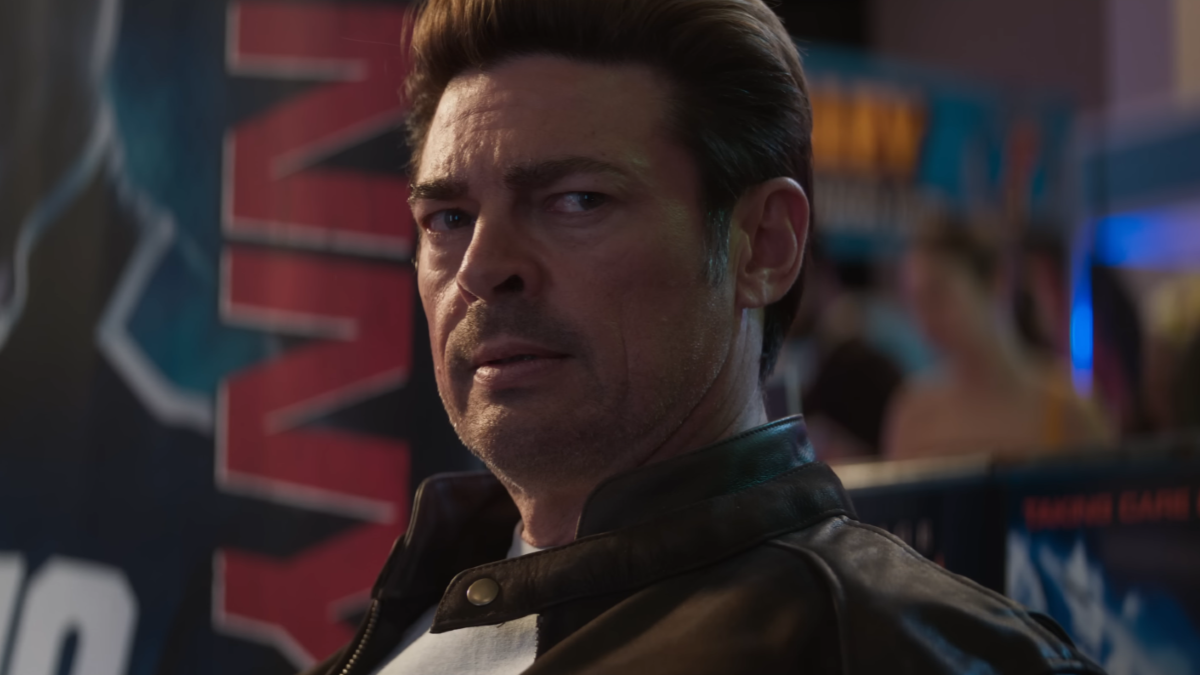
- Karl Urban’s Johnny Cage and Adeline Rudolph’s Kitana are the standout new additions, with fan-favorite Cole Young killed off early
- Critics gave the film a 65% on Rotten Tomatoes, while fans pushed the audience score to 89%
- Producer Todd Garner publicly attacked critics before issuing an apology after backlash
- Screenwriter Jeremy Slater is already writing Mortal Kombat 3, with the ending setting up a trip to the Netherrealm
Mortal Kombat II finally gave fans what the first film promised and never delivered: an actual tournament. Five years after the 2021 reboot introduced audiences to a new universe — and one very divisive original character — director Simon McQuoid is back, screenwriter Jeremy Slater has stepped in fresh, and the result is a movie that knows exactly what it is and largely commits to it with both fists.
The film opened this past weekend to $40 million domestically and $23 million internationally, landing at $63 million globally against an $80 million production budget. It was beaten to the top spot by The Devil Wears Prada 2, which earned $43 million in its second weekend — with a Mother’s Day boost analysts say gave Miranda Priestly an unfair advantage over Shao Kahn. Still, by any franchise measure, it’s a win: the 2021 original grossed just $84.4 million in its entire theatrical run, and MK2 is already on pace to surpass that.
Karl Urban, Adeline Rudolph, and the Farewell Nobody Mourned
The biggest swing the film takes — and largely lands — is centering everything on Johnny Cage (Karl Urban) and Princess Kitana (Adeline Rudolph) while sidelining, and eventually killing, Cole Young (Lewis Tan). The original character created for the 2021 film was never embraced by game fans, and Slater made a conscious choice to give them the send-off they’d been demanding for years.
About halfway through the film, Cole steps up to face the hulking Shao Kahn (Martyn Ford) on the iconic Dead Pool stage. He almost wins. Then Kahn — newly made immortal via a stolen amulet and Raiden’s siphoned power — heals from a slit throat and smashes Cole’s head into something that can only be described as unforgettable. The movie doesn’t pause to mourn him for long. It moves on.
For Slater, that was entirely the point. “Cole Young is someone the hardcore fans did not respond to in the first movie,” he told Forbes in a recent interview. “They really felt like he didn’t necessarily belong. The fans were just sort of calling for his death for the last several years. And so, we knew getting rid of Cole would be satisfying for those hardcore fans and would be really, really shocking for the casual viewers who had only seen the first movie and had no idea that Cole wasn’t from the games.”
Lewis Tan, for what it’s worth, does everything he can with what little he’s given before his exit. But the film’s best moments belong to Urban, whose Cage is introduced sitting alone at a comic convention booth — zero fans, surrounded by unsold merch — before being dragged into the fate-of-the-world business he very much does not want. It’s a weathered, washed-up version of the character, and Slater says that was a deliberate choice. “Our Johnny is older, he’s weathered, he’s much less successful,” Slater explained. “He’s kind of the cocky Johnny Cage from the games if all of his dreams slipped through his fingers.”
Slater said he used the Cliff Booth archetype from Once Upon a Time in Hollywood as a reference point while writing — not writing for Brad Pitt specifically, but keeping that energy of the tired, capable, quietly tragic badass in mind. Urban brings it, though some critics feel the script doesn’t always give him the sharpest lines to work with. His chemistry with Josh Lawson’s Kano — another returning fan favorite, brought back from the dead specifically for his comedic value — is one of the film’s consistent highlights.
Adeline Rudolph’s Kitana, meanwhile, is arguably the emotional backbone of the whole thing. Her backstory — a young princess who watches Shao Kahn destroy her father and is forced to become his warrior — is what grounds the film’s otherwise breakneck pacing. Tati Gabrielle appears as her guard and companion Jade, though neither character gets quite enough room to breathe beyond the ensemble.
The Fights Are the Point — and the Film Knows It
If the plot exists primarily to move characters from one fight to the next, that is not entirely a criticism. Slater’s stated mission from the moment he pitched the job was clear: “A Mortal Kombat movie should never be boring. It should never have any downtime. It should be a blast from start to finish.” Warner Bros. hired him about thirty minutes after that pitch, and the film largely delivers on that promise.
The fight choreography is a step up from the first film, and Slater credits that partly to the decision to lean into the cast’s real-world abilities. Ludi Lin, who plays Liu Kang, apparently showed up on set and asked if he could do a 540 kick instead of the scripted 180. “Everyone was kind of like, ‘Is that something a human being can actually do?’” Slater recalled. “And he’s like, ‘Oh, yeah, watch!’ And he just does a 540 kick in the air, because he’s insane.” The so-called Blue Portal fight has been cited across multiple reviews as the standout sequence of the entire film — precisely because it relies on two world-class martial artists and almost nothing else.
The film also leans into the franchise’s dark humor in ways the first film didn’t. Kano gets a scene with the villain Quan Chi that features what can only be described as a very creative Harry Potter insult. Johnny Cage clocks that the whole tournament sounds like a real-life Squid Game. And when tasked with destroying an immortality amulet, Cage makes a Lord of the Rings reference — which lands especially well given that Karl Urban himself played Éomer in Peter Jackson’s trilogy. The film’s opening sequence, a deliberately over-the-top ’90s-style kung-fu movie that established Cage’s faded stardom, sets the tone perfectly.
Kano and Cage share the comic relief load, and the film is better for it. Lawson’s Australian energy and Urban’s Kiwi humor make them the two characters you most want to spend time with, even when the script around them occasionally goes thin.
Also returning: Sub-Zero (Joe Taslim), Kung Lao (Max Huang), and Sonya Blade (Jessica McNamee), along with Jax Briggs (Mechad Brooks) and Raiden (Tadanobu Asano). Several of them — including Liu Kang and Jax — are killed during the tournament, a choice Slater said was about keeping stakes real and surprising both types of audience members. “Liu Kang canonically kills Shao Kahn. He’s the one who wins the tournament. They’re expecting him to ultimately be the victor,” Slater said. “So we knew that death would be really shocking for the hardcore fans.”
Mortal Kombat game creators Ed Boon and lead writer Dominic Cianciolo were involved throughout production — something Slater says was a conscious correction from the first film. “It’s so different to be able to go directly to the horse’s mouth, the guy who has been interacting with the fan base for 34 years,” he said. NetherRealm Studios’ fingerprints are visible in the fan-service moments that land hardest.
The Producer Drama Nobody Asked For
Before the opening weekend numbers were even in, producer Todd Garner took to Twitter to vent about the film’s early critical reception, which had settled around a 65-66% Rotten Tomatoes score. “Some of these reviews are cracking me up,” he wrote. “It’s clear they have never played the game and have no idea what the fans want or ANY of the rules/canon of Mortal Kombat. One reviewer was mad that a guy ‘had a laser eye!’ Why the f*** do we still allow people that don’t have any love for the genre review these movies! Baffling.”
The backlash was swift. Critics and industry observers pointed out that a film adaptation should be able to stand on its own without requiring homework, and that reviewers aren’t obligated to be franchise fans. Garner subsequently walked it back. “I realize that, in my eagerness to defend the people who worked so hard on this film, I lost sight of the fact that our job is to create the best possible movie — not only for the fans, but for anyone coming to the cinema. Once that movie is out in the world, no one is above criticism. For that, I apologize.”
The audience, for their part, didn’t need convincing. Fans pushed the Rotten Tomatoes audience score to 89%, with the consensus reading: “Karl Urban as Johnny Cage alone is worth the price of admission.” The film earned a B CinemaScore from opening-weekend audiences, and 75% of ticket buyers were male, according to PostTrak — a demographic split that was nearly the exact inverse of The Devil Wears Prada 2.
What Comes Next
The ending of MK2 is not subtle about its intentions. Johnny Cage and the surviving fighters head toward the Netherrealm to retrieve their fallen friends — Liu Kang, Jax, Cole Young, and others — setting up what Slater describes as, essentially, Mortal Kombat in Hell. He’s already writing the script for the third film, though he’s staying tight-lipped on specifics. “We’re really taking a look at what the fans are asking to see. Who are the characters they really love who still haven’t shown up? Who are the villains that haven’t gotten their time in the spotlight yet?”
One character who didn’t make the cut this time: Tremor, the earth-bending ninja. Slater tried several versions and couldn’t make it work, and says the experience taught him something about the franchise going forward. CGI-based powers are less satisfying than watching real athletes fight. “Characters like Tremor, where it was much more about, ‘I’m going to generate earthquakes and throw big rocks at you,’ is not as satisfying as watching two great fighters really go at it.”
There’s also the matter of timing. MK2 opened on Mother’s Day weekend, going head-to-head with The Devil Wears Prada 2 in its second week — a scheduling decision that, in hindsight, looks like it cost the film some box office runway. An October release has been floated as a smarter window for the third installment, giving it room to breathe against a less competitive field.
Streaming will matter too. The 2021 film became HBO Max’s most-watched original movie of that year, and a strong streaming run for MK2 could go a long way toward justifying the third film’s greenlight. New Line Cinema is already eyeing it, and Slater is already writing it. Whether the box office math adds up enough for Warner Bros. to fully commit is the real fight still unfolding.
Oh — and for anyone curious: almost none of the cast actually knows how to play the game. Karl Urban’s strategy is to find one move that works and spam it until his opponent figures out a countermeasure. Director Simon McQuoid says the stunt team destroys him every time and he’s stopped trying. Ludi Lin only played the Genesis version growing up and didn’t know there was a block button until recently. These are the people who just made the most successful Mortal Kombat movie ever produced. Finish him.
Filed in

Comments
0