
Martin Short’s Netflix Doc Is a Love Letter to Chaos
Netflix’s ‘Marty, Life Is Short’ digs into why Martin Short divides audiences — and why the people who love him really, really love him.
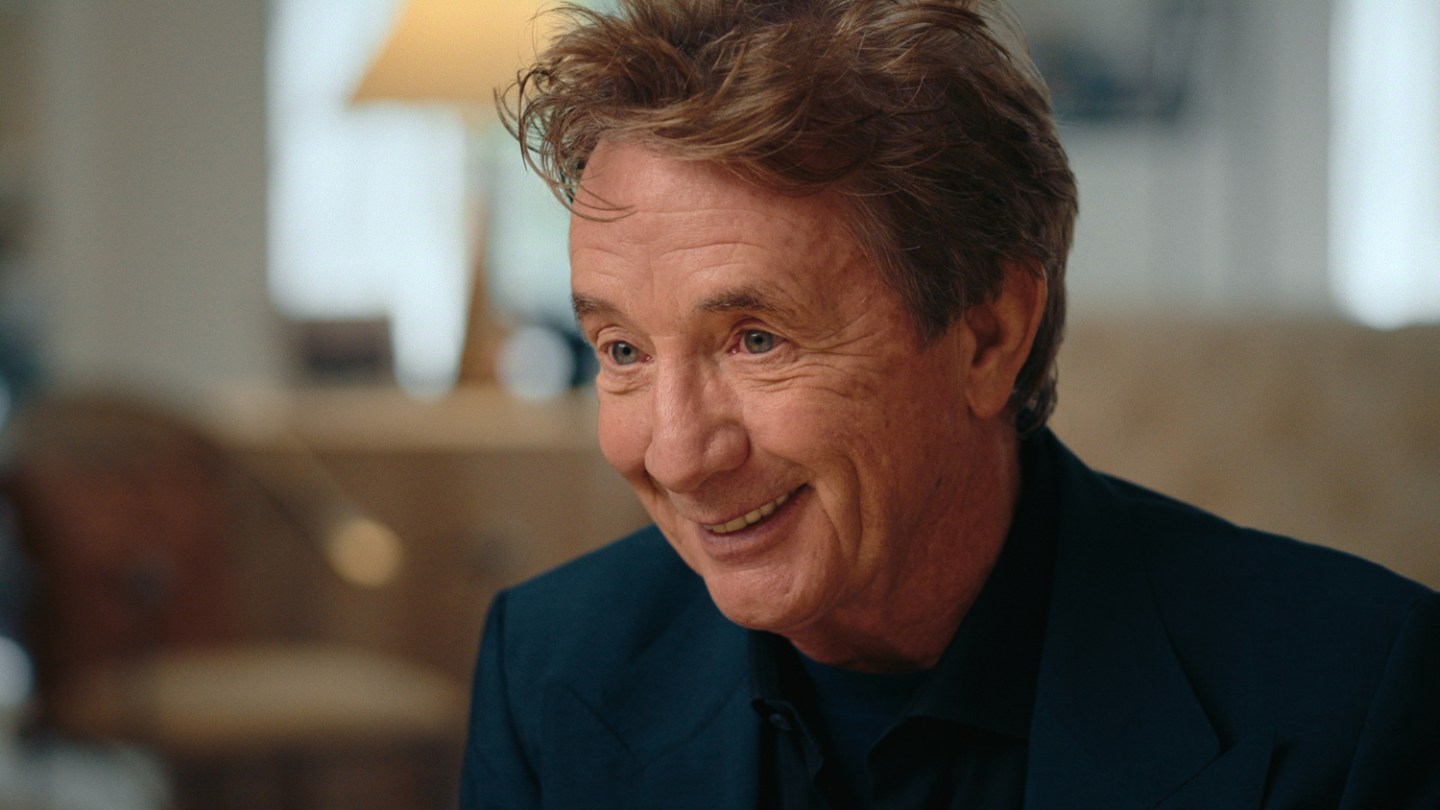
- Netflix’s Marty, Life Is Short is directed by Lawrence Kasdan and now streaming
- Tom Hanks, Steve Martin, Eugene Levy, and the late Catherine O’Hara all appear in the film
- The documentary covers Short’s decades of personal tragedy alongside his remarkable career
- Short estimates 80–98% of his career has been commercial failure — and doesn’t seem to mind
- The film ends with dedications to both O’Hara and Short’s daughter Katherine, who died earlier this year
The new Netflix documentary about Martin Short opens at a Boxing Day party in early-1990s California — a British Commonwealth holiday being celebrated in Hollywood, which feels exactly right for a man who has always seemed slightly out of place in the industry he’s conquered. Tom Hanks is there. Steve Martin. Eugene Levy and Catherine O’Hara, fellow Canadians. The footage is warm and crackling and slightly chaotic, and it tells you everything you need to know about what Marty, Life Is Short is going to be.
The documentary, directed by Short’s longtime friend Lawrence Kasdan — the man behind The Big Chill and Raiders of the Lost Ark — began streaming Tuesday. At 101 minutes, it’s less a rigorous career retrospective than an affectionate portrait of a man who has turned the act of having a good time into something close to a life philosophy. And in doing so, it quietly answers the question that’s dogged Short for decades: why does he provoke such strong reactions, in both directions?
“Let’s say you’re going to host a dinner party and you invite Marty,” Steve Martin tells the camera, “then it turns out Marty can’t come? You cancel the party.”
The Case For (and Against) Martin Short
Short, now 76, has never been easy to categorize. He can’t do Eugene Levy’s understated deadpan. He can’t play it straight the way Catherine O’Hara could. He is — and this is both his gift and his problem — a lot. His comedy doesn’t ease its way in; it announces itself. Ed Grimley, the manchild with the gelled cone of hair. Jiminy Glick, the obnoxious entertainment journalist buried under latex and a fat suit. Characters so committed to their own bizarre logic that they either make you laugh immediately or make you want to leave the room.
A 2023 Slate piece by Dan Kois put words to what Short’s detractors have always felt — that his “manic, slightly creepy intensity” tips over into desperation, that the approval-seeking overwhelms the actual comedy. It prompted fierce pushback from fans and fellow celebrities alike. The documentary engages with that criticism directly, and it’s Jiminy Glick himself who delivers the sharpest response, appearing in character near the film’s end: “I don’t really find him very interesting. I find people who push too hard and are desperate for the approval without really presenting any reason for the approval — I find it offensive.”
“There’s basically three voices, two hairstyles, and four dance moves,” Glick adds. “And you can’t build an empire on that.”
It’s a genuinely clever move — using the most polarizing version of himself to disarm the criticism with the one weapon Short has always had: the joke.
Short is clear-eyed about his record. “I would say my career has been 80 percent failure,” he says at one point, later revising that upward to 90. John Mulaney, also appearing in the film, quotes Short’s own “98 percent” figure back at him. The flops are real: Pure Luck, Three Fugitives, Captain Ron, and the legendarily strange Clifford, in which Short played a 10-year-old boy and which Roger Ebert memorably described as “not bad in any usual way. It’s bad in a new way all its own.” Short calls himself “the cheap Amigo” from the 1986 film he made with Martin and Chevy Chase, and he says it with zero apparent bitterness.
The mantra he’s built around all of it: “98 percent of it is failure; nothing works and then something works.” And right now, something is very much working — Only Murders in the Building has made Short more beloved than ever, and his live comedy shows are selling out across the country.
A Life Built Around Loss
The documentary’s emotional weight comes from somewhere most viewers may not fully know about. Short grew up in Ontario as the youngest of five children in a family where making each other laugh was practically a competitive sport. “I profited from trickle-down comedy,” he says. But when Short was 12, his eldest brother David was killed in a car accident. A camp counselor delivered the news bluntly: “Your brother’s been in an accident and it killed him.” Short’s response, as he recalls it, was simply: “Is he OK?”
His mother died of cancer when he was 17. His father died roughly two years later from complications of a stroke. By 20, Short had lost his brother and both parents. He describes the aftermath as a choice: collapse and “become defeated forever,” or “learn that life is short and have a glass of wine and fun.”
He chose the wine.
The film also charts the love story at the center of his adult life — his marriage to Nancy Dolman, whom he met during a now-legendary 1972 Toronto production of Godspell that also starred Levy, Andrea Martin, Gilda Radner, and Victor Garber. (That production is apparently getting its own documentary, which, fair enough.) Short and Nancy were married in 1980. When they discovered they couldn’t have biological children — Nancy had endometriosis and the medications affected her badly — Short told her: “You have to stop those drugs, and we’re going to adopt a baby.” They adopted three: Katherine, Oliver, and Henry.
Nancy was diagnosed with ovarian cancer in 2007. She died in 2010 at 58. The film handles her illness and death with real grace. Eugene Levy says that at a certain point, “we kind of knew it wasn’t going to work out.” Tom Hanks remembers the family’s attitude: “You’re not going to stop doing work because this malady is going to do its damage.” Andrea Martin says Nancy “wanted to keep going until she couldn’t,” and that Short “was a perfect partner because he let her. It was extraordinary to watch.”
Catherine O’Hara — who appears throughout the documentary and to whom the film is dedicated following her death in January — shared something quietly remarkable about Short and Nancy’s marriage. O’Hara revealed she was going through a rough patch with her own husband, production designer Bo Welch, and the two went to couples therapy. When the therapist asked them to name a couple whose relationship they’d want to emulate, they both immediately said Martin and Nancy. The therapist’s response: “I can’t tell you how many people have named them when I’ve asked this question.”
After Nancy’s death, Short coped the only way he knows how: he kept working. His son Oliver puts it simply in the film: “I don’t know what he would do if he wasn’t on the move.”
The Documentary Kasdan Wanted to Make
Kasdan’s approach here is worth noting, especially given the recent wave of comedy-icon docs — Steve Martin, Chevy Chase, Eddie Murphy, Gene Wilder, Mary Tyler Moore, Albert Brooks, and even Lorne Michaels. Kasdan isn’t making a career retrospective. He’s making something closer to a portrait of a friendship, and a philosophy.
Short jokes at the film’s opening that he’s worried Kasdan will make a hatchet job he’ll refuse to promote. But he’s also clearly delighted by the whole process — and not shy about poking fun at it. When Kasdan films him sipping coffee for B-roll, Short looks up and says, “We’re staging a breakfast I’ve already eaten,” then proceeds to take exaggerated bites of eggs and bacon. “Mmm! That’s so good!”
The home movie footage Kasdan has assembled is genuinely extraordinary — Short cavorting with Goldie Hawn and Sally Field, Steven Spielberg and Rita Wilson, at Christmas parties and summers at the Short family cabin in Ontario. There’s one clip where Short and Hanks recreate the final scene of Butch Cassidy and the Sundance Kid, with Spielberg behind the camcorder. These aren’t staged celebrity moments. They’re just people who really like each other, and Short is always at the center of it, making it happen.
“Marty operates at the speed of joy,” Hanks says.
The film doesn’t address Short’s rumored romance with Meryl Streep, and it doesn’t cover the death of his daughter Katherine, who died by suicide in February at 42. Short has spoken about it publicly since — telling CBS Sunday Morning, “My daughter fought for a long time with extreme mental health, borderline personality disorder, other things, and did the best she could until she couldn’t.” But the documentary was already complete, and Kasdan closes instead with title cards: dedications to O’Hara and to Katherine. The whiplash of Glick’s jokes giving way to those two names is, quietly, the most affecting moment in the film.
“Marty is busier and more in demand now than he has ever been,” Hanks says near the end. “That is not coming out of a desire to stay on top or to fill his coffers or to stay relevant. Marty is doing it because the opportunity is there to have a blast.”
For a man who has lost as much as Martin Short has, that’s not a small thing.
Filed in

Comments
0