
How Miranda Priestly Made Meryl Streep a Pop Culture Icon
The Devil Wears Prada 2 is a massive hit — but the original film changed everything for Meryl Streep. Here’s the full story of how Miranda Priestly remade a legend.
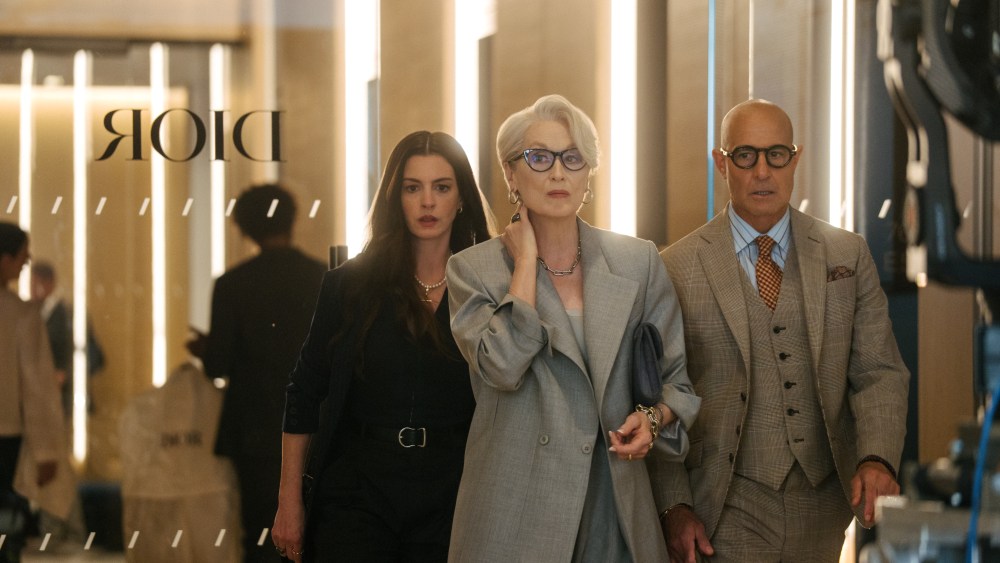
- The Devil Wears Prada 2 opened to $77M domestically and $233M globally, already outpacing the original’s entire run
- Meryl Streep initially turned down the first film — then doubled her asking price and got it
- Streep’s Miranda Priestly performance in 2006 launched a second wave of stardom that made her a mainstream icon
- Streep has never attended the Met Gala despite standing invitations — her rep confirmed it’s simply “never been her scene”
- The sequel marks Streep’s biggest box office debut ever, and her first major theatrical release since 2017’s The Post
Twenty years ago, Meryl Streep walked onto a film set in a silver wig, spoke barely above a whisper, and changed her career forever. Now, with The Devil Wears Prada 2 opening to $233 million worldwide in its debut weekend — the second-biggest global launch of 2026 — it’s worth asking: how did a “chick flick” about a fashion magazine turn the most celebrated actress of her generation into a genuine pop culture icon?
The short answer is Miranda Priestly. The longer answer involves a salary negotiation, a near-retirement, and a performance so controlled it rewrote what audiences thought Meryl Streep was capable of.
https://youtube.com/watch?v=PMd1at7OwiE%3Fsi%3Des054YjvQ4PAUFwt
The Legend Before the Icon
By 2006, Streep was already a monument. Two Oscars from 13 nominations. Collaborations with Michael Cimino, Mike Nichols, Robert Zemeckis, Clint Eastwood, and Spike Jonze. An AFI Life Achievement Award at 55. She had delivered what many consider the greatest screen performance in cinema history with Sophie’s Choice in 1982 — playing a Holocaust survivor forced to choose which of her children would die — and won her second Oscar for it. She had also famously rewritten her own dialogue in Kramer vs. Kramer, insisting her character not be reduced to a lazy villain, and crafted a courtroom scene so raw it’s startling to learn the script didn’t provide it.
She was, by every measure, a legend. But “legend” and “beloved” are not always the same thing.
The image that had calcified around Streep was of a technically formidable, accent-perfecting, award-collecting force who trafficked in suffering. Audiences respected her enormously and occasionally found her exhausting. Her comedic ventures didn’t move the box office needle. She was entering her 40s in an industry that treats women in their 40s as a problem to be managed. Quirkier projects like Adaptation and Angels in America kept her credibility intact, but nothing had cracked open a new mainstream audience for her.
Then came the call about a movie based on Lauren Weisberger’s 2003 novel about working as a personal assistant to a thinly-veiled Anna Wintour.
She said no.
The Negotiation That Changed Everything
Streep has since revealed on Open Book with Jenna that she initially turned the role down flat. “They called me up, and they made an offer, and I said ‘No. I’m not going to do it,’” she recalled. She was 56 and, by her own admission, contemplating retirement. “I’m 56 years old, it took me this long to understand that I could do that.”
What changed her mind was a realization about leverage. She recognized the script’s potential — and decided to test it. “I wanted to see if I doubled my ask,” she said, “and they went right away and said, ‘Sure.’” She was in.
The producers had reportedly been hesitant about casting her at all, unsure she could be funny. (A baffling concern for anyone who has seen Death Becomes Her.) What they got was something more interesting than funny: a performance of icy, aristocratic minimalism that made every other choice in the film look loud by comparison.
What Made Miranda Priestly Work
The Miranda of Weisberger’s novel is not a complicated creation. She’s a pantomime villain — mean-spirited, thinly drawn, a punching bag in reverse. That works fine for a beach read. It doesn’t work for a film you want people to quote for two decades.
Streep’s Miranda never raises her voice. She doesn’t need to. A raised eyebrow does the damage. An imperious pause before “That’s all” lands harder than any shout. The famous cerulean monologue — where Miranda dismantles Andy’s smug certainty about fashion being beneath her — is delivered with the calm of someone who has already won every argument she’s ever entered. The genius is that Streep plays the character as someone whose aloofness is partly genuine and partly armor, a woman who has helped shape a brutal world and knows exactly what it cost her.
She’s monstrous and magnetic in equal measure. As Tina Fey once put it, b*tches get stuff done — and you never doubt Miranda’s power, even as you wince at how she wields it.
The performance earned Streep her 15th Oscar nomination. More importantly, it earned her something she hadn’t quite had before: a fandom.
https://youtube.com/watch?v=-rDTRuCOs9g%3Fsi%3DDm6GU7100sKODgN7
The Second Wave
As The Devil Wears Prada stuck around in theaters for months — and then in the culture for years — it became clear that Streep’s performance was the adhesive holding the whole thing together. Younger audiences who had no particular attachment to Sophie’s Choice or Kramer vs. Kramer were doing impressions of Miranda Priestly. Making memes. Wearing the aesthetic. You can’t make a meme from a Holocaust drama. You absolutely can from “By all means, move at a glacial pace.”
What followed was a genuine reinvention. Mamma Mia! in 2008 proved she could carry a broad, exuberantly silly crowd-pleaser and make audiences dance in the aisles with her. Julie & Julia made her a smash with the older female demographic that Hollywood chronically ignores. It’s Complicated opposite Alec Baldwin and Steve Martin gave her a rom-com hit. Even The Iron Lady — arguably one of her clumsier performances, playing Margaret Thatcher as equal parts camp harridan and underestimated girlboss — pulled in $115 million worldwide and handed her a third Oscar. None of those films had the precise wit of The Devil Wears Prada, but they all ran on the same newly ignited current: Meryl, having fun, letting audiences in.
She had cracked a new model of screen-icon status. Not the cold, chameleonic technician of the prestige-drama years. Something warmer, more accessible — a great Hollywood entertainer who happened to also be the greatest actress alive.
The Sequel, the Comeback, and the Met Gala She Never Attended
Getting Streep back for a sequel was no small feat. Director David Frankel, screenwriter Aline Brosh McKenna, and the entire original cast had publicly dismissed the idea for years. “I think we’re all on record multiple times saying we wouldn’t do a sequel,” McKenna admitted. “I think I said that in 2021!” What unlocked it, Frankel said, was McKenna’s screenplay — a vision that felt genuinely new rather than a rehash. Streep agreed when she felt the project offered “an opportunity to say something completely new about these characters and about the world that they inhabit.”
That world has changed considerably. The Devil Wears Prada 2 picks up Andy Sachs returning to Runway as a features editor, navigating a media landscape decimated by tech money and clickbait economics — a timely hook that gave the story real stakes beyond nostalgia. The full original cast returned: Anne Hathaway, Emily Blunt, and Stanley Tucci, all back in the hallowed halls of Runway.
Hathaway, for her part, has been effusive about the experience. “I loved making the first,” she told People. “I know I was stressed and anxious and all those things, but it’s one of the most hilarious experiences ever because of the people I was with.” Of Streep specifically, she said: “She’s someone I admire. Someone who defines how it’s done. Somebody who is just living greatness and never rests on that laurel, but is always pushing herself to expand as an artist. She’s unbelievable.”
The timing of the release — opening May 1, the day before the Met Gala — was not accidental. Miranda Priestly is, of course, a character built in Anna Wintour’s image, and Wintour has chaired the Met benefit for over three decades. Social media lit up with speculation that Streep herself would finally make her Met debut. She didn’t. She never has. “Meryl has been invited to the Met Gala for many years but has never attended,” her representative told People in a statement. “While she appreciates Vogue, Anna, and her incredible imagination and stamina — it has never quite been her scene.”
What Miranda Priestly does wear to a Met Gala-esque event in the sequel’s opening scene, though, is a plunging scarlet Balenciaga gown that Streep helped select herself. Costume designer Molly Rogers recalled their initial lunch meeting: “Almost at the same time, we both said, ‘It’s going to be red. The devil reappears in red! Case closed.’”
A Box Office Force at 76
The Devil Wears Prada 2‘s $233 million global opening ranks as the second-biggest worldwide debut of 2026, trailing only The Super Mario Galaxy Movie and beating the Michael Jackson biopic Michael. It’s already expected to outgross the original’s entire $326 million lifetime haul before the month is out. Disney spent roughly $100 million to produce it and another $80 million on marketing — a bet that is paying off spectacularly, with 76% of the opening weekend audience being women and an enthusiastic A- CinemaScore.
For context: the original Devil Wears Prada opened to $27.5 million in 2006. This is a different scale entirely.
“This is a sensational opening for a comedy-drama,” said box office analyst David A. Gross. “Very few dramedies do this kind of business once, let alone a second time that’s bigger.” The New York Times noted it’s the biggest domestic debut for a traditional comedy since Pitch Perfect in 2015.
Streep, now a 21-time Oscar nominee, a four-time Emmy winner, and a Kennedy Center honoree, hasn’t led a wide theatrical release since Steven Spielberg’s The Post in 2017. Her recent work — Don’t Look Up, The Prom, Let Them All Talk — all went to streaming. The multiplex missed her. This weekend proved the feeling was mutual.
In a promotional interview that cut through the usual PR polish, Streep was asked whether she’d softened Miranda for the sequel. Her answer said everything about where she stands in the industry right now: “I think when we tend to Marvel-ize the movies now — we got the villains and we got the good guys — and it’s so boring. What’s really interesting about life is that some of the heroes are flawed and some of the villains are human and interesting and have their own strengths. So that’s what I like about this. It’s messier.”
It takes a certain kind of star to casually dismiss the Marvel machine while promoting the film kicking off Disney’s summer slate. But that’s precisely the point. The Devil Wears Prada didn’t just make Meryl Streep an icon. It made her the kind of icon who doesn’t have to answer to anyone — and knows it.
Up next: a Joni Mitchell biopic from Cameron Crowe, a lead role opposite Sigourney Weaver in Joseph Cedar’s corporate thriller Useful Idiots, and a matriarch turn in a TV adaptation of Jonathan Franzen’s The Corrections. Whatever she does, the audience will follow. Miranda Priestly made sure of that.
Filed in

Comments
0