
Adam Scott’s ‘Hokum’ Is the Horror Hit You Need to See
Damian McCarthy’s latest Irish horror film ‘Hokum’ stars Adam Scott as a grumpy novelist in a haunted hotel — and it’s already his biggest box office hit.
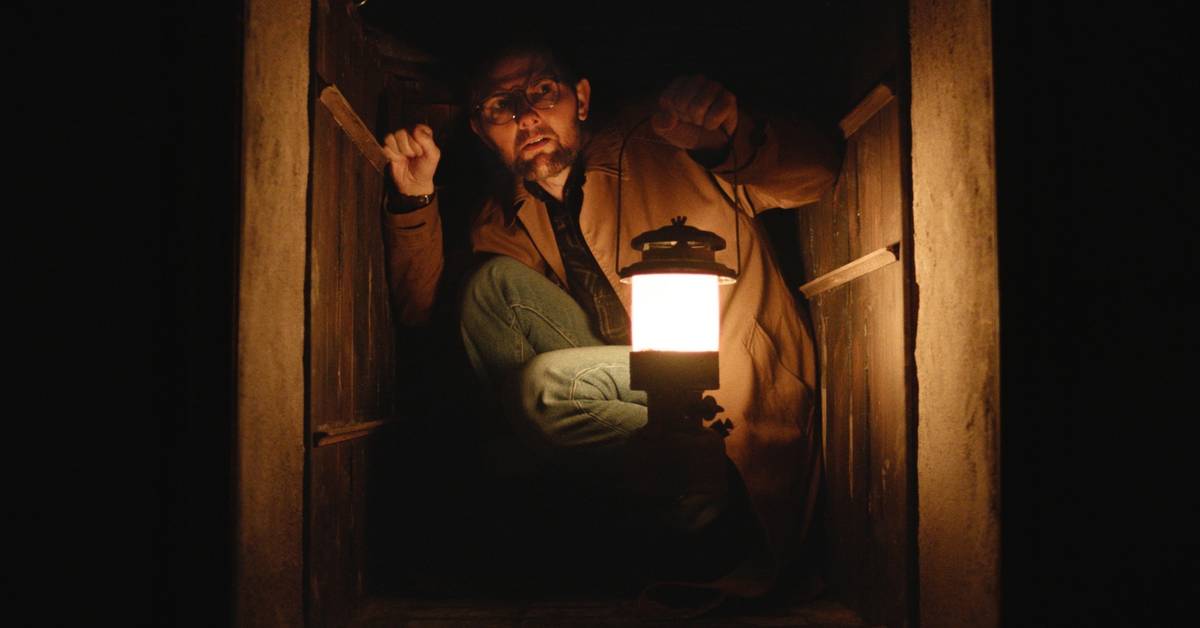
- Damian McCarthy’s Hokum stars Adam Scott as a cantankerous novelist investigating a haunted Irish hotel’s forbidden honeymoon suite
- The film is already McCarthy’s biggest box office hit, following the acclaimed Oddity (96% on Rotten Tomatoes)
- McCarthy and Scott revealed the ending was originally far bleaker — Ohm was meant to be punished by karma with no hope of survival
- The film features McCarthy’s signature style: isolated settings, cursed objects, Irish folklore, and recurring rabbit motifs
- Hokum is a Neon release, rated R, running 101 minutes
Damian McCarthy has done it again. The Irish director who quietly became one of horror’s most exciting voices — first with 2020’s Caveat, then with 2024’s Oddity — is back with Hokum, and it’s his most entertaining, most accessible, and most commercially successful film yet. Adam Scott leads the charge, and while the movie has a few rough edges, it delivers exactly what horror fans want: genuine scares, a compelling mystery, and an atmosphere so thick you can practically feel the cold Irish air.
Scott plays Ohm Bauman, a renowned novelist who travels to a remote inn in Ireland to scatter his parents’ ashes near the hotel where they honeymooned. He’s finishing his conquistador trilogy, and the weight of that unfinished work follows him everywhere. Ohm is, to put it plainly, a nightmare of a human being — dismissive, entitled, and almost pathologically rude to every hotel employee he encounters within minutes of arriving. The one exception is Fiona (Florence Ordesh), the bartender, who becomes his only real connection at the inn. When she disappears, Ohm does the one thing you’d expect a horror protagonist to do: he breaks into the one room he was explicitly told never to enter. The Honeymoon Suite. Locked by the hotel’s owner (Brendan Conroy) and whispered about for years, the suite is supposedly home to something ancient and very, very angry.
A Horror Movie That Plays Like a Video Game — and That’s a Compliment
Hokum has an unusual energy for a horror film. It moves fast, it doesn’t overstay its welcome, and there’s a quality to Ohm’s journey — a lone man in a jacket, searching for a missing girl, solving puzzles, unraveling a mystery room by room — that feels genuinely inspired by horror video games like Alan Wake, Silent Hill, and Amnesia. Scott’s character being somewhat one-note, stubbornly pissy throughout, actually feeds into this rather than working against it. He’s less a fully realized literary character and more a vehicle through which McCarthy can put the audience through its paces. And McCarthy’s paces are something to behold.
The filmmaker has become, in just three films, one of the most reliable architects of horror set pieces working today. He’s one of the few directors who can still pull off a clever jump scare — not the cheap, musical-sting variety, but the kind that’s earned through genuine tension. Hokum is stuffed with them. There’s a Halloween party, a terrifying children’s TV show host that appears in Ohm’s visions like demonic flashes, nightmares rooted in childhood trauma, Chekhov’s crossbow, an Irish whiskey problem, and a bearded van-dweller named Jerry (David Wilmot) living in the woods who may or may not have killed his wife. A lot is dangled and not much is explained, which will frustrate some viewers — but horror movies rarely improve with elaborate blueprints, and McCarthy trusts his audience enough not to over-explain.
The hotel itself is a character. In its well-trafficked areas it toes the line between charming and creepy, all antiquities and aged wood. But in the Honeymoon Suite, it’s practically rotting from the inside — cobwebs, peeling wallpaper, a putrid swamp where a bathtub used to be. McCarthy uses shadows masterfully, and while each of his films has gotten progressively darker in visual tone, they never lose their vibrant colors. It’s old-fashioned ghost story filmmaking done with real craft.
The Ending Almost Went Somewhere Much Darker
The ending audiences see in theaters — which leans toward something quietly hopeful without erasing Ohm’s sins — was not always the plan. In an interview with CBR, McCarthy revealed that early drafts of Hokum had a far more punishing conclusion.
“In early drafts, yeah, it was all about that,” McCarthy said. “It was all about having a much heavier, bleaker ending to it, really to kind of punish the character and say, ‘He deserves everything that’s coming to him. Karma has caught up.’”
The problem, he said, was that every time he came back to the script over the course of a couple of years, the darker ending just didn’t excite him. “‘Are people going to return to this? Are they going to find this entertaining?’” he recalled thinking. The shift came when Jerry entered the story, bringing a slightly lighter energy with him. David Wilmot’s performance apparently helped McCarthy find a different emotional register for the whole film.
What audiences get instead is an ending with real ambiguity baked in. The final twist reveals that Alby, a bellhop Ohm burned earlier in the film, secretly drugged Ohm’s whiskey with Jerry’s mushroom powder for revenge — which raises the possibility that everything Ohm experienced, including the shape-shifting ancient witch, was a psilocybin-fueled hallucination. Or maybe not. Ohm still has the marks on his wrists from being chained up.
Scott said he loved that the twist “questions everything without copping out.” “Because whether it was real or not, whether all of that occurred or not, Ohm is in the place he’s in,” Scott said. “He’s in a better place, and he is looking forward to the rest of his life now. But also, he still has the marks on his wrists from being chained up. So, who knows?”
For McCarthy, it came down to making the survival feel earned rather than undeserved. “Still having quite a terrifying film with this very complicated character that Adam brings to life so brilliantly,” he said, “but having that happy ending earned when you get to it.”
McCarthy’s Signature Style Is Getting Harder to Ignore
Three films in, Damian McCarthy has a recognizable aesthetic that’s becoming more refined with each project. He’s part of a new wave of Irish horror that blends the supernatural with the mundane — from the outside, the gorgeous Irish countryside looks peaceful and inviting. Through McCarthy’s lens, it’s a trap. His protagonists are always isolated, always pulled toward the one place they shouldn’t go, always confronting something that blurs the line between folklore and reality.
And then there are the rabbits. McCarthy has woven rabbit imagery into all three of his films, starting with the angry-looking toy rabbit in Caveat that functions as a harbinger of danger. That same rabbit toy makes a brief appearance in Oddity, alongside a painting of a white rabbit. In Hokum, there are two figures in rabbit costumes: one who guides Ohm from beyond the grave through a taped diary, and one — a nightmarish children’s TV host — that is genuinely one of the more disturbing images in recent horror memory. The duality maps onto good and evil, but McCarthy’s rabbit obsession goes deeper than Alice in Wonderland references. In Irish folklore, the Púca is a shapeshifting fairy that sometimes takes the form of a rabbit. It’s the kind of specific, layered detail that separates a filmmaker with a genuine vision from one just hitting genre beats. For more on how McCarthy keeps returning to the same creepy idea — and why it keeps working — it’s worth hearing it from the director himself.
He’s also a former electrician, and that background shows. In Hokum, he uses a delicately timed clock to trigger a button that calls a dumbwaiter elevator back up to the forbidden suite. It’s a small detail, but it’s the kind of practical ingenuity that gives his films a tactile, handmade quality that big-studio horror often lacks.
A Few Cracks in the Foundation
None of this means Hokum is perfect. The film’s opening — a sun-drenched desert, a Spanish conquistador in armor, a little boy with a map — is a jarring mismatch with everything that follows. The connection to Ohm’s unfinished trilogy is logically coherent, but the conquistador subplot feels like it belongs in a different, less aesthetically cohesive movie, and it takes a while to shake off that dissonance once the Irish hotel comes into frame.
Ohm himself is a genuine challenge. He is, without exaggeration, one of the most insufferable protagonists in recent horror memory — the kind of guy who will go out of his way to say something cruel when saying nothing at all would have been fine. You spend the early stretches of the film almost rooting for the witch. The movie is aware of this, and there’s arguably a point being made about human decency (it’s Fiona, the one person Ohm treats with basic respect, who ultimately helps him), but it tests your patience before the haunting kicks in and gives you something else to focus on.
And while all three of McCarthy’s films are genuinely good, they are also — by his own design — variations on the same fundamental premise: a person in a creepy, possibly haunted location who must solve a mystery to survive. It works. It keeps working. But at some point, the question of what McCarthy can do outside this particular sandbox becomes more interesting than the sandbox itself.
Still, Hokum is a genuinely fun horror movie — scary when it needs to be, surprisingly funny in moments, and anchored by a filmmaker who knows exactly what he’s doing with a camera and a dark room. The Severance star and the Irish indie horror director are an unlikely pairing that, somehow, works. Whether Ohm’s ordeal was real or a mushroom trip, he walked out of that hotel changed.
So will you.
Hokum is in theaters now from Neon. Rated R. 101 minutes.
Filed in

Comments
0