
Bruce Springsteen Brings Fire and Purpose to MSG
Bruce Springsteen’s Land of Hope and Dreams Tour hit Madison Square Garden with a three-hour show that was part concert, part American revival.
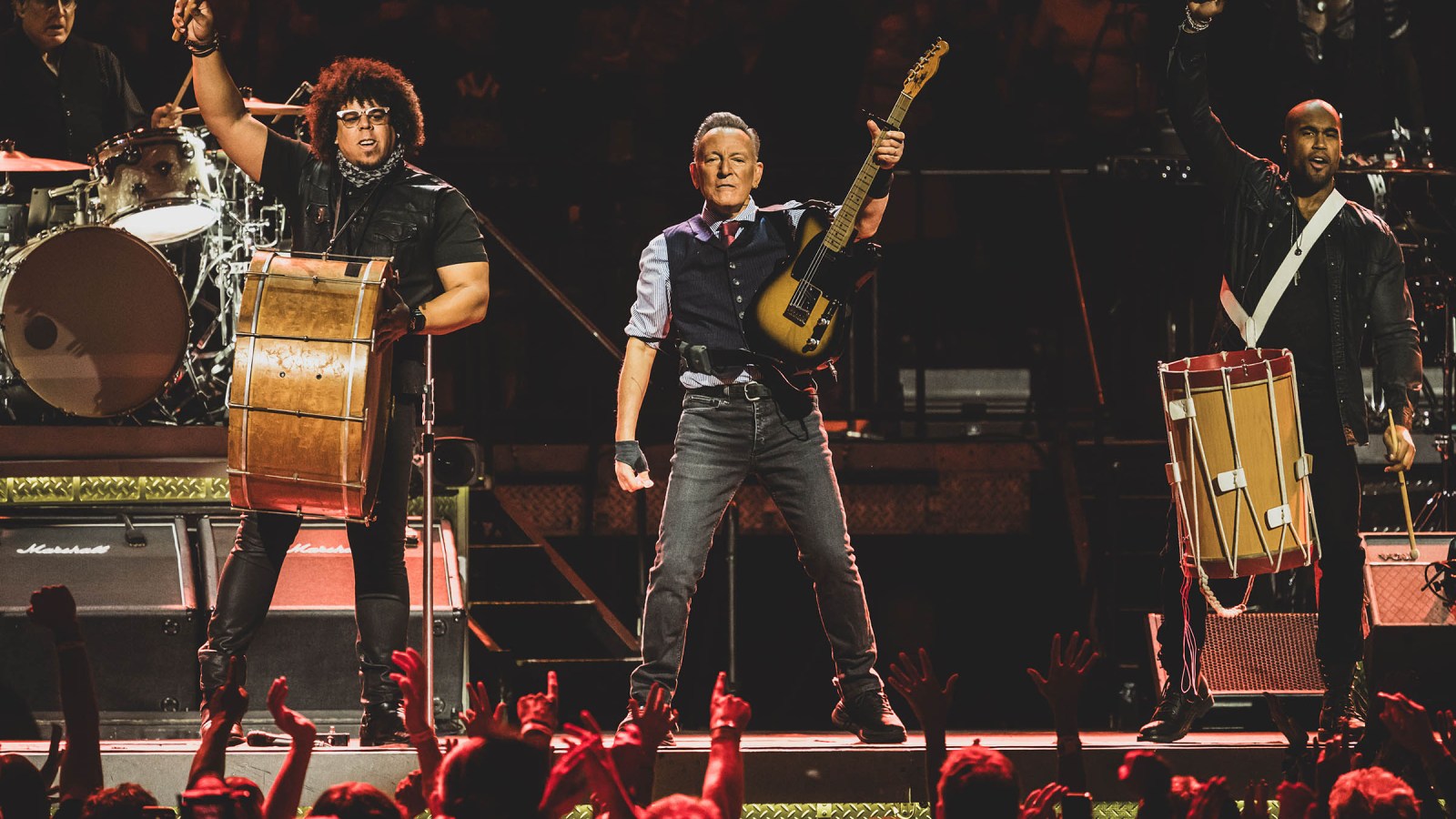
- Bruce Springsteen’s Land of Hope and Dreams Tour stopped at Madison Square Garden for a three-hour set that doubled as a full-throated rebuke of the Trump administration
- Tom Morello joined the E Street Band onstage, with standout moments on “The Ghost of Tom Joad” and a cover of the Clash’s “Clampdown”
- Springsteen opened every show with a spoken prayer before launching into Edwin Starr’s “War” — setting the political tone from the jump
- New protest anthem “Streets of Minneapolis” honors Renée Good and Alex Pretti, killed by ICE agents, and has crowds chanting “ICE out now” at arenas nationwide
- At 76, Springsteen is delivering what many are calling one of the most urgent and alive shows of his career
Bruce Springsteen walked into a spotlight at Madison Square Garden Monday night and didn’t let up for three hours. The Land of Hope and Dreams Tour — subtitled “No Kings” — has been building momentum across the country, and by the time it hit New York City, it had become something that transcends the usual category of “classic rock show.” This was a revival. A reckoning. And one of the most commanding performances of Springsteen’s five-decade career.
It started before a single chord was played. Springsteen stepped to the mic as the E Street Band played quietly behind him and delivered what has become his nightly opening prayer: “We begin the night with a prayer for our men and women in service overseas. We pray for an end to this conflict and for their safe return.” Then, the pivot: “Our democracy, our constitution, our rule of law, are being challenged right now as never before by a reckless, racist, incompetent, treasonous president and his ship of fools administration.” He let the last word hang — and then bellowed it. “War.” And the band launched right into Edwin Starr’s Vietnam-era protest anthem, the crowd erupting before the first verse landed.
From there, he went straight into “Born in the U.S.A.” — a song Springsteen famously avoided playing in America for years after Ronald Reagan co-opted it in the ’80s. Its meaning, he clearly felt, needed no clarification in 2026. Then “Death to My Hometown.” Then a cover of the Clash’s “Clampdown,” with guest guitarist Tom Morello stepping up to shout the song’s central lyric — “Let fury have the hour” — before Springsteen joined in harmony: “Anger can be power. Do you know that you can use it?”
There was no easing in. No warm-up lap. Just three hours of barely relenting energy from a band whose core members — Max Weinberg, Garry Tallent, Nils Lofgren, Roy Bittan — are all in their seventies and playing like they have something to prove.
A Setlist Built Like an Argument
What’s remarkable about this tour is how deliberately Springsteen has sequenced his catalog into something that feels less like a greatest-hits celebration and more like a sustained piece of political and emotional storytelling. “Darkness on the Edge of Town,” “Streets of Minneapolis,” and “The Promised Land” sat together in one stretch. “Murder Incorporated” — with a surprise guitar-solo barrage from Steve Van Zandt that had the Garden on its feet — led directly into “American Skin (41 Shots),” his 2001 composition about the police killing of Amadou Diallo, which in turn gave way to the weary hope of “Long Walk Home.”
“American Skin” was a particular highlight, with Morello delivering some of the most lyrical, stunt-free soloing of his career — beginning with a trilling exchange with saxophonist Jake Clemons, who has grown visibly more confident in the role his late uncle Clarence made iconic. The current E Street Band, it’s worth saying, is genuinely multiracial, with nearly as many Black performers onstage as white ones — a fact that feels quietly significant in the context of everything being said from that stage.
“Streets of Minneapolis” — the tour’s sole new song, written after ICE agents shot and killed Renée Good and Alex Pretti — has become an instant anthem. Boomer-heavy arena crowds are shouting “ICE out now” at venues across the country. It’s a protest song that actually works as a protest song, which is rarer than it sounds.
Morello’s presence throughout the night was a reminder of how elastic the E Street Band has become. His once-jaw-dropping whammy-bar theatrics on “The Ghost of Tom Joad” have settled into something that just feels like part of the fabric now — a counterpart to Nils Lofgren’s equally soaring solo on “Youngstown,” or his spinning-top physicality during “Because the Night.” The band isn’t nostalgia. It’s a living thing.
The Speeches the Democratic Party Should Be Taking Notes On
Between songs, Springsteen delivered the kind of clear-eyed, emotionally direct political address that has been conspicuously absent from actual American political leadership. He didn’t hedge. He didn’t triangulate. He reminded the crowd of DOGE’s dismantling of USAID and the deaths overseas that followed. “It’s not on the front pages anymore,” he said, “but it’s happening now. People are dying.” He talked about the Supreme Court’s assault on the Voting Rights Act. He talked about immigrants held in for-profit detention centers. He talked about what he called “an incompetent and illegal war” in the Middle East. Each item on the list was punctuated with the same phrase: “This is happening now.” Simple, yes. But in the context of those songs, each repetition landed like a fist.
“We are now, to many, America the reckless, unpredictable, predatory, rogue nation,” he told the crowd. “Honesty, honor, humility, truth, compassion, humanity, thoughtfulness, morality, true strength and decency — don’t let anybody tell you that these things don’t matter anymore — they do…. So join us and let’s fight for the America that we love.”
The speeches have been nearly identical at every stop on the tour, which makes them feel less like improvised passion and more like a carefully considered sermon — one Springsteen has decided the country needs to hear, night after night, in every city.
The message landed differently for different people in the room. One observer noted two ultra-wealthy moguls sitting nearby — one from media, one from sports — who appeared entirely unmoved. As Springsteen made his final plea for humanity near the end of the set, one was eating. The other had closed his eyes. Jon Bon Jovi, who was also in attendance, reportedly leaned over to try to explain what was happening. The rest of the 20,000 people in the building were on their feet.
That image — the thunderous majority and the two checked-out billionaires — felt like its own kind of parable about the divide Springsteen has spent this entire tour trying to address.
What a 76-Year-Old Can Still Do
Purely as a concert, this is extraordinary. No 76-year-old rock icon should be able to sustain three hours at this level — landing one song like a jumbo jet while the next is already counting down for takeoff, as one observer put it. Weinberg’s drumming is ferocious. Lofgren is a spinning top during his solos. Van Zandt commands his corner of the stage with the quiet authority of someone who’s been doing this for fifty years and still means every note. And Springsteen himself dances, shimmies into the crowd, and drives the whole thing forward like a man with no interest in coasting.
The show closed with covers of Bob Dylan’s “Chimes of Freedom” and Woody Guthrie’s “This Land Is Your Land” — a bookend to the opening “War” that felt earned rather than obvious. In between those two poles, Springsteen had conjured something that his catalog has always gestured toward: a vision of America that is broken and beautiful and worth fighting for.
He allowed himself one personal, elegiac moment at MSG — reminiscing about playing his first New York City show as a teenager at Cafe Wha. “What I’m saying is, thanks for a lifetime,” he said, and the ovation that followed was notably different from the political thunder of the rest of the night. Quieter. More emotional. Like the crowd understood exactly what he meant.
The show had opened with a light lingering on an empty spot behind a mic stand, before Springsteen stepped into it. In those few seconds before he arrived, the void was impossible to ignore — and impossible not to dread.
https://youtube.com/watch?v=Y4r7K6WeY2o%3Fsi%3Dtoy4e4U6BozEwmE9
Filed in

Comments
0