
Martin Short’s Netflix Doc Is a Joyful, Bittersweet Ride
Lawrence Kasdan’s ‘Marty, Life Is Short’ on Netflix is a warm, funny, and quietly heartbreaking look at the comedian’s life, loves, and career.
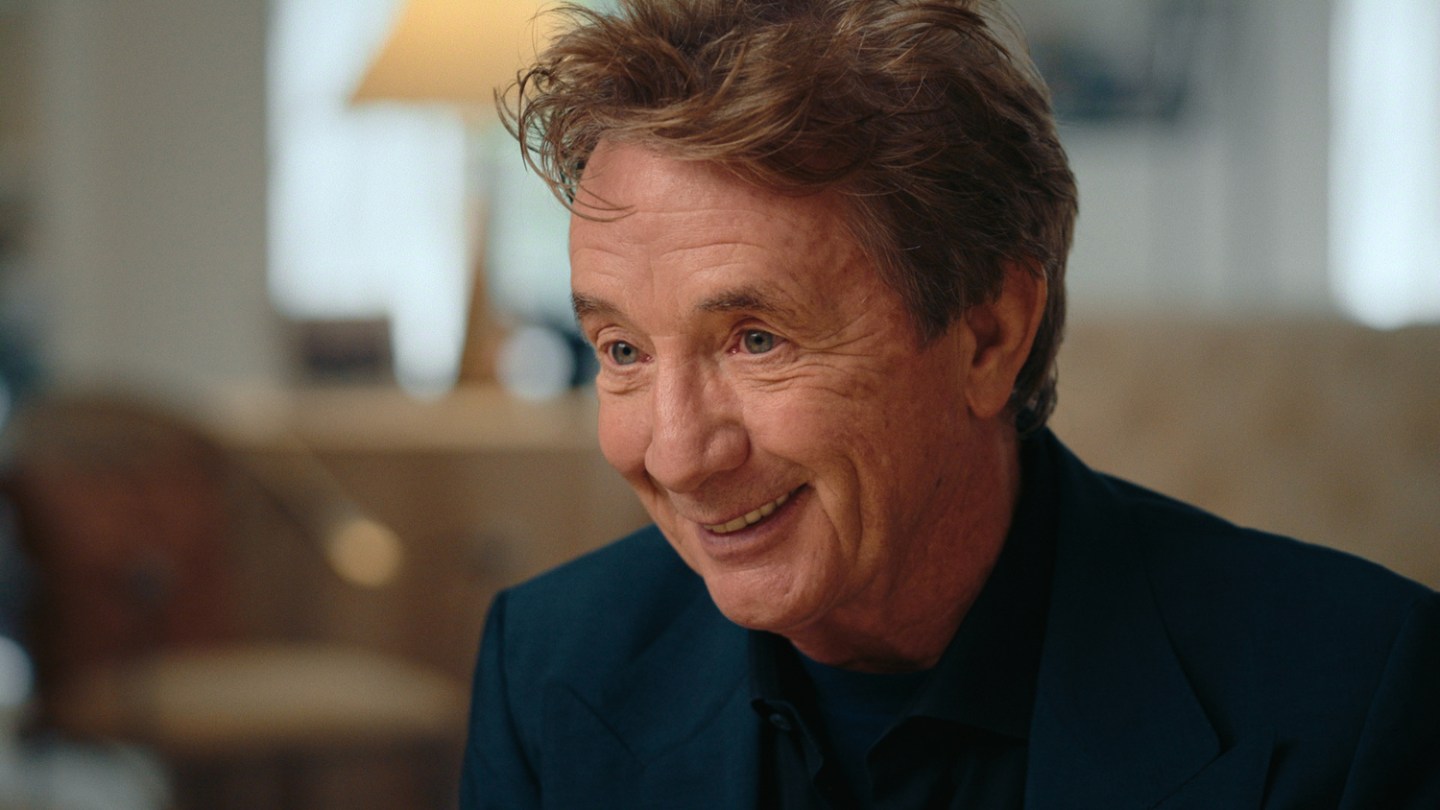
- Lawrence Kasdan’s documentary Marty, Life Is Short is now streaming on Netflix
- The film covers Martin Short’s decades-long career alongside deeply personal stories about love and loss
- It features interviews with Steve Martin, Tom Hanks, Eugene Levy, and the late Catherine O’Hara, to whom the film is dedicated
- Short’s wife Nancy Dolman, who died in 2010, is central to the documentary’s emotional core
- The Hollywood screening drew Selena Gomez, Billy Crystal, Jerry Seinfeld, Kate Hudson, and more
Martin Short has spent roughly 40 years making people laugh, and Marty, Life Is Short — Lawrence Kasdan’s warm, funny, and quietly devastating new documentary — makes a compelling case that he’s never really stopped. The film, now streaming on Netflix, is the kind of portrait that earns its emotion honestly: it doesn’t manufacture tears, it just follows a man who has lived a lot of life and kept showing up anyway.
“Let’s say you’re going to host a dinner party and you invite Marty,” Steve Martin tells viewers early on. “Then it turns out Marty can’t come? You cancel the party.” It’s a line that gets a laugh, but it also sets the tone for everything that follows — a film about someone so fundamentally committed to joy that the people around him have organized their lives around it.
A Life That Earns Its Title
Kasdan — the writer of Raiders of the Lost Ark and director of The Big Chill — is not an objective observer here. He and Short have been close friends for decades, a relationship that dates back to the 1999 dark comedy Mumford, and the two have had, by Short’s own count, “thousands of lunches.” The film opens with Short joking that he’s worried the whole thing will be a hatchet job he’ll refuse to promote. It is not a hatchet job.
What it is, at 101 minutes, is a generous and clear-eyed look at a career that Short himself describes as “80 percent failure” — a number he later revises upward to 90, and which collaborator John Mulaney quotes as 98. The math is grim, but the spirit isn’t. Films like Captain Ron, Pure Luck, and the legendarily strange Clifford — in which Short played a 10-year-old boy, prompting Roger Ebert to write that “it’s not bad in any usual way; it’s bad in a new way all its own” — are accounted for honestly. The documentary even includes on-set footage from Captain Ron that makes the point plainly: a movie can be a critical and commercial disaster and still be a genuinely fun experience to make.
But what’s more interesting than the flops is how Short processed them. His mantra, repeated throughout the film in various forms, is essentially: keep moving. “98 percent of it is failure; nothing works and then something works.” It’s a philosophy he didn’t arrive at by accident.
Short grew up as the youngest of five children in Hamilton, Ontario, where, as he puts it, “I profited from trickle-down comedy” — the family’s currency was making each other laugh. Then, when he was 12, his eldest brother David was killed in a car accident. His mother Olive, the concertmistress of the Hamilton Symphony Orchestra, died of cancer when Short was 18. His father Charles died two years after that. By the time he was 20, both parents were gone. Short describes the choice that period forced on him: collapse and “become defeated forever,” or “learn that life is short and have a glass of wine and fun.”
He chose the wine.
Where It All Started
The documentary traces Short’s path from pre-med student to social work graduate to, eventually, one of the most distinctive comic performers of his generation. The turning point was a now-legendary 1972 Toronto production of Godspell — a cast so stacked it will reportedly be the subject of its own upcoming documentary — that featured Short alongside Eugene Levy, Andrea Martin, Gilda Radner, and Victor Garber. From there came Second City Toronto, then SCTV, then a stint on Saturday Night Live in the mid-’80s, and then Hollywood.
The SCTV alumni are among the film’s most valuable voices. Levy and Andrea Martin offer anecdotes going back to college. And then there is Catherine O’Hara — who appears throughout the documentary in interviews and archival footage, and to whom the film is dedicated. Seeing O’Hara so soon after her death is genuinely hard. She is radiant and funny and warm in every frame, a reminder of everything that made her so beloved, and her presence in the film carries a particular weight that Kasdan doesn’t try to soften.
The film is also dedicated to Short’s daughter Katherine, who passed away earlier this year. Her death is not discussed in the documentary — nor is O’Hara’s. Kasdan made a deliberate choice to keep the film’s grief largely offscreen, which is either a limitation or an act of mercy depending on how you look at it. What it means in practice is that the closing title cards — coming immediately after a bit where Short’s alter ego Jiminy Glick dismisses the very idea of a Martin Short documentary — land like a gut punch. The whiplash is the point.
The Home Movies Are Everything
If there’s a single element that elevates Marty, Life Is Short above the crowded field of recent comedy-legend docs — and it is crowded, with films on Steve Martin, Chevy Chase, Eddie Murphy, Gene Wilder, and Lorne Michaels all arriving in recent years — it’s the home footage. Short has been filming his life for decades, and what’s captured on those tapes is extraordinary.
There are the raucous holiday parties at Short’s Pacific Palisades home, where guests like Sally Field climb pianos and Andrea Martin jokes about hiring a vocal coach to perform for the occasion. There are summers at the Short family’s lake cottage in Ontario — the Malibu of the North, as it’s been called — where Tom Hanks and Short reenact the final jump scene from Butch Cassidy and the Sundance Kid while Steven Spielberg mans the camcorder. There’s Goldie Hawn blowing kisses at the lens while Kurt Russell looks amused behind her. There’s Short narrating a storm rolling in off the lake, or flirting with his wife Nancy in the kitchen, or just playing with his kids on the deck.
Nancy Dolman is the film’s emotional center. She and Short met during that 1972 Godspell production and were married for 30 years until her death in 2010. Everyone Kasdan interviews describes them as the perfect couple. The documentary leans into that, treating the marriage less as a tragedy to be mourned and more as a love story to be celebrated — closer in spirit to Judd Apatow’s recent treatment of Mel Brooks and Anne Bancroft than to a conventional grief narrative. It works.
“Marty operates at the speed of joy,” Tom Hanks says at the film’s end. “Marty is doing it because the opportunity is there to have a blast.”
Why Some People Can’t Stand Him (And Why That’s Part of the Point)
One of the more honest things Marty, Life Is Short does is acknowledge, head-on, that Martin Short is not universally beloved. A 2023 Slate piece by Dan Kois examined Short’s “manic, slightly creepy intensity” and prompted fierce pushback from both fans and fellow celebrities. The documentary doesn’t pretend that criticism doesn’t exist.
Short’s comedy — built around characters like the perpetually gelled manchild Ed Grimley and the obnoxious entertainment journalist Jiminy Glick, who appeared in a fat suit and thick glasses — has always been maximalist. “I always figured that if you walked on stage and you looked totally insane, you’d get a laugh,” Short says, “and then you were halfway there.” That approach works brilliantly or it doesn’t land at all, and Short has always known it. “It’s actually quite hard to make a completely bizarre character real,” Steve Martin says. “And that’s what he does.”
The film closes with Glick himself weighing in on the documentary’s subject. “I don’t really find him very interesting,” Glick says of Short. “I find people who push too hard and are desperate for the approval without really presenting any reason for the approval — I find it offensive.” Then: “There’s basically three voices, two hairstyles, and four dance moves. And you can’t build an empire on that.”
It’s the biggest joke in the movie. And it’s also, somehow, a kind of answer.
The Screening Was Its Own Event
The Hollywood premiere of Marty, Life Is Short was about as Martin Short as a Martin Short documentary screening could be. The guest list included Short’s Godspell co-stars Eugene Levy and Andrea Martin, his Only Murders in the Building co-star Selena Gomez, and a constellation of famous friends: Jimmy Kimmel, Billy Crystal, Jerry Seinfeld, Kate Hudson, Paul Shaffer, and Brian Grazer, who served as executive producer.
Gomez, who plays Mabel alongside Short’s Oliver Putnam and Steve Martin’s Charles-Haden Savage on the Hulu hit, posted her reaction after seeing the film. “This man who doesn’t have social media is truly outstandingly witty, smart and has given the most wonderful attributes to our world of comedy,” she wrote on Instagram. “Martin Short is nothing short of a legend. His outlook on life is simply joyful… thank you Marty for your inspiring and tremendous heart that makes me forever happy.”
Short, for his part, has been busy. During a recent appearance on CBS Sunday Morning, he teased that he and Only Murders co-star Meryl Streep are developing a Broadway show together — which, if it happens, would add yet another chapter to a career that has already included a Tony Award for Little Me, the stage version of The Producers, Hairspray Live!, and the musical series Schmigadoon!
Marty, Life Is Short is not a complete picture of Martin Short’s life — it can’t be, and Kasdan doesn’t pretend otherwise. But it is a deeply felt one, made by a friend who wanted to capture something true about a man who has chosen, over and over, to meet the world with laughter. Whether that makes you want to cancel the dinner party or just buy a ticket to the show probably says something about you. Either way, the documentary makes its case warmly and well.
Filed in

Comments
0