
Sandra Hüller Shines in Pawlikowski’s ‘Fatherland’ at Cannes
Pawel Pawlikowski’s ‘Fatherland’ starring Sandra Hüller premieres at Cannes 2026 — reviews call it a masterclass and a frontrunner for the Palme d’Or.
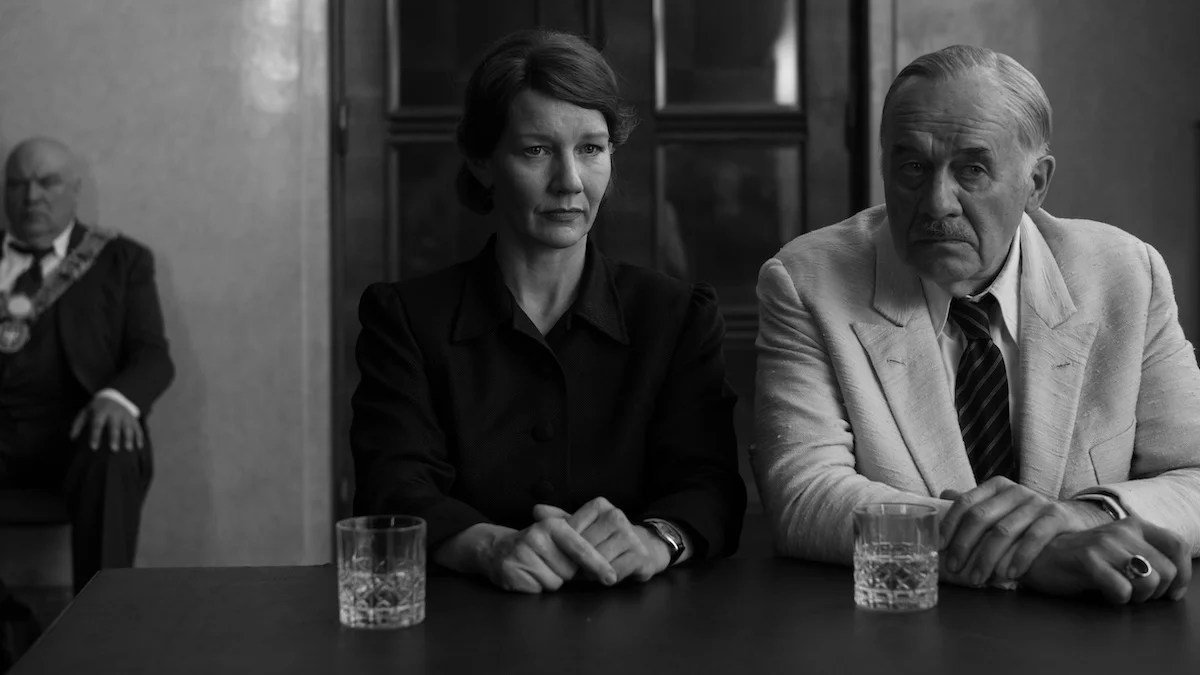
- Pawel Pawlikowski’s Fatherland premiered in competition at the 2026 Cannes Film Festival
- Sandra Hüller plays Erika Mann, daughter of Nobel-winning author Thomas Mann, on a 1949 road trip across divided Germany
- The 82-minute film completes a loose trilogy with Pawlikowski’s Ida and Cold War
- The story was originally developed by Conclave director Edward Berger before he passed it to Pawlikowski
- MUBI has acquired rights in North America, the UK, Germany, and several other territories
Pawel Pawlikowski is back at Cannes, and he hasn’t lost a step. Fatherland, which premiered Thursday in the festival’s main competition, is the Polish director’s most precise, most disciplined work yet — a luminous black-and-white road movie set in the ruins of postwar Germany that arrives as a near-certain frontrunner for the Palme d’Or.
At 82 minutes — a welcome mercy at a festival whose competition slate includes five films running over two and a half hours — it follows Nobel Prize-winning German writer Thomas Mann (Hanns Zischler) and his daughter Erika (Sandra Hüller) on a journey from US-controlled Frankfurt to Soviet-run Weimar in the summer of 1949. Mann has been invited back to Germany for the first time since fleeing the Nazis in 1933, to accept a prize honoring the 200th birthday of Goethe, Germany’s most revered literary figure. Both sides of the freshly drawn border want to claim both Goethe and Mann as their own. Neither side particularly deserves either of them.
https://youtube.com/watch?v=kxDLkNfPBUA%3Fversion%3D3%26enablejsapi%3D1%26origin%3Dhttps%253A%252F%252Fdeadline.com%26rel%3D1%26showsearch%3D0%26showinfo%3D1%26iv_load_policy%3D1%26fs%3D1%26hl%3Den-US%26autohide%3D2%26wmode%3Dtransparent
It is, as Pawlikowski himself put it in his director’s statement, a film about “the turmoils of history, with exile and with our transcendental need for home and belonging.” But where previous Pawlikowski films — Ida and Cold War — invented characters to stand in for historical forces, Fatherland plants itself squarely in the real lives of the Mann family. “Trying to fuse the personal and the historical in a poignant, mutually enhancing way,” Pawlikowski said, “we took some liberties with historical facts and their chronology, while trying to stay faithful to the emotional and intellectual truth of the matter.”
The film opens not in Germany but in Cannes, in a cramped two-star hotel room where Erika’s brother Klaus (August Diehl) sits by a rumpled bed — last night’s lover still tangled in the sheets, a hypodermic needle catching the light on the nightstand — talking to his sister on the phone. Palm trees whip in a storm outside. It’s a perfectly composed Pawlikowski diorama: intimate, loaded, and telling you everything about this family before a word of exposition has been spoken. Klaus will soon take his own life with an overdose of sleeping pills. Thomas, upon hearing the news, insists they continue with the trip anyway. Erika agrees to bury her grief and her hatred of postwar Germany and keep driving.
Sandra Hüller Carries the Weight of It All
If there’s a single reason to see Fatherland — and there are many — it’s Hüller. Fresh off a supporting role in the certified blockbuster Project Hail Mary and a Berlinale best actress prize for the black-and-white period drama Rose, she adds yet another register to what is becoming one of the most remarkable recent runs by any actress working today. Her Erika Mann is a woman who has spent over a decade as her famous father’s fixer, assistant, translator, and human shield — filtering the poison pen letters from his mail, managing border guards, choosing his next tie, extracting him from fans with patient, unflappable efficiency. When she finally hits a man at a bar, you feel the sting of it as viscerally as if she’d hit you.
Hüller can convey four emotions at once with nothing more than a sideways glance. The film leans heavily on that gift. Almost nothing is spelled out — not the queer sexualities of the leading characters, not the precise nature of Erika’s history with AP journalist Betty Knox (Anna Madeley), not the exact weight of her resentment toward her father. It’s all there in hungry looks, tiny gestures, costume choices, and the vast, charged silences that Pawlikowski lets breathe where another filmmaker would rush to fill them.
There’s also a simmering question beneath every scene Hüller plays: what about her own life, beyond being somebody’s daughter? Erika had a rich career as a writer and war correspondent, had been refused American citizenship three times despite living in the States, and has been left — as the film pointedly notes — a citizen of nowhere by two wars, including the cold one now beginning. “Let’s go home,” she says to her father at one point. “Where is that?” he replies. Zischler’s Mann is a lost soul, full of airy, sonorous pronouncements that sound profound and mean almost nothing, a man who fled Germany’s darkest hour and now must face the people who remember that he did.
“If I’d stayed,” he tells a journalist who accuses him of running out on them, “I wouldn’t be talking to you now.”
The World They Move Through
Pawlikowski and his regular cinematographer Łukasz Żal — who also shot The Zone of Interest — shot the film in Poland, with practical sets built to recreate block after block of crumbling German facades and smashed masonry. The boxy Academy ratio they’ve used since Ida is deployed here with the same compositional intelligence: characters are frequently positioned in the lower half of the frame, with acres of empty space hanging above their heads, as if history itself is pressing down on them from above.
The world the Manns move through is dense with period texture — sharply cut suits, elegant brass-and-Bakelite telephones, surly restaurant service in the East, a big band fronted by Cold War actress and Pawlikowski muse Joanna Kulig in the West. (Kulig, who in that earlier film was playing a version of the director’s own mother, appears here as a lounge singer — a cameo that will delight Pawlikowski loyalists.) In Weimar, it’s nothing but children’s choirs and military choruses singing with exhausting precision. Both sides want Mann as their ornament. “They need him as an ornament,” Erika snaps in disgust.
The supporting cast fills in the edges of this world with precision. There’s the sinister CIA operative (David Menkin) assigned to keep tabs on the Manns; Erika’s ex-husband Gustaf Gründgens (Joachim Meyerhoff), a Nazi collaborator she can barely tolerate; German Communist author Johannes R. Becher (Devid Striesow), who joins them for a car ride; and a Soviet colonel (Daniel Wagner) who is both sinister and a pretentious buffoon, most entertainingly when he wants to debate dialectical materialism with Thomas. The film’s streak of dry, dark humor runs strongest in these later Weimar scenes.
It’s worth knowing that the story was originally developed by All Quiet on the Western Front and Conclave director Edward Berger, who ultimately decided it would be more interesting in the hands of a non-German filmmaker and sent it to Pawlikowski. The screenplay is credited to Pawlikowski and co-writer Henk Handloegten.
A Trilogy Complete — or a New Chapter Beginning
Stylistically, Fatherland sits in unmistakable dialogue with Ida and Cold War, and critics have largely agreed it forms a loose trilogy with those two films. It may be the smallest of the three — more chamber piece than epic — and some will find Pawlikowski’s elliptical approach, his preference for suggestion over statement, a frustrating limit on emotional payoff. Those who prefer their ethical questions spelled out with diagrams may struggle. But for viewers tuned to his frequency, the restraint is the point. The film is in black and white, as one reviewer noted, but the world it depicts is not.
Both Pawlikowski and Hüller grew up behind the Iron Curtain — he in Poland, she in East Germany — and there’s a quality to the film’s portrayal of life under Soviet influence that only insiders can bring. It remembers the secret police and the bad food just as clearly as the choirs singing songs about birch trees and the generosity of people who barely have anything to share.
Kamila Dorbach, Director of the Polish Film Institute, called the Cannes premiere “a symbolic moment” for Polish cinema. “This is cinema that engages in a dialogue with European history, memory and identity,” she said, describing the film as either “a conclusion or a new phase” of Pawlikowski’s trilogy. MUBI has acquired rights across North America, the UK, Ireland, Germany, Austria, and several other territories, with a release date to be announced.
The film ends in a crumbling church where a lone organist plays Bach in the choir loft — the only music, we’re told, that Klaus could still listen to near the end of his life. It’s a perfect Pawlikowski cocktail: beauty and decay, love and death, genius under the specter of madness, and a quiet, hard-won grace note of healing between a father and his daughter. You leave the theater carrying it with you.
Filed in

Comments
0