
Hamaguchi’s ‘All of a Sudden’ Is a 3-Hour Masterwork About Dying Well
Ryusuke Hamaguchi’s Cannes 2026 competition entry stars Virginie Efira and Tao Okamoto in a slow-burning, deeply moving meditation on care, mortality, and hope.
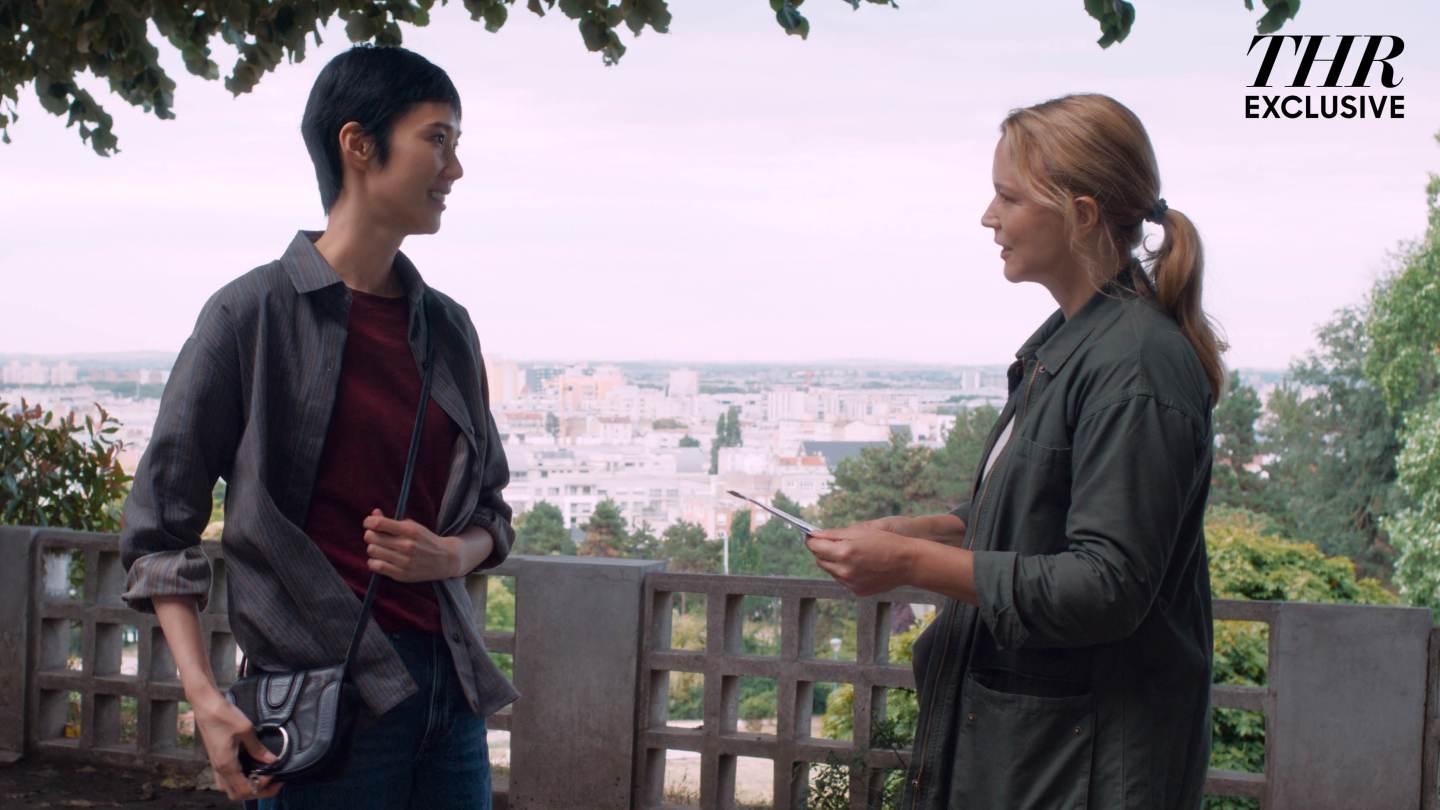
- Ryusuke Hamaguchi’s All of a Sudden premiered in Competition at the 2026 Cannes Film Festival
- The film stars Virginie Efira and Tao Okamoto as two women — a nursing home director and a terminally ill theater director — whose bond transforms both their lives
- At 3 hours and 16 minutes, it’s the longest film in Cannes’ Main Competition this year
- NEON will release the film in U.S. theaters later this year
- Both lead actresses say the shoot genuinely changed their lives
There is nothing sudden about All of a Sudden. Ryusuke Hamaguchi’s latest film — the longest entry in Competition at this year’s Cannes Film Festival at three hours and 16 minutes — unfolds at its own unhurried, deeply deliberate pace, and demands that you surrender to it completely. For those who can, the rewards are extraordinary.
The Drive My Car director has built a career on the radical idea that conversation is action. His films are dense with talk — long, winding, philosophically loaded talk — and All of a Sudden is perhaps the most ambitious expression of that instinct yet. Set primarily in a Paris memory care facility and loosely adapted from a nonfiction book of letters exchanged between a terminal breast cancer patient and a medical anthropologist, it weaves together a workplace drama, a meditation on mortality, a testament to female friendship, and a surprisingly rigorous critique of late-stage capitalism. That it manages to be emotionally devastating in the process feels like a small miracle.
Two Women, Two Languages, One Long Night
Virginie Efira plays Marie-Lou Fontaine, the director of a Paris nursing home called “The Garden of Freedom,” where she has been given unusual latitude to implement a Japanese care philosophy called Humanitude — a methodology that prioritizes dignity, eye contact, touch, and verticality, coaxing patients to walk rather than leaving them bedridden. Her progressive approach is constantly bumping up against the realities of chronic understaffing, institutional inertia, and the bottom-line logic of for-profit healthcare. The nurses who’ve been there longest, particularly outspoken senior nurse Sophie (Marie Bunel), aren’t simply resistant to change — they’re pragmatic professionals who know exactly how much time and money Humanitude costs and who worry about what happens when the afternoon shift inherits everything the morning shift couldn’t finish.
It’s a genuinely complex workplace dynamic, and Hamaguchi doesn’t stack the deck. The skeptics have a point. So does Marie-Lou. That tension is the film’s engine in its first hour, and it’s more absorbing than it might sound — though it does include a scene where a character delivers a casual lecture on demographic decline, complete with diagrams and bullet points on a whiteboard, that will either delight or test you depending on your tolerance for this kind of thing.
Then Marie-Lou spots an agitated nonverbal boy running alongside her tram through Paris, gets off, and follows him to a park. His name is Tomoki (Kodai Kurosaki), and his severe autism makes him prone to unpredictable behavior. When his guardians arrive — elderly actor Gorô (a wonderful Kyōzō Nagatsuka) and younger theater director Mari (Tao Okamoto) — they invite a visibly moved Marie-Lou to see their show.
The production, titled “Up Close, No One Is Normal,” is a one-man monologue about the Italian doctor who dismantled his country’s abusive psychiatric system. Gorô performs it while Tomoki runs onstage whenever the mood strikes, incorporated into the performance rather than removed from it. Marie-Lou stays for the post-show Q&A and asks, simply: “Do you think the impossible can be possible?” Mari says yes — and then, in Japanese, which most of the audience can’t understand, quietly adds that she has terminal cancer and was given six months to live a year ago. “I chose this subject because I needed courage for myself.”
What follows is the film’s magnificent center: a night-long walk and conversation between the two women, drifting through Paris and eventually back to the nursing home, talking about art, capitalism, Japanese social codes, mortality, and the strange blurring of work and life. Marie-Lou is fluent in Japanese — she studied anthropology in Tokyo, driven there by a love of Hayao Miyazaki and Isao Takahata, “even Pom Poko,” she insists. Mari is equally fluent in French, having studied philosophy at the Sorbonne. They switch languages freely, sometimes mid-thought. The camera, at one point, backs away and watches them from across a late-night street, as if respecting their privacy. When they finally leave a room they’ve been talking in for hours, Hamaguchi holds on the empty space for a few seconds, as if he expects them to return. He’d clearly like to.
The comparison to Before Sunset is obvious and apt. But where Linklater’s film is charged with romantic longing, Hamaguchi keeps things more ambiguous — not quite romantic, not quite not. The connection between Marie-Lou and Mari is described in the film as “almost spiritual,” and that feels right. What’s most interesting isn’t whether they’ll become lovers but the role that desire — for life, for meaning, for connection — continues to play in both their lives.
The Performances Are Quietly Extraordinary
Efira, who has been on a remarkable run in recent years (her work in Rebecca Zlotowski’s Other People’s Children is especially worth seeking out), brings a natural tenderness to Marie-Lou even in moments of friction and burnout. She’s a woman so committed to her work that she’s volunteered to live on the nursing home grounds, knowing full well she’ll be the first called for any emergency. Hamaguchi doesn’t entirely question that choice — he ultimately seems to support it — but Efira makes you feel the cost.
Okamoto, widely known in Hollywood for The Wolverine and Batman v Superman: Dawn of Justice, is a revelation here. Her Mari is tranquil without being saintly, dying without being a symbol of dying. There’s a suggestion throughout that she’s left wanting more from Marie-Lou — more time, more closeness, maybe more than that — and Okamoto keeps that longing present without ever letting the character tip into tragic archetype. Her performance is, as one review put it, “delicate and ethereal” while staying just on the right side of believability.
What’s remarkable is how much of that performance grew from genuine immersion. Okamoto spent twelve months preparing for the role, visiting cancer research centers and care facilities, learning French from scratch (she’d initially pretended she already knew it when she auditioned), and wrestling with Hamaguchi’s dense, philosophically layered script. She felt the pressure acutely. “I have been complimented before on how I can be aware of where the light is coming from, where the camera is without looking at it,” she says. “But he told me the first week, ‘Can you just forget that you’re acting?’ It was quite a challenge for me to cancel all these systems within myself.”
Efira, a César Award winner who met Hamaguchi for the first time at the Place de la Bastille in Paris, describes the encounter in characteristically vivid terms: “He has this attentiveness, this curiosity, and that puts you in sort of a trance. After we met, I was left there almost like I was drunk.” She came to the role without any Japanese, learning the basics for the part, and was struck by how thoroughly Hamaguchi prepared his actors — writing entire scenes that never appear in the finished film, purely to give the characters a shared history to draw from.
His process on set was equally demanding. A single conversation scene might take two full days to shoot — starting with one long tracking shot, breaking it into sections, returning to the master, then rehearsing what the next day would look like. The words had to be exact. The interpretation was entirely free. “If something goes wrong or you misunderstand or misreact at the 12th minute,” Efira explains, “we just start all over.”
The two actresses developed a real friendship over the two-month shoot that mirrors the bond between their characters — and both say the experience left a lasting mark. “Even though Virginie seems very confident and experienced, she was very nervous — it was so cute, she made me touch her heart, and it was beating like crazy,” Okamoto recalls of one of their earliest days. “She was also a real caretaker, on and off set.” Efira is equally direct: “It turns out the best summer of my life was in a nursing home, which I never expected. We all say that it changed our lives and I’ve never had this on any other set — and that’s not a promo line.”
Okamoto goes further: “It changed my life completely. I was scared of death as a child — it was one of my biggest fears, and something that I learned how to avoid thinking about growing up — and I had to face it again.”
A Film That Grows More Hopeful as It Moves Toward Death
The third act, set partly in Kyoto where Mari plans to check into a hospice, and partly back in Paris where Marie-Lou convinces her to return and take up a live-in artist-in-residence position at the care home, is deliberately foreboding and occasionally scattered. Hamaguchi doesn’t overplay his hand. He rarely does. Instead he trusts the accumulation — the way the scenes between Marie-Lou and her staff have grown increasingly freighted with feeling, the way Mari’s workshops begin to benefit the caregivers as much as the patients, the way a simple pot of noodles eaten on a Kyoto mountainside overlooking the city can feel like everything.
The film climaxes with a chaotic restaging of Gorô’s play, which elegantly demolishes the line between audience and participant — among other boundaries the film has been quietly working to dissolve. It’s a fitting ending for a movie so insistent on mixing things together: work and life, health and illness, friendship and love, the living and the dying.
The underlying argument — that separating these states too cleanly is exactly what allows capitalism to devalue both — is stated plainly by Mari in one of the film’s most striking scenes, a whiteboard lecture on systemic failures that Okamoto says was the moment she knew she had to take the role. “I don’t think I’ve ever seen any movie explain and verbalize the system of capitalism and where we are like this,” she says. It’s heady stuff, and the film is unashamed of its didactic streak. But Hamaguchi earns it.
All of a Sudden is not as viscerally overwhelming as Evil Does Not Exist, nor as emotionally rich as Drive My Car at its peak. At nearly three and a quarter hours, it will test even patient viewers. But it arrives at something those films don’t quite reach: a sustained, credible, hard-won hopefulness. A belief that care is a form of resistance, that all lives hold value no matter how diminished, that the impossible is only impossible until it isn’t.
As Marie-Lou puts it, standing beside a patient whose hand lies still in hers: “An inert hand is not a dead hand… there’s life until there’s not.”
NEON will release All of a Sudden in U.S. theaters later this year.
Filed in

Comments
0