
Adam Driver Shines in James Gray’s ‘Paper Tiger’ at Cannes
James Gray’s ‘Paper Tiger’ stars Adam Driver, Miles Teller, and Scarlett Johansson in a gripping Russian mob thriller that premiered at Cannes 2026.
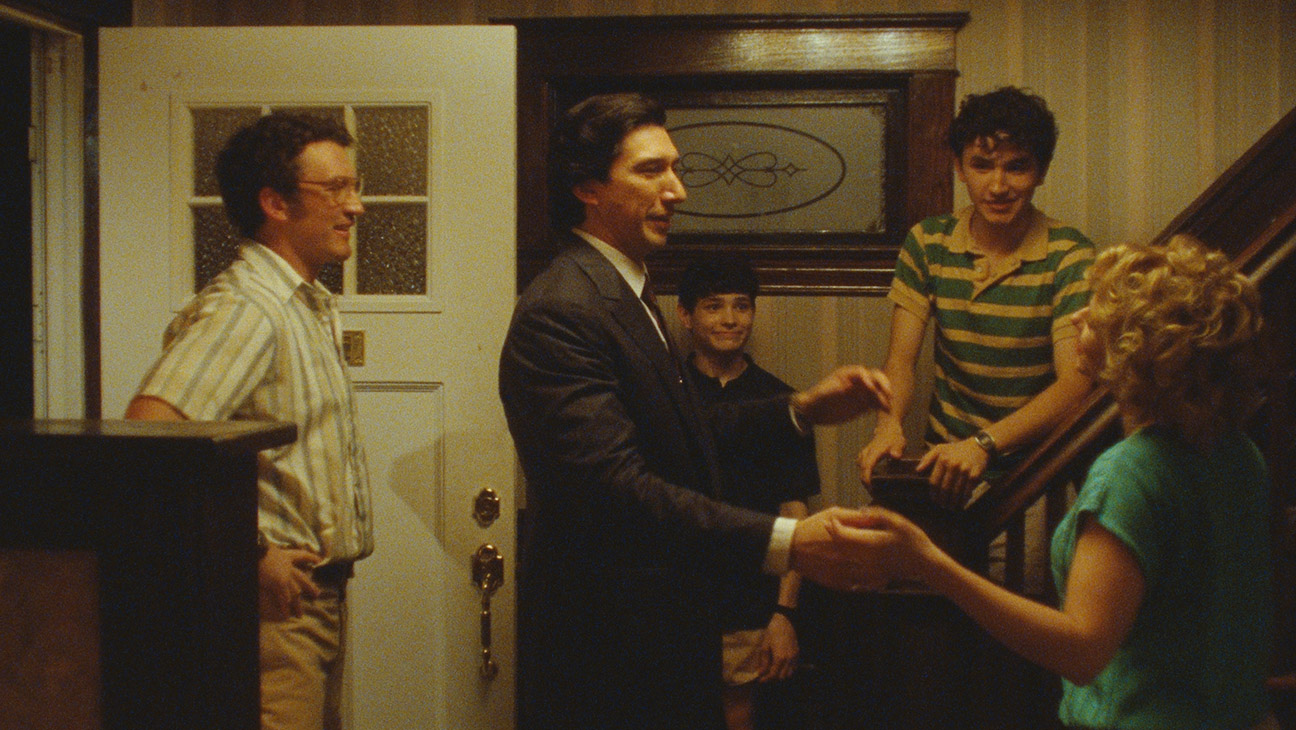
- James Gray’s Paper Tiger premiered in competition at the 2026 Cannes Film Festival on May 16
- Adam Driver, Miles Teller, and Scarlett Johansson star as a Queens family entangled with the Russian mob in 1986
- Driver is earning early awards buzz with critics calling it a career-best performance
- The film is a spiritual companion to Gray’s 2022 Armageddon Time, again rooted in the director’s own childhood
- NEON will release Paper Tiger in theaters later this year
James Gray brought Paper Tiger to the Grand Théâtre Lumière at Cannes on Saturday night, and if the reaction from critics is any indication, he may have finally made the film that earns him the Palme d’Or that has eluded him across six competition appearances at the festival. Adam Driver, Miles Teller, and Scarlett Johansson walked the red carpet alongside Gray — with Demi Moore, Cate Blanchett, Chloé Zhao, and Ruth Negga among the guests who turned out for the gala — and what they unveiled is a bruising, operatically intense crime drama that has already ignited one of the more spirited critical conversations of this year’s festival.
Set in 1986 Queens, Paper Tiger opens on Irwin Pearl (Teller), a mild-mannered reservoir engineer living a modest but decent life with his wife Hester (Johansson) and their two teenage sons, Scott (Gavin Goudey) and Ben (Roman Engel). The family is tight-knit, a little cash-strapped, and quietly anxious about the future — particularly whether Scott can realistically aim for an Ivy League school. Then Uncle Gary (Driver) shows up at the door with caterers from Peter Luger Steak House in tow, his ankle holster visible, his blue Mercedes parked out front, and a business proposition that sounds, at first, almost reasonable.
Gary, a divorced ex-cop who still has deep connections inside the NYPD, has gotten wind of a lucrative opportunity tied to the long-overdue cleanup of the Gowanus Canal — the notoriously polluted 1.8-mile stretch of Brooklyn waterway. He needs his brother’s engineering expertise to make the deal work. What he neglects to mention is that the other partners in this venture are the Russian mob.
The Brothers Pearl
The film’s emotional core is the relationship between these two brothers, and Gray — who has spent his career excavating fraternal strain in films like Little Odessa and The Yards — has never pulled at those ties more forcefully. Irwin isn’t blind to Gary’s flaws, exactly. He just can’t resist him. Teller plays the character with the wizened humility of a man who knows it would be gauche to forsake what his family sacrificed to make possible, while still feeling the quiet, corrosive sting of watching his flashier brother glide through a world that seems to have no place for a decent, hardworking engineer.
Driver, meanwhile, is earning the kind of reviews actors frame and hang on walls. His Gary is a vintage ’80s showboat who only knows how to show affection by offering to share in his apparent success — a calculated charmer whose bravado masks something more complicated and more desperate underneath. The tragedy of Paper Tiger, as several critics have noted, isn’t simply that getting mixed up with the mob tears these brothers apart. It’s that the danger pulls them closer together than they’ve been in years, forcing into the open an extraordinary bond that also happens to be the reason everything went so wrong in the first place.
“We’ve never played in the dirt,” Gary tells Irwin at one point, lying through his teeth about the Gowanus deal being above board. But they’re playing together now.
The Russians themselves — led by the thuggish Alexei (Yavor Vesselinov) and the genuinely terrifying mob boss Semion Bogoyavich (Victor Ptak) — are rendered without much ambiguity, which is somewhat by design. Gray plays up their ruthlessness to underscore just how far out of his depth Irwin truly is. The film’s most harrowing early sequence arrives when Irwin, in a moment of well-meaning naivety, drives his sons out to Brooklyn one school night to show them what their dad has gotten into — and witnesses the Russians illegally dumping waste into the canal. What follows is a stomach-churning confrontation: Irwin gets punched in the face in an office while a mobster climbs into the car with his boys and produces a stiletto. It’s the kind of scene that works precisely because it arrives so early, before the audience has had time to brace for it.
The logical response, of course, would be to walk away immediately. The fact that Irwin doesn’t — that he continues forward even after a knife has been held to his son’s face — is where some critics have found the film’s plausibility strained. The Russians subsequently inform the brothers that, due to Irwin’s “transgression,” they now owe $150,000. Gary’s reassurance that these men are a “paper tiger” — less dangerous than they appear — lands as either a profound act of self-deception or a reckless lie, and the film is more interested in the human cost of that choice than in making Gary’s psychology entirely legible.
Johansson’s Quiet Devastation
While the brothers spiral, Hester is quietly managing her own crisis. She’s been experiencing mental lapses and throbbing headaches, and the news she eventually receives from her doctor — that she may have as little as a year to live — she keeps entirely to herself, unwilling to add to the weight already crushing her family. It’s a performance Johansson has rarely matched: tough-edged and Queens-accented on the surface, but growing more hollowed out and heartsick with every scene. The moment she finally learns what Irwin and Gary have been hiding from her — the full scope of the danger her sons were put in — is, by most accounts, one of the film’s most shattering. Her rage and terror arriving simultaneously, without anywhere to go.
The film also features a standout set piece that’s already being described as among the finest sequences Gray has ever staged: a chase through a tall, deserted wheatfield as Gary tries to lose the Russians tailing him, shot both from within the maze of grass and from above, with a visual energy that recalls the crop-duster sequence in North by Northwest</em. Cinematographer Joaquin Baca-Asay — who shot We Own the Night and Two Lovers for Gray — works in 35mm, and the period textures of late-’80s New York are rendered with the kind of gritty specificity that makes the world feel genuinely inhabited rather than dressed. Christopher Spelman’s score, blending ominous orchestral swells with lugubrious Russian choral music, does the rest.
Gray’s Most Personal Film Yet
Paper Tiger was originally conceived as a more direct follow-up to Armageddon Time, with Anne Hathaway and Jeremy Strong set to reprise their roles as Gray’s parents. When scheduling conflicts caused both to drop out, Gray pivoted — casting Teller and Johansson in what are essentially heightened, fictionalized versions of the same figures, renamed Irwin and Hester (variations on his actual parents, Irving and Esther). The result is something he has described as closer in spirit to Little Odessa, his 1994 debut, lending the film what Hollywood Reporter called “a gratifying full-circle symmetry.”
The film opens with a quote from Aeschylus’ Agamemnon — “Let there be wealth without tears; enough for the wise man who will ask no further” — and Gray means it as both a warning and an elegy. The Ronald Reagan era, the film suggests, was a precise inflection point when wealth stopped being a goal and became an obsession, and the Pearl family is caught in that cultural undertow without quite knowing it.
“We already had everything,” Irwin will eventually murmur. The deepest cut of Paper Tiger is that, by the time he says it, he’s only just begun to understand what that meant.
Paper Tiger premiered in competition at the 2026 Cannes Film Festival. NEON will release it in theaters later this year.
Filed in

Comments
0