
Almodóvar: ‘Europe Must Never Be Subjected to Trump’
Pedro Almodóvar brought Cannes to its feet with a fiery call for artists to resist censorship — and a pointed message about Trump and democracy.
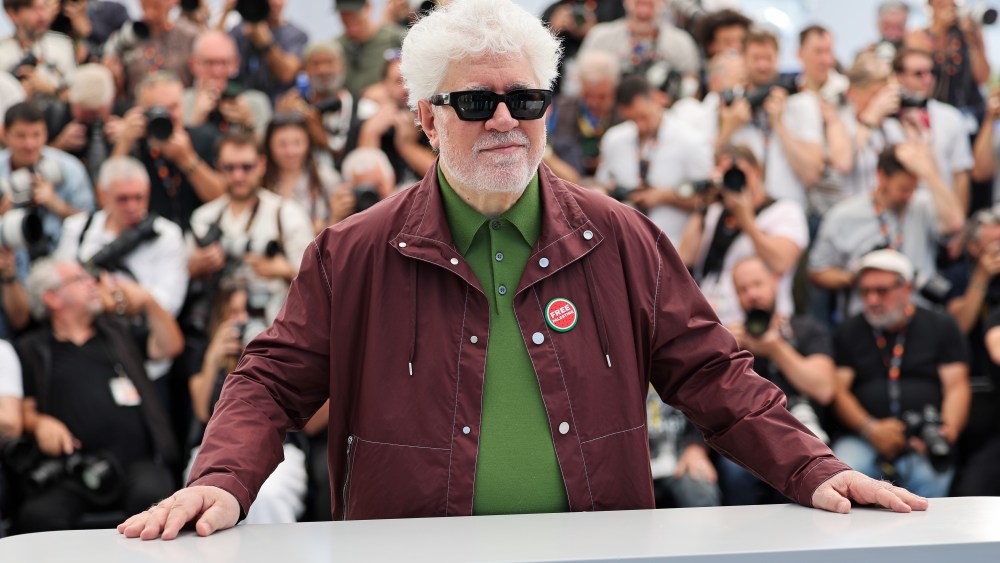
- Pedro Almodóvar declared “Europe must never be subjected to Trump” at his Cannes press conference, drawing loud applause from international press
- The director wore a “Free Palestine” pin and called speaking out a “moral duty” for all artists
- His comments came amid a growing controversy over Canal+ CEO Maxime Saada threatening to blacklist artists who signed an anti-Bolloré petition
- Over 600 industry figures, including Juliette Binoche, signed the petition warning of a “fascist takeover” of French film
- Almodóvar’s new film Bitter Christmas received a standing ovation at its Cannes world premiere
Pedro Almodóvar didn’t come to Cannes to stay quiet. At Wednesday’s press conference for his new film Bitter Christmas, the Oscar-winning Spanish director brought a room full of international journalists to their feet with a declaration that’s already echoing well beyond the Croisette: “Europe must never be subjected to Trump!”
The applause was immediate and thunderous.
Almodóvar was responding to a question about two converging crises — the political climate in the U.S. under Trump, and a very French controversy involving Canal+, the country’s premier pay-TV channel. He was wearing a “Free Palestine” pin as he spoke.
“I don’t want to judge anyone, but I think artists have to speak out about the situation in which they live in contemporary society. It’s a moral duty,” he said. “Silence and fear is a symptom that things are going badly. It’s a serious sign democracy is crumbling. On the contrary, creators must speak out… the worst thing that could happen would be to remain silent or to be censored. We have a moral obligation to speak out.”
He went further, urging fellow artists to “act as a shield against this madness” — and specifically named Netanyahu alongside Trump as targets of that resistance. “We need to turn against Netanyahu. In Europe, we have laws, there are certain limits.”
The Canal+ Controversy Fueling the Fire
The Canal+ situation has been a slow-burning crisis that finally ignited at this year’s festival. On opening day, May 12, more than 600 members of the French film industry — including Juliette Binoche, Adèle Haenel, Cannes contenders Arthur Harari and Bertrand Mandico, and Anatomy of a Fall actor Swann Arlaud — signed an open letter published in the newspaper Libération. The letter warned that right-wing media mogul Vincent Bolloré’s growing stranglehold over French entertainment — he owns Canal+, its production arm Studiocanal, and is now in the process of acquiring UGC, France’s third-largest cinema chain — risked becoming a “fascist takeover of the collective imagination.”
The response from Canal+ was swift and chilling. CEO Maxime Saada announced at a Cannes producers’ brunch that the network would essentially refuse to work with anyone who’d signed the petition. “I don’t want to work with people who call us crypto-fascists,” Saada said. It’s the kind of statement that turns an industry dispute into something that feels much larger — and it’s why audiences at this year’s Cannes have been booing the Canal+ logo before screenings, every single day.
The parallel to what’s happening in the U.S. is hard to miss. Bolloré’s consolidation of French film — from production to distribution to exhibition — mirrors the kind of media concentration playing out stateside with David Ellison’s Paramount-Skydance deal and the ongoing Warner Bros. Discovery situation. One crisis on each side of the Atlantic, the same underlying anxiety about who gets to control the stories we tell.
Almodóvar Has Been Saying This for a While
Wednesday’s press conference wasn’t a sudden breaking point for Almodóvar — it was the latest in a string of increasingly direct statements. Ahead of the festival, he told the Los Angeles Times that he was struck by how muted this year’s Oscars felt politically. “It was quite notable watching the Oscar telecast where there were not many protests against the war or against Trump,” he said. “The only real example I can remember came from a European, a friend of mine, Javier Bardem, who did directly say, ‘Free Palestine.’”
“People are obviously very frightened,” he continued. “The U.S. is not a democracy right now. Some people say it’s maybe an imperfect democracy, but I really don’t think the U.S. is a democracy right now. The heartbreaking and ironic thing is that democracy has given rise, through the proper, right voting mechanism, to this kind of totalitarian regime. And it’s both a paradox and it’s also incredibly sad.”
When the LA Times asked whether he worries that speaking out could hurt his career, his answer was immediate: “Not at all.” He credited both his nationality and his position outside Hollywood for giving him the freedom to be direct. “In a generalized Spanish sense, here we’re not afraid to call things for what they are,” he said. “It’s easier for me to be clear” because he works outside the American industry’s orbit.
He’s been consistent. Back in 2025, while accepting the Chaplin Award at Lincoln Center in New York, he described America as “ruled by a narcissistic authority, who doesn’t respect human rights” — and later said Trump would be remembered as a “catastrophe.”
A New Film, and a New Direction
Bitter Christmas, which received a standing ovation — reports clocked it at somewhere between six and seven minutes — at its world premiere Tuesday night, is Almodóvar’s eighth film in competition at Cannes. It tells two parallel stories: one following a successful writer-director named Raúl Rossetti (Leonardo Sbaraglia) who’s hit a wall creatively, and another set 22 years earlier involving a filmmaker named Elsa (Bárbara Lennie), who’s abandoned features for advertising after a string of flops. The two timelines may or may not be connected.
For Almodóvar, it’s also something of a turning point. “I want to discover a universe that’s different from my own. I would like to change direction and paths,” he said at the press conference. “This is the last film about myself.”
He’s won at Cannes before — best director for All About My Mother in 1999, best screenplay for Volver in 2006. Whether Bitter Christmas adds to that tally remains to be seen. But right now, it’s his voice off-screen that has the festival talking.
Filed in

Comments
0