
Sally Field and a Scene-Stealing Octopus Make Netflix’s ‘Remarkably Bright Creatures’ Worth the Cry
Sally Field, Lewis Pullman, and Alfred Molina’s voice bring Shelby Van Pelt’s beloved novel to life in Netflix’s tearful, warm-hearted new drama.
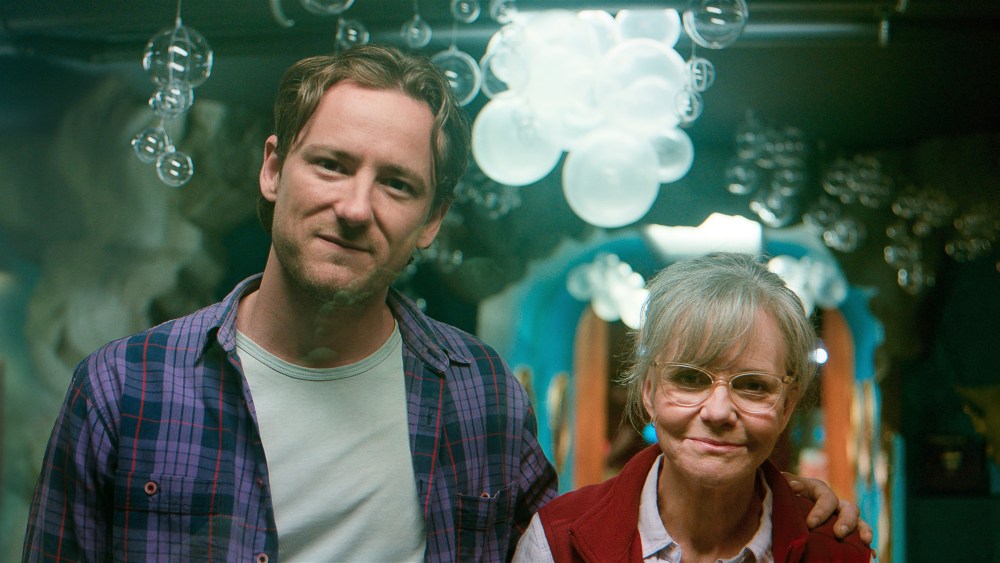
- Remarkably Bright Creatures begins streaming on Netflix on May 8, based on Shelby Van Pelt’s bestselling 2022 novel
- Sally Field stars as Tova, a grieving widow who bonds with a giant Pacific octopus named Marcellus, voiced by Alfred Molina
- Lewis Pullman plays Cameron, a drifter searching for his father whose path becomes unexpectedly intertwined with Tova’s
- Field, 79, was involved with the project before the book even hit shelves — and says it took years to get the screenplay right
- Critics are largely warm on the film, praising Field and Pullman’s chemistry even where they find the plot mechanics contrived
Sally Field has been making audiences cry for over six decades. With Remarkably Bright Creatures, Netflix is banking on her doing it one more time — and from the sound of it, she delivers.
The film, which begins streaming Friday, is an adaptation of Shelby Van Pelt’s beloved 2022 novel, which spent more than 64 weeks on the New York Times bestseller list and became a quiet phenomenon in book clubs everywhere. It’s the kind of story that sounds almost aggressively whimsical on paper: a lonely 70-year-old widow named Tova (Field) cleans an aquarium at night and pours her heart out to a giant Pacific octopus named Marcellus, who happens to be voiced by Alfred Molina and happens to be narrating the whole thing. A scruffy drifter named Cameron (Lewis Pullman) blows into town, takes a temp job at the aquarium, and slowly, inevitably, becomes something like family to her.
Don’t worry — the octopus doesn’t talk to them. Just to us.
Director Olivia Newman, who previously adapted Where the Crawdads Sing, brings the same affectionate, soft-touch sensibility to Van Pelt’s material here. Co-written with John Whittington, the screenplay makes smart, purposeful trims from the source novel — losing some backstory and secondary characters, but keeping the emotional core intact and arguably sharpening it for the screen.
Sally Field Fought to Get This Made
Field, now 79, didn’t just sign on to star — she was one of the first people to believe in this story. “It came to me very early in galleys of the book,” she said in a recent interview. “I read a few chapters and said, ‘Yeah, let’s find a way to set this up and get it made.’ But it was a long haul to get it to where it is and to get the screenplay right because it’s a wonderful and complicated little book and all of the pieces had to be in place. You can’t lose the magic.”
For Field, the appeal wasn’t just a great role — though it is that. It was what the story was actually about. “It’s an homage to ocean creatures and to creatures altogether,” she said. “Human beings have an extraordinary connection to creatures. We’re ruining our oceans. We’re ruining the planet. We’re killing each other. Is anything good happening? I don’t know. But in this little movie, there are some good things happening and that’s nice to do in the midst of everything.”
She also connected to Tova in a way that felt personal. During the pandemic, Field got a puppy — a tiny dog named Dashiell Hammett, Dash for short — and found herself understanding for the first time the kind of bond that forms between a lonely person and an animal that can’t talk back but somehow listens anyway. “The story of Marcellus and Tova and how important Marcellus is to Tova resonated in me,” she said.
This is Field’s most substantial leading role since Hello, My Name Is Doris in 2015, and she’s said openly that finding good parts at her age is genuinely difficult. “It’s very hard to find stories that are worth telling,” she acknowledged. “There are more and more roles now for women, but are they better roles? How many of them are really complicated, interesting characters?” Tova, she felt, was one of them — a woman dealing with aloneness, grief, friendship, loss, and healing. Not just looking for a date.
What the Critics Are Saying
Reviews are largely warm, with a few reservations about the plot’s more mechanical contrivances. The consensus seems to be: the film earns its tears, even when it’s working a little too hard to set them up.
The Hollywood Reporter called it “as cozy as an old woolen blanket, as sweet as a mug of hot chocolate,” praising Field as “unsurprisingly fantastic” and singling out a third-act monologue in which Tova cracks open her deepest wounds as “a stunner” — noting that “sniffles rang out across my entire theater.” Pullman, the piece noted, has a rare gift as a scene partner: “Whether Cameron is listening intently to Tova or trying to tune her out, both stars are so attuned to their energy together that you cannot help but feel it under your own skin.”
IndieWire was similarly taken, calling it “a cozy little drama with twists and turns that feel both inevitable and delightful” and praising the adaptation for actually doing the work of adaptation rather than just transcribing the novel. “Taking the best parts of a sweet story, and paring it down to its best bits” is how they put it.
Deadline called it “a warm and rather wonderfully old fashioned movie winner” and predicted flatly: “There won’t be a dry eye in the house.” They also noted that Field’s performance requires “some heavy emotional bridges to cross as well as a light touch” — and that she navigates all of it with the ease of someone who has been doing this for 62 years.
Variety was more measured, acknowledging the film’s pleasures while pushing back on its plotting. The script, they wrote, is “a hokey pileup of intersecting destinies and cornball coincidence,” and the secondary characters — including Joan Chen and Kathy Baker as Tova’s friends — feel “wholly wasted” and “more sitcom-like than convincingly lived-in.” They also noted that the more the film leans on Molina’s voiceover to deliver late revelations, the more it strains credulity, effectively turning Marcellus into what they memorably called an “all-out deus ex mollusca.”
But even Variety conceded that Field and Pullman “spark off each other to amiable and spontaneous effect” — and that fans of the novel “should find the film on point in all departments.”
The Octopus in the Room
Marcellus is a giant Pacific octopus — rust-colored, CGI-rendered with impressive heft and personality by the effects team at Untold Studios — who has spent the last several years in captivity at the Sowell Bay Aquarium near Puget Sound. He is, by his own estimation, vastly superior to humans in every measurable way. He has nine brains, three hearts, and 360-degree vision. He has figured out how to escape his tank, snack on fellow aquarium residents, and return undetected. He is, as Molina voices him, wry, world-weary, and occasionally devastating in his assessments of the people he watches through the glass.
He is also, in his own way, dying — aging out of the years an octopus typically gets — which gives the film a quiet ticking clock that runs beneath the warmer human storyline.
Netflix, it’s worth noting, also distributed My Octopus Teacher, the 2020 documentary that won the Oscar for Best Documentary Feature and made an unexpected cultural splash during the early pandemic. Remarkably Bright Creatures is a very different kind of octopus story — fictional, sentimental, explicitly designed to make you cry — but it’s landing on the same platform that made the world briefly obsessed with cephalopod intelligence. Whether that’s coincidence or programming strategy, it’s a good fit.
Field, for her part, has been careful not to give away too much about how Marcellus was brought to life on screen. “I won’t say,” she said when asked. “It’s extraordinary what these guys did, but I won’t say so much because it spoils the magic.”
Field and Pullman: An Unlikely Pair That Works
Field had never met Lewis Pullman before this film, though she knew his father well. She and Bill Pullman had worked together on stage at the Old Vic in London — “a glorious time,” she called it — and she says there’s a reason Lewis is as good as he is. “Bill is such a wonderful actor and man to stand across from the stage. I couldn’t have asked for a better human being.”
The chemistry between Field and Pullman that critics keep pointing to wasn’t entirely scripted. Field says much of what you see between Tova and Cameron grew out of improvisation. “We’d had a brief meeting where he and I began to improv,” she said. “A lot of what you see between the two of them is just improv. It’s me being Tova and him being Cameron.”
Pullman plays Cameron as a perpetual drifter — broke, living out of a battered camper, convinced his unknown father is somewhere in this small Washington town and possibly wealthy enough to change his life. He’s not great at the aquarium job. He is, however, good at showing up for Tova in the small ways that matter, fixing things around her house, listening when she talks. The surrogate mother-son dynamic that develops is, as the Hollywood Reporter put it, “as inevitable as the ebb and flow of the tides” — but inevitable in the best way, the kind where you know where you’re going and you enjoy the trip anyway.
The supporting cast rounds things out with Colm Meaney as a lovelorn local shopkeeper who approaches Tova like she’s a bird he’s afraid of startling, and Sofia Black-D’Elia as Cameron’s sharp, funny love interest Avery — a paddleboard shop owner who gets some of the film’s best lines and, most critics agree, deserved more screen time.
The film was shot largely in Vancouver, Canada — “magnificent Canada,” Field said, with feeling — with one night of filming at an actual aquarium there for the larger tank sequences, and the rest built on a stage.
As for what’s next for Field after this: she’s thinking about the stage. “I’m months away from being 80,” she said. “My next project is on stage, but I’m waiting to see what happens with that.” For now, though, she has this — a film she championed for years, built around a character she had to work to find, opposite a co-star she improvised her way into a relationship with, and an octopus who, in his own cranky, superior way, holds it all together.
“Whatever they want,” Field said when asked what she hopes audiences take from Remarkably Bright Creatures. “You can’t think about that. You have to do the work and let the pieces fall where they may.”
Filed in

Comments
0