
Venice Biennale 2026: Art, Politics, and Protest
The 61st Venice Biennale is as much about what’s missing as what’s on display — withdrawn nations, a fractured jury, and art that refuses to look away.
- The 61st Venice Biennale, themed “In Minor Keys,” opened to the public May 9, 2026
- Geopolitical tensions dominated the week, with withdrawn countries and a fractured jury making headlines alongside the art
- South Africa cancelled its pavilion artist over her tribute to a murdered Palestinian poet, forcing her to find an alternative venue
- The U.S. pavilion notably avoided the public amid protest fears, while the Holy See pavilion drew widespread praise
- Standout works ranged from Japan’s interactive baby doll installation to a Belarus dissident theatre piece featuring a surveillance crucifix
The story of this year’s Venice Biennale isn’t only told in paint and performance. It’s told in empty pavilions, last-minute relocations, and the charged silence of things left unsaid. The 61st edition of the world’s oldest international art exhibition — themed “In Minor Keys” — opened to the public on May 9, and from the very first preview days, it was clear this would be a Biennale defined as much by absence as by presence.
Withdrawn countries. A fractured jury. A geopolitical atmosphere that made the Giardini feel less like a garden party and more like a diplomatic flashpoint. As Al Jazeera correspondent Karly Abou Samra put it, the event has become “a stage for geopolitical tension.”
The Pavilions That Made the Week
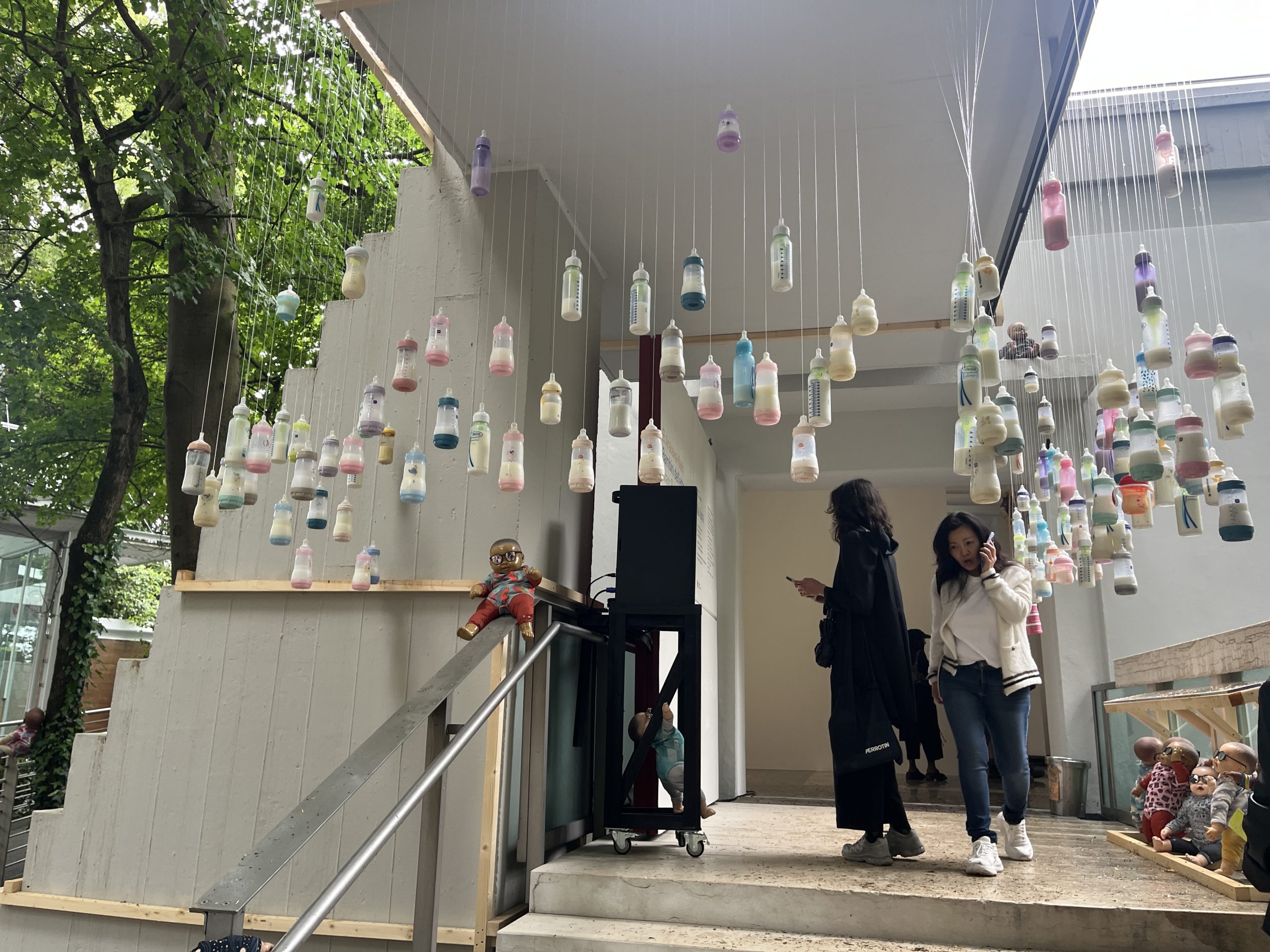
Amid the noise, some of the most talked-about moments came from unexpected places. The Japan Pavilion — titled Grass Babies, Moon Babies (2026) by artist Ei Arakawa-Nash — was, by multiple accounts, a genuine oasis. Milk bottles lined the entrance. Inside, 208 baby dolls in colorful onesies and tiny sunglasses hung from ropes and perched on metal scaffolding, with a few positioned in front of a large screen, watching. Visitors could pick up a doll, carry it upstairs, and change its diaper — inside which a QR code led to a poem to read aloud to the doll. Then you’d send it back down in a basket via rope pulley.
It sounds absurd. It wasn’t. Each doll weighs around 6 kilograms — about 13 pounds, the size of a real four-month-old — and something about the weight of it, the slowness it required, transformed people. On opening day, one couple actually used the changing stations (the only ones available anywhere on the Biennale grounds) to change their real baby’s nappy. Everyone, reportedly, slowed down and smiled.
The Holy See Pavilion was another standout — and a genuinely surprising one. Explicitly inspired by Pope Leo’s Rosary for Peace address on April 11, the pavilion asked visitors to walk through a beautifully tended herb and flower garden wearing headphones playing choral music by Saint Hildegard of Bingen, reinterpreted by an eclectic roster of collaborators: Precious Okoyomon, Matt Dryhurst and Holly Herndon, Brian Eno, FKA Twigs, and Patti Smith, whose contribution involved reading from Hildegard — leaning into the erotic dimensions of her descriptions of the Virgin’s impregnation. The music shifted seamlessly as visitors moved through the space, engineered to blend from one collaborator to the next.
This all landed against a very specific backdrop: a public feud between the Pope and the U.S. President that had been playing out in the weeks prior. The U.S. pavilion, meanwhile, reportedly avoided opening to the public altogether, apparently wary of protests. The contrast was hard to miss.
The Art That Had to Fight to Be Seen
The most politically charged story of the week belonged to South African artist Gabrielle Goliath, whose performance piece Elegy — a sustained, rotating single note held by multiple singers over the course of an hour, mourning the ongoing loss of Black, brown, female, and queer lives — ended up in a Venice church after Goliath was abruptly dropped as South Africa’s pavilion artist. The reason: her tribute to Hiba Abu Nada, a Palestinian poet killed during the conflict in Gaza, which South Africa’s culture minister called “divisive.”
Far from the main grounds, in a space built for contemplation, Elegy found what may have been its ideal home. One section honoring two anonymous Nama women killed more than a century ago in the Ovaherero and Nama Genocide was described as an “aching, soulful lament” — the kind of remembrance that, without art, might never happen at all.
Across town, in a church in San Polo, the Belarus Free Theatre offered something equally confrontational. Their installation — which you had to physically navigate past a towering “surveillance crucifix” covered in CCTV cameras to fully experience — ended at a confessional booth where a biometric scan determined whether you were a threat to the regime. It was darkly funny and genuinely unsettling, and it was doing something that much of the main exhibition, by many accounts, was not: dealing directly with authoritarian power.
The contrast with the official Giardini was pointed. Russia’s pavilion, per reports from the grounds, hosted a vodka bar.
The Performances and the Bigger Picture
Also making waves during preview week: Ghanaian artist Bernard Akoi-Jackson, who presented Untitled: Flaggings IN on May 9 as part of the 1922 Revisited program, in partnership with the European Cultural Centre. The performance — described as a series of processional gestures, fictive liturgical invocations, and collective acts of re-membering — draws on what Akoi-Jackson calls “disturbed methodologies,” a framework for examining postcolonial and decolonial conditions. Trained in painting and sculpture at Kwame Nkrumah University of Science and Technology in Kumasi, he also appears in the Biennale’s invitational exhibition as part of the Ghana-based collective blaxTARLINES Kumasi.
Then there was Indian photographer Dayanita Singh’s exhibition at the State Archives of Venice — 25 years of tender, intimate black-and-white images made in Italy, arranged as freestanding columns of 20 prints each, set inside an archive that spans over eight centuries of Venetian history. Singh, 65, plans to reconfigure the arrangements as the show travels to Rome, Turin, and New Delhi — the work shifting, as she put it, like memory itself.
And one more: an unnamed aquatic performance piece that featured nude women on jet skis, trick archers, exploding sewage stations, a woman used as a bell clapper — and, yes, the harvesting of audience pee. Chaotic in description, apparently brilliant in execution.
What ties all of it together, the quiet and the loud, the cancelled and the celebrated, is the sense that this Biennale is asking a question it can’t quite answer: what is art supposed to do when the world outside the gallery is this fractured? The most honest answer on offer, it seems, came not from the grandest pavilions but from the ones that had to fight hardest to exist at all.
Filed in

Comments
0