
How Euphoria Built That Insane Sydney Sweeney Giant Scene
Euphoria’s Cassie-zilla sequence took a year to build and almost no CGI. Here’s how Sam Levinson pulled off the most ambitious scene of Season 3.
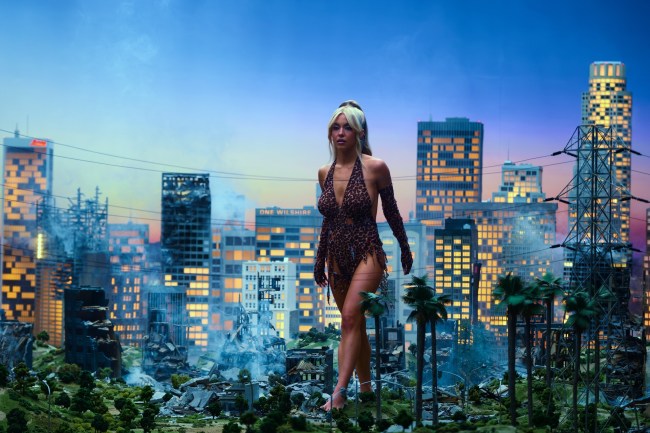
- Euphoria Season 3, Episode 5 features a fantasy sequence where Cassie (Sydney Sweeney) grows to Godzilla-size and stomps through a miniature Los Angeles.
- The sequence was inspired by the 1958 cult film Attack of the 50 Foot Woman and the classic Godzilla franchise, using practical miniature effects over CGI.
- Production designer François Audouy and VFX supervisor David Van Dyke built a 90-foot Translight backdrop and forced-perspective miniature city that took nearly a year to construct.
- Much of Euphoria Season 3 was shot on 65mm film, giving the sequence an old Hollywood texture that mirrors Cassie’s larger-than-life interior world.
- Fans have been divided — wowed by the technical ambition but questioning what the sequence actually reveals about Cassie as a character.
It’s one of the most technically ambitious sequences HBO has put on screen in years — and it involves Sydney Sweeney in a leopard-print outfit bursting at the seams before she grows into a rampaging giantess and stomps through downtown Los Angeles. Welcome to Euphoria Season 3.
The sequence arrives in Episode 5, “This Little Piggy,” and it’s a fantasy rooted in Cassie Howard’s exploding OnlyFans fame. After a montage of Cassie and her best friend-turned-aspiring-manager Maddy Perez (Alexa Demie) filming content together, the show pivots into full kaiju territory — Cassie growing larger and larger until she’s towering over a cartoonishly small version of Los Angeles, notifications pouring in and the whole city at her feet. She eventually presses herself against an office building window, where a man inside is, let’s say, very actively engaged with one of her videos. The window shatters. The man’s fate is left to the imagination.
It’s wild. It’s audacious. And almost none of it was done with computers.
A Year in the Making — Built the Old-Fashioned Way
“It was a lot of fun. It took about a year to build all the miniatures,” series creator Sam Levinson said in a behind-the-scenes video released by HBO. That timeline makes sense once you understand the scale of what was constructed. Production designer François Audouy worked with J.C. Backings to build a 90-foot Translight — essentially a massive photographic backdrop — that covered the entire rear wall of the soundstage. In front of it, model builders from John Merritt Productions constructed a miniature downtown Los Angeles, complete with the Eastern Columbia Building and a recreation of the Orpheum Theatre sign, fitted with thousands of tiny incandescent bulbs. “The smallest incandescent bulbs that are made,” Audouy noted.
Merritt Productions isn’t a newcomer to this kind of work — their credits include Kill Bill, Speed, and Dick Tracy. But this sort of assignment has become genuinely rare in the age of digital effects. “It was really amazing to work with a team of model builders who don’t get asked to do this kind of stuff anymore,” Audouy said. “They’re like the last knights of another era.”
The inspiration came straight from the history books of genre filmmaking. Levinson and his team looked to the 1958 cult classic Attack of the 50 Foot Woman, the 1961 kaiju landmark Mothra, and the broader Japanese Tokusatsu tradition. “In Japan, there’s this Tokusatsu miniature tradition that started in the late 1950s with ‘Godzilla,’” Audouy explained. “They continued creating these city destruction miniatures for decades, in movie after movie, and we looked at some of those movies for inspiration.”
The Physics of Making a Giant Woman Look Real
Getting Sweeney to convincingly tower over a miniature city required solving some genuinely complicated mathematical problems. The miniature set was built in forced perspective — foreground buildings at 1/24 scale, background structures at 1/48 scale, with certain close-up shots requiring 1/12 scale elements. “When you’re mixing scales and things like that from shot to shot, it requires a lot of complicated physics,” Audouy said.
Visual effects supervisor David Van Dyke approached his role less as a digital artist and more as a physical one — layering in practical elements like smoke, explosions, and tiny model helicopters to give the sequence depth and texture. For a shot where a man in an office watches Cassie’s video as she looms outside, Van Dyke had to align two separately shot plates with different frame rates. The office footage ran at a standard rate; the plate of Cassie approaching was shot at a higher frame rate to give her movement more gravity and weight.
The entire miniature set was built on wheels, so rather than moving the camera between setups, the crew could simply rotate the set itself. It was a choreographic challenge that cinematographer Marcell Rév — who shot much of Season 3 on 65mm celluloid — and the show’s ADs had to execute with precision. The whole sequence, months in the making, was captured in just a couple of days of actual shooting.
Then there’s the moment that apparently came together almost at the last minute: Cassie pressing her chest through the glass window. Levinson and Sweeney brought the idea to Audouy late in pre-production, which sent KNB EFX Group’s Mark Byers scrambling to sculpt a giant chest appliance the old-fashioned way. “Mark put the whole thing on a sled and timed it so that when the rig hit the glass, the glass was squibbed to shatter at exactly that moment,” Audouy said. “KNB sculpted it the old-fashioned way and did a terrific job.”
Style With a Purpose — At Least According to the Crew
For Van Dyke, the most satisfying part of the whole endeavor was that the methodology wasn’t just an aesthetic choice — it felt narratively justified. “Sometimes people want to use miniatures just because they think it’s ‘neat,’ but there’s no real meaning behind it,” he said. “When François and I read this, it just made a lot of sense; it was exciting. When I do effects, I want to know what I’m doing and why I’m doing it.”
Audouy framed it the same way. “Cassie’s inner life is one of the most heightened things on the show,” he said, “so going back to an old Hollywood craft tradition was a way to lean into her storyline.” Van Dyke agreed: “It really gives it a natural cinema feel, an old Hollywood feel that fits in with the rest of the show.”
The sequence does fit within a broader Euphoria tradition of using surreal fantasy to externalize a character’s psychology — think Rue’s (Zendaya) recurring vision of herself as a private detective, or the musical number that closed out her Season 1 relapse. Cassie’s Godzilla moment is the first time Season 3 has gone fully into that territory, and it’s technically the most ambitious version of it the show has ever attempted.
What Fans Actually Think
Online reaction has been… split. The craftsmanship is getting its flowers — viewers are genuinely impressed by how tactile and cinematic the sequence looks, especially for a TV production. But a vocal contingent is asking whether the spectacle is doing enough work. The imagery — woman becomes famous online, woman becomes literal giant — is being called out for being on the nose, and some critics have noted that the sequence is sandwiched within a hypersexualized content montage that doesn’t do much to develop Cassie beyond her current status as a fame-hungry caricature.
It’s a fair tension. The sequence is extraordinary filmmaking in service of a character whose arc, so far this season, hasn’t quite matched the ambition of the craft surrounding it. Whether Episode 5 marks a turning point for Cassie — or just a very expensive metaphor — is a question Euphoria still has time to answer.
New episodes of Euphoria Season 3 air Sundays at 9 p.m. ET on HBO and Max.
Filed in

Comments
0