
Paul Dano and Jude Law in The Wizard of the Kremlin
Paul Dano and Jude Law star in Olivier Assayas’ chilling new film about Putin’s rise — and why it feels uncomfortably familiar to American audiences.
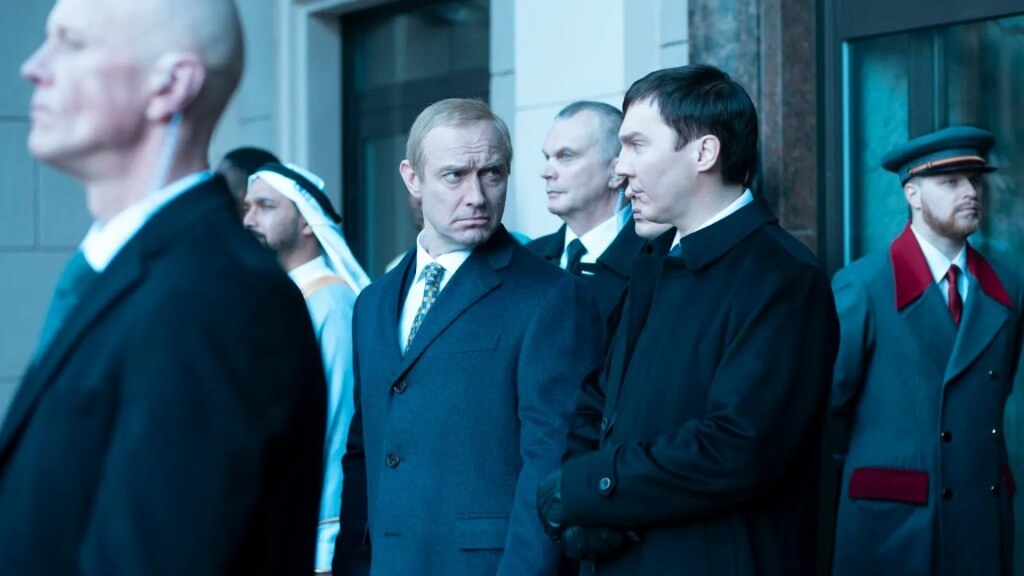
- The Wizard of the Kremlin stars Paul Dano and Jude Law in Olivier Assayas’ fictionalized account of Putin’s rise to power
- Dano plays Vadim Baranov, based on real-life Putin advisor Vladislav Surkov, the shadowy spin doctor behind “Putinism”
- The film is adapted from Giuliano da Empoli’s Italian novel and runs 130 minutes, structured in miniseries-like chapters
- Dano appeared on The Daily Show to discuss the film’s eerie parallels to modern American political tactics
- Alicia Vikander and Jeffrey Wright round out a cast in what critics are calling a quietly chilling political drama
There’s a scene in The Wizard of the Kremlin where Paul Dano’s character has to physically tie Boris Yeltsin to a wooden chair to keep him upright for a televised address. It’s darkly funny. It’s also terrifying. And it might be the film’s most efficient summary of what director Olivier Assayas is doing across 130 carefully calibrated minutes — showing us exactly how power gets manufactured, packaged, and sold, one controlled image at a time.
The film, adapted from Giuliano da Empoli’s novel, centers on Vadim Baranov, a fictionalized version of Vladislav Surkov — the real-life political operative who served as Vladimir Putin’s chief ideological architect until 2020 and played a key role in advising Putin during the 2014 annexation of Crimea. Baranov starts as an avant-garde theater director, a creature of the artistic underground, before discovering that his talent for shaping perception has a far more powerful application: building a president.
A Different Kind of Power Player
Dano plays Baranov with a deliberate, almost unsettling softness. You find yourself leaning in to catch what he’s saying — which, it turns out, is entirely the point. “Most men of power get their aura from the position they hold,” Jeffrey Wright’s Western journalist character Rowland observes early on. “When they lose it, it’s like a plug has been pulled. Baranov was a different breed.”
Wright’s Rowland arrives at Baranov’s snow-blanketed dacha having originally come to Russia to research Yevgeny Zamyatin, author of the dystopian novel We. What he finds instead is Zamyatin’s nightmare made flesh — and a man willing to explain, with sardonic candor, exactly how it happened.
Baranov’s recollections are delivered like confessions from someone who has never quite felt guilty. He laughs at Gorbachev. He describes the so-called “New Russians” of that era as cocaine-crazed greed merchants. “The Soviet system was based on privilege, not cash,” he tells Rowland — a distinction that mattered enormously in what came next. And what came next was Putin.
Jude Law as the Man Himself
Jude Law plays Putin as an operator whose wheels never stop turning. The film captures him as someone Baranov initially identifies as an apt pupil — disciplined, unreadable, strategically ascetic. In one telling scene, the two dine at an upscale restaurant and Putin ignores the menu entirely, ordering a simple bowl of kasha. “Two,” Baranov says. It’s a small moment that lands like a statement of philosophy.
Assayas’ film has been compared to a mash-up of Soderbergh’s Che and Scorsese’s Goodfellas — only with the volume dialed from eleven down to about four. That deliberate quietness is a choice, and a meaningful one. This is a story about how catastrophes are engineered not through screaming but through the careful, patient manipulation of reality itself.
Alicia Vikander appears as Kesenya, Baranov’s only real romantic attachment — a woman he first encounters doing a punk-rock performance piece who turns out to believe in neither punk nor performance art, but was simply using it to distract the KGB. Vikander plays her across three distinct appearances in the film, each one a different version of the same disillusionment. Tom Sturridge also turns up in what critics have called one of the film’s most quietly devastating supporting turns — a former comrade who backs himself into an inescapable corner.
The Mirror It Holds Up to America
When Dano appeared on The Daily Show with host Jordan Klepper this week to promote the film, the conversation went exactly where you’d expect it to — and Dano didn’t dodge it.
“I think in some ways, the film is about complicity,” Dano said. “This is where this person was rewarded and given power, so this is what I will do.” He described being genuinely disturbed by the tactics depicted in the film. “One of the ones that really struck a note with me as an American was this idea of consciously creating chaos because then you need a strong figure in the middle. Years later, now we have heard Steve Bannon use the term ‘muzzle velocity,’ because they are just going to come at you so fast that we can’t do anything about it. So I think there is a pretty big mirror held up in this film, not just to Russia, but to the world at large.”
Klepper, for his part, framed Baranov as “the Rasputin to Vladimir Putin” — a man who goes from avant-garde theater to becoming, as he put it, “an amoral device of the state.”
The film never mentions Donald Trump by name. It doesn’t need to. The parallels Assayas is drawing — between the hypernormalization of Russian political life in the 1990s and the disinformation ecosystems that have taken root in Western democracies — are embedded in the architecture of the storytelling itself. In that sense, The Wizard of the Kremlin is doing something similar to what Ali Abbasi’s The Apprentice did with Roy Cohn and Trump: focusing not on the leader, but on the enabler. The person in the shadows who understood the machinery before anyone else did.
“I want to be part of the times, not just a witness,” Baranov says at one point. By the end of the film, you understand exactly what that cost him — and what it cost everyone else.
Filed in

Comments
0