
Almodóvar Gets 6.5-Min Ovation for ‘Bitter Christmas’ at Cannes
Pedro Almodóvar’s ‘Bitter Christmas’ earned a 6.5-minute standing ovation at Cannes — while a separate press screening was evacuated due to a medical emergency.
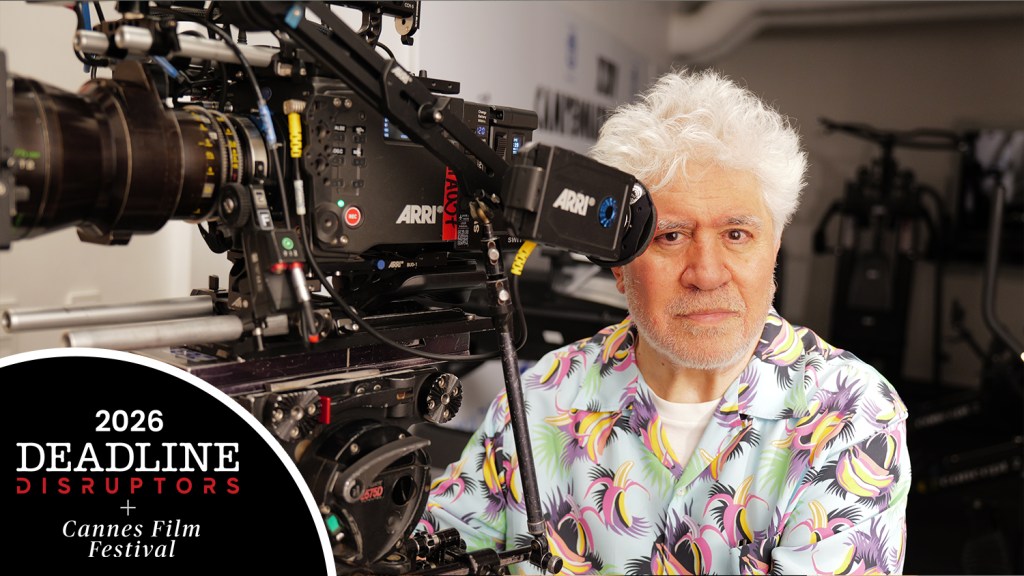
- Pedro Almodóvar received a 6.5-minute standing ovation at the Cannes international premiere of Bitter Christmas
- The film is Almodóvar’s eighth in competition at Cannes — a festival record — but the Palme d’Or has still eluded him
- A simultaneous press screening in the Bazin theater was evacuated after an elderly attendee collapsed about 15 minutes in
- Critics are divided: some call it a fascinating act of self-interrogation, others find it emotionally remote despite its craft
- Almodóvar told Deadline he spent four years writing the script and hinted he may make another English-language film
Pedro Almodóvar brought the Cannes crowd to its feet Tuesday night. The Spanish auteur’s Bitter Christmas earned a 6.5-minute standing ovation at its international premiere in the Grand Théâtre Lumière, with the director attending alongside leads Bárbara Lennie and Leonardo Sbaraglia and the full ensemble cast. It wasn’t the 17-minute marathon that greeted The Room Next Door at Venice — but the Cannes crowd made their affection clear, cheering Almodóvar all the way out of the theater after he addressed them directly.
“I always enjoy the warm reception Cannes gives me from the moment I enter the cinema,” Almodóvar told the audience, adding that he would miss it when he could no longer attend. That drew another fresh wave of applause.
It’s his eighth film in competition here — a festival record — cementing a relationship with Cannes that stretches back decades. He won best director for All About My Mother in 1999, best screenplay for Volver in 2006, and Antonio Banderas took best actor for Pain and Glory in 2019. The Palme d’Or, somehow, has never come.
What ‘Bitter Christmas’ Is Actually About
Bitter Christmas — which opened in Spain in March to positive reviews before making its Croisette debut — is, in the simplest terms, a Russian nesting doll of a movie. It begins in 2004, following Elsa (Lennie), a cult filmmaker turned advertising director plagued by migraines and panic attacks, who travels to the volcanic island of Lanzarote with her friend Patricia (Victoria Luengo) after the death of her mother. Her devoted younger boyfriend Bonifacio, played by Patrick Criado, is a firefighter who moonlights as a stripper — and yes, we get the full routine, set to Grace Jones.
Then the film pulls back to reveal that Elsa’s entire story is a screenplay being written by Raúl Rossetti (Sbaraglia), an esteemed auteur in 2026 who carries Almodóvar’s bearing and silvery hairdo, and who has been creatively running on fumes. Raúl lives in an airy villa beside a Hockney-esque swimming pool, supported by his younger partner Santi (Quim Gutiérrez) and his indispensable assistant Mónica (Aitana Sánchez-Gijón). As the film progresses, the boundary between Raúl’s fiction and his reality begins to dissolve — and by the end, it becomes clear that Raúl is Almodóvar’s own alter ego, with Elsa functioning as an alter ego once removed.
The ensemble also includes Milena Smit as Natalia, a young mother undone by grief, and a characteristically scene-stealing cameo from Rossy de Palma as the madrileña social butterfly Gabriela — “like an Auntie Mame,” as one reviewer put it — who pauses a fabulous party long enough to give Elsa her stash of heavy-duty painkillers. The movie takes its title from a Chavela Vargas ranchera, and the late Mexican singer’s music appears twice, including a raspy late-career performance of “La Llorona” that several critics singled out as the film’s most ravishing sequence.
The Scene Everyone’s Talking About
The film’s emotional climax arrives in a pair of ferocious confrontations between Raúl and Mónica, after she reads his script and returns furious — both at his use of a friend’s suicide attempt as dramatic material, and at his broader obliviousness to the people around him. In one moment that got a laugh at the Cannes screening, she suggests he cut the problematic section entirely, call it a minor work, and sell it to Netflix. “I ask for your advice,” Raúl shoots back, “and you tell me to make a TV movie!”
Sánchez-Gijón is being singled out for her work in these scenes — fierce, unsparing, and clearly speaking for the director himself. Almodóvar confirmed as much in an interview with Deadline. “Monica’s character is a reflection of the ways in which I may question myself,” he said. “As Monica is challenging him, yes, she’s challenging me as a director. And I found the experience of displaying that both liberating and amusing because it did become a process of criticizing myself.”
He was equally candid about the ethics of autofiction — the film’s central preoccupation. “Sometimes a writer doesn’t think of the way precisely that they’re going to hurt the people around them, because at the end of the day, they don’t think about the hurt, they think about the idea, and that becomes a dangerous thing,” he said. “And so at a certain level, my screenwriter is kind of also the villain in the film.”
The script itself, he revealed, has been brewing for about four years — adapted from a short story he wrote years earlier that originally just followed Elsa, her firefighter boyfriend, and their trip to Lanzarote. The character of Mónica, who ends up driving the entire third act, wasn’t part of the original at all. “She was not part of the story previously. She came to me,” Almodóvar said.
The Press Screening That Had to Stop
While Almodóvar was receiving his ovation in the Grand Théâtre Lumière, things took a more alarming turn across the Palais. About 15 minutes into the simultaneous press screening in the Bazin theater — ironically, during a hospital sequence — an elderly attendee collapsed in their seat. Loud yelps were heard, the person’s eyes were closed, and those nearby surrounded them as the film kept running. The ushers then cleared the entire theater.
The festival confirmed the incident in a statement: “The screening was immediately interrupted, and the theater evacuated to allow emergency services to assist them. The person was conscious and responsive before being transported to the hospital for further medical care. Once the intervention was completed, the screening resumed from the beginning of the film.”
Eyewitnesses on social media described hearing a loud scream and reported that the person appeared to suffer some kind of seizure. One attendee told Deadline the response felt disorganized: “It was a muddle and it seemed as though the festival didn’t have any protocol in place for such an emergency.”
Where Critics Land
The reviews have been warm but measured — the consensus being that this is unmistakably Almodóvar, and unmistakably minor Almodóvar. The craft is beyond dispute: Alberto Iglesias’ score, Antxón Gómez’s production design (not a single apartment in the film you wouldn’t want to live in), Pau Esteve Birba’s cinematography — particularly a bird’s-eye shot of Elsa and Patricia lying on white towels against Lanzarote’s black volcanic sand, wearing red and black — all land with the director’s signature visual intensity. Hot pink, as one critic put it, has never burned hotter.
Where critics diverge is on emotional access. Some find the film’s layers of self-critique genuinely thrilling — “a difficult but virtuoso piece of auto-fiction,” in The Wrap’s assessment. Others feel the double-proxy structure keeps the audience at arm’s length, that Almodóvar is working things out in his own head rather than inviting viewers to share the experience. The Hollywood Reporter noted that while Pain and Glory stung with “startling vulnerability and poignancy,” Bitter Christmas “stays somewhat at a distance for the audience, compelling but seldom affecting.”
Deadline’s review landed somewhere in the middle, comparing it favorably to the idea that even minor Fellini and minor Bergman is a gift — a line that, tellingly, Almodóvar put into Mónica’s mouth in the film itself.
Bitter Christmas is produced by Agustín Almodóvar for El Deseo. Sony Pictures Classics handles North American distribution, Warner Bros. releases in Spain and Mexico, and Curzon covers the U.K. and Ireland. The film has grossed around $3 million domestically in Spain since its March opening — more than The Room Next Door and Parallel Mothers managed, though well short of Pain and Glory.
As for whether he’ll return to English-language filmmaking, Almodóvar left the door open. “I would like to work again with Tilda and Julianne,” he said, referring to Tilda Swinton and Julianne Moore. “So, perhaps in the future there will be another movie in English.”
For now, though, he’s back in Spanish — and back on the Croisette, where the crowd still cheers him all the way out the door.
Filed in

Comments
0