
Miles Davis at 100: Why the Icon Still Defines Cool
On the centennial of his birth, musicians from Carlos Santana to Nas explain why Miles Davis remains the most influential artist in American music history.
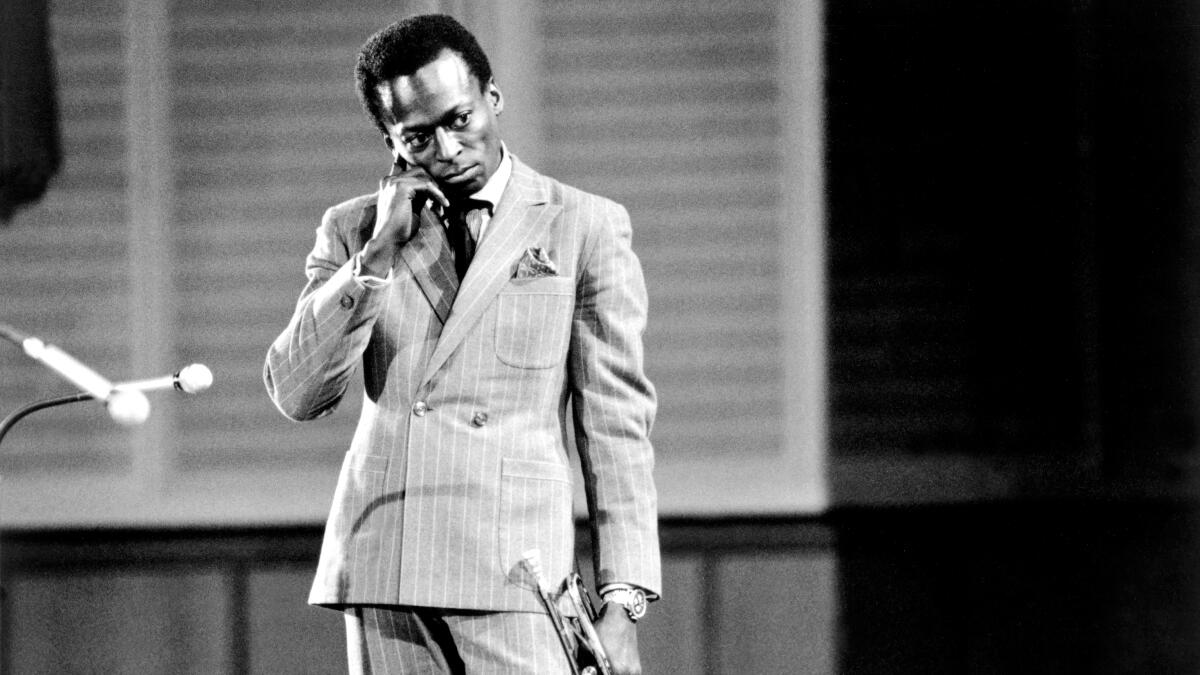
- Miles Davis was born 100 years ago today, on May 26, 1926, in East St. Louis, Illinois
- Musicians across every genre — from Carlos Santana and Flea to Nas and Chuck D — are paying tribute to his unmatched influence
- Jazz at Lincoln Center, WRTI Philadelphia, Birdland, and the Montreux Festival are hosting centennial celebrations
- A Mick Jagger-produced film about Davis’s affair with French actress Juliette Gréco is forthcoming
- His legacy remains complicated: writers and musicians are also reckoning with his documented abuse of women
Miles Dewey Davis III would have turned 100 today. A century after his birth in East St. Louis, and 35 years after his death in 1991, the trumpeter who reinvented American music at least five separate times remains as magnetic and as contested as ever.
“He probably changed the face of music more than anybody did, at least four or five times. Maybe more than that,” producer Don Was told the Los Angeles Times. “It’s a combination of mastery and an unstoppable spirit of adventure that I think make him unique.”
That spirit — restless, uncompromising, perpetually pointed toward whatever was next — is what the music world is celebrating and wrestling with this week as tributes pour in from every corner of culture.
The Man Who Never Repeated Himself
Davis began in the white heat of bebop, playing alongside Charlie Parker before he was 20. But he quickly sought something cooler, more spacious. Birth of the Cool in 1957. Then Kind of Blue in 1959 — still the best-selling jazz album ever made, and for millions of listeners, the entry point to an entire art form. Then the streamlined fire of his 1960s quintet with Herbie Hancock, Wayne Shorter, Ron Carter, and Tony Williams. Then the electric rupture of Bitches Brew in 1970, which fused jazz with rock and funk and opened a door that still hasn’t closed.
“Every time Miles changed it up, he destroyed everything that came before,” Red Hot Chili Peppers bassist Flea said. “He is the ultimate artist, always evolving, always coming organically from the depths. His music is the warmest and the wildest.”
NPR’s Nate Chinen, writing a centennial overview for the network, compared the scope of Davis’s reinventions to Picasso’s periods. “For many artists, that would be enough. For Davis, you could just chalk it up to his ‘Blue Period.’”
Musicians Speak
The LA Times assembled an extraordinary roundtable of artists — from those who played in Davis’s bands to those who grew up in his shadow — and the consensus was unanimous: there is Miles, and then there is everyone else.
“Miles is Da Vinci, Stravinsky, Picasso,” Carlos Santana said. “Collect all the geniuses of this planet, and that’s what Miles is in one note.”
Ron Carter, who held down the bass in Davis’s Second Great Quintet for five years, recalled the pressure of those early gigs: “I was just trying to do what I thought was necessary to make this guy think he hired the right guy and make the band sound good. Whatever his method was, it was successful.”
Nas put it simply: “With Miles it wasn’t just about the music he made, it was about how he carried himself as an artist and a pioneer.”
Wyclef Jean said he started his daughter on Birth of the Cool. “Now she’s vibing and slowly working her way up.” Trombone Shorty called Davis “the coolest — when they say cool, Miles Davis has to be next to that word.” And Ibrahim Maalouf, who learned of Davis through Quincy Jones, said the trumpeter’s legacy is “not only a sound, it’s a mindset. He gave all of us the permission to be many people in one lifetime.”
The Centennial Celebrations
The tributes are global. Jazz at Lincoln Center staged an orchestral celebration led by Wynton Marsalis, taking audiences through Davis’s most important work of the late 1950s and early 1960s. Philadelphia’s WRTI is devoting every hour of today to his music. Birdland and the Montreux Jazz Festival are both running retrospective programming. Legacy Recordings has been steadily reissuing expanded editions of landmark albums, including the five-volume Bootleg Series that traces his evolution from the Second Great Quintet through the electric period.
And a Mick Jagger-produced biographical film, Miles & Juliette, about Davis’s love affair with French actress Juliette Gréco, is on the way.
The Uncomfortable Truth
No honest reckoning with Miles Davis’s centennial can avoid what Vanity Fair called his “complicated legacy.” Davis was a serial abuser of women — something he admitted openly in his autobiography, written with poet Quincy Troupe, without offering real apology or remorse.
Writer Pearl Cleage, whose 1990 book Mad at Miles remains the definitive feminist reckoning with his violence, told Newsweek this week: “I think we have to honor the artistic genius but still acknowledge his abuse of women. We have to. His violence toward women robbed me of the pleasure of wrapping myself up in Kind of Blue. It’s a terrible contradiction that women have to confront regularly when our geniuses and heroes abuse us.”
It’s a contradiction the centennial celebrations are not ignoring. Vanity Fair’s tribute explicitly framed its appreciation through that tension: the man who made “hypnotic music, revolutionary music, healing music” was also someone who hurt the people closest to him.
What He Leaves Behind
A Chicago Tribune op-ed this week drew an unexpected parallel between Davis’s musical philosophy and American democracy itself — both require balancing individual freedom with collective responsibility, both thrive on tension rather than uniformity. The piece recalled the famous story of Herbie Hancock playing a clashing chord during a 1963 concert, only for Davis to pause, digest the dissonance, and respond with a melody that made the “wrong” note sound right. Hancock later said Davis taught him that in music and in life, “the important thing is that we grow and turn poison into medicine.”
That may be the most useful frame for approaching Miles Davis at 100: not as a saint, not as a villain, but as the embodiment of the idea that art — like democracy, like life — is never finished. It’s always moving from one note to the next.
As Davis himself once said: “I’ll play it first and tell you what it is later.”
Filed in

Comments
0