
Frida Kahlo and Diego Rivera Finally Get Their Opera at the Met
El Último Sueño de Frida y Diego opens at the Met Opera May 14 — a surreal, Spanish-language love story two decades in the making.
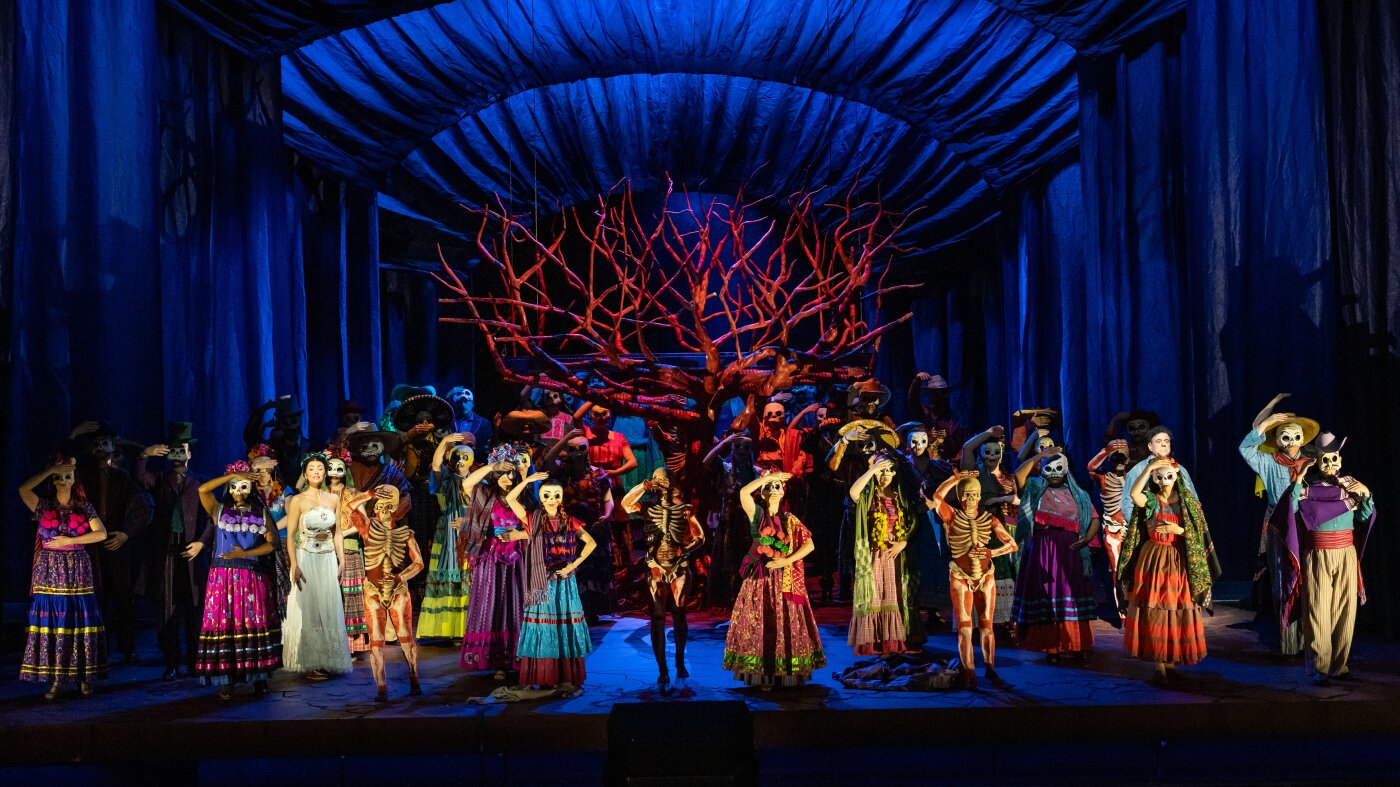
- El Último Sueño de Frida y Diego opened at the Metropolitan Opera on May 14, with performances running through June 5.
- The Spanish-language opera — two decades in the making — imagines Kahlo’s spirit returning from the underworld on the Day of the Dead to reunite with a dying Rivera.
- Composer Gabriela Lena Frank and librettist Nilo Cruz are both Pulitzer Prize winners; mezzo-soprano Isabel Leonard stars as Frida.
- The Met’s entirely new production is directed by Deborah Colker and features a visually stunning set designed by Jon Bausor, who also co-curated a companion exhibition at MoMA.
- The May 30 matinee will be broadcast live in HD to cinemas across the U.S. and internationally.
Shortly before she died, Frida Kahlo wrote in her diary: “I joyfully await the exit — and hope never to return.” The Metropolitan Opera is betting audiences everywhere will be glad she did.
El Último Sueño de Frida y Diego — The Last Dream of Frida and Diego — opened at New York’s Met Opera on May 14, and it’s already shaping up to be the cultural event of the spring. The Spanish-language opera, with music by Gabriela Lena Frank and a libretto by Nilo Cruz, imagines Kahlo’s spirit rising from the underworld on the Day of the Dead to reunite with Diego Rivera, the great Mexican muralist who, in this telling, has grown so weary of life without her that he summons her back. It’s a reverse Orpheus story, soaked in magical realism, pain, color and a love that was — by any measure — a complete disaster and completely unbreakable.
“We all see elements of this relationship in our own relationships and how we replicate these kinds of toxic elements too,” Frank said ahead of opening night. “They remind me a little bit of Elizabeth Taylor and Richard Burton, you know, they were just brilliant and charismatic and attracted to one another and then they drove each other nuts also.”
Mezzo-soprano Isabel Leonard stars as Kahlo — and not only sings the role but dances it. Baritone Carlos Álvarez plays Rivera. The full cast includes soprano Gabriella Reyes as Catrina, gatekeeper to the underworld, and countertenor Nils Wanderer as Leonardo, a spirit who impersonates Greta Garbo. Met music director Yannick Nézet-Séguin conducts six of the seven performances.
Twenty Years to Opening Night
The road to Lincoln Center was a long one. The idea originated more than two decades ago, when the late Joel Revzen — then artistic director of the Arizona Opera — approached Frank about writing an opera centered on Kahlo. Frank, who is of Peruvian Chinese and Lithuanian Jewish descent, was intrigued, and eventually sat down with Cruz, a Cuban-American playwright who had recently won a Pulitzer, at her publisher’s office. It was, as Frank would later describe it, basically a blind date.
Cruz almost said no. “When Gabriela approached me about the project, I immediately said to her, I’m not interested in writing a biopic on Frida and Diego,” he recalled. “I was very resistant because the movie had come out with Salma Hayek, I’d seen several plays, the biographies were out, and so I really wanted to veer away from that.”
Then Frank played him a piece of music she’d written, inspired by the Day of the Dead. Something clicked.
“It immediately inspired me,” Cruz said. “I said, ‘this is the entry into their world. How about if Frida is dead, but Diego is dying and he wants her to come back for the Day of the Dead.’” Frank jumped in to finish the memory: “That’s it. We got the framework in our very first meeting! We didn’t even know each other. It was like a blind date!”
The opera had a COVID-delayed world premiere at the San Diego Opera in 2022, then traveled to San Francisco, Los Angeles and, earlier this year, the Lyric Opera of Chicago. The Met’s production, commissioned by general manager Peter Gelb, is an entirely new one — not a restaging. Gelb brought in director and choreographer Deborah Colker, a Brazilian artist who runs her own dance company and has worked with Cirque du Soleil, along with set designer Jon Bausor, the same team behind the Met’s acclaimed 2024 production of Osvaldo Golijov’s Ainadamar.
“It’s not anything against the original,” Gelb said. “But when you have a work as important and appealing as this there’s no reason why there shouldn’t be more than one production. It’s a sign of its artistic success.”
What’s Actually Happening on That Stage
Colker’s production is kinetic and surreal — hip-hop popping skeletons, chorus singers in death masks, and a visual language pulled deep from both artists’ imagery. “It’s not biographic. It’s not their painting. It’s a dream, no?” Colker said. “I thought that I needed to bring this surrealism language all the time. It’s through the imagination, through dance, through movement.”
Bausor drew his central inspiration from Kahlo’s painting Tree of Hope, Remain Strong, which depicts two versions of Frida — one seated in an elegant dress on a hospital gurney over cracked earth, another lying behind her with angry red surgical stitches in her back. That image of cracked earth became the stage floor itself, out of which skeleton dancers emerge. A blood-red tree with branches that resemble human arteries rises at the center, linking the world above to the underworld below. The sides of the stage are draped in recycled blue plastic — “a kind of shroud, or blue gauze like you might wrap wounds in,” Bausor said. And above the stage hangs a mirror, a direct nod to the one installed under the canopy of Kahlo’s bed so she could paint while immobilized after her catastrophic 1925 bus accident.
“It gave us a symbol for the audience to understand that we weren’t in a real space,” Bausor said of the tree. “It’s a link between the living world above with the foliage at the top and the dead world with the roots below.”
Bausor also found unexpected inspiration in Rivera’s lesser-known work: a set of watercolor costume designs Rivera created for a 1932 ballet called H.P. (Horsepower) by Mexican composer Carlos Chávez — outfits depicting dancers as a giant bunch of bananas, a cigar, a gold bar. “The ballet was a massive flop,” Bausor said, “but I hadn’t seen these works before or even heard of them. They are weirdly literal for Rivera, but I love them because they’re fun. It was a real discovery for me.” He used those designs as inspiration for some of his own costumes.
Frank’s score is equally immersive. She deliberately avoided leaning on recognizable Latin music tropes. “What I wanted to convey instead was something very colorful, something that sounded otherworldly, sometimes ancient,” she said. The marimba appears in nearly every scene — sometimes so woven into the texture you don’t realize it’s there. “That’s my main tribute to Mexican culture, the inclusion of this magnificent instrument,” Frank said. The New Yorker’s Alex Ross praised the result, writing that Frank “establishes a dreamlike, liminal mood from the start” — no small feat when your subject matter invites every cliché in the book.
Frank, who recently won the Pulitzer Prize for her orchestral work Picaflor: A future myth, visited MoMA’s companion exhibition with Cruz before opening night, lingering in front of Kahlo’s surreal self-portrait with her head superimposed on the body of a deer pierced by arrows. “If I had to pick one Frida Kahlo painting that I would look at for the rest of my life, it was always going to be this one,” Frank said. “I remember seeing this as a little girl. I was just kind of haunted by it.”
The Story the Opera Tells
The plot is deliberately not a biography. Frida is already dead. Diego is dying. He calls her back on the Day of the Dead, desperate for a final reunion — and desperate to have their ashes mixed together in death, something his family denied him in reality. (Rivera had explicitly wanted his ashes united with Kahlo’s; his family refused and buried him in a cemetery instead.) “It was fascinating to me that he wanted his ashes to be united with hers,” Cruz said. “I thought — this is a story of love after death. So that became the theme of the opera.”
Down in the underworld, Frida isn’t so sure she wants to come back. She remembers the pain — the polio she contracted as a child, the bus accident that shattered her spine as a teenager, a lifetime of surgeries and suffering. She remembers Rivera’s affair with her younger sister Cristina. But she also remembers the colors, the markets, the animals, the life she loved so fiercely.
“She’s convinced to come back because she actually wants to see her art and she wants to see her house and she wants to visit the world again,” Leonard said. “She loved the world and she was in love with the colors of her home and the animals and the market. She had such passion, I think, for all of those things, including for Diego.”
There’s one rule in this reunion, and it cannot be broken. “They get together, they separate, they cannot touch each other,” Álvarez said. “Death needs to have a distance with life. And then only when they touch each other is when Diego dies.”
At the end, blossoms fall from above. The chorus sings that their art is eternal. And Cruz’s final question hangs in the air: “This is the last dream of Frida and Diego. And then you wonder at the beginning, whose dream is it? Is it his dream? Is it her dream? Or are we all dreaming this dream when we come see this opera?”
Fridamania Has Taken Over New York
The opera doesn’t exist in a vacuum. This spring, New York is deep in a Kahlo moment. MoMA’s Frida and Diego: The Last Dream — named after the opera’s English translation — runs through September 12, featuring paintings and drawings by both artists, archival photographs, and an environment co-created by Bausor himself, making this his first foray into museum curation. Scaffolding holds paintings in the middle of the gallery. A giant red tree sprouts from a blue bedframe and grows into a mirror on the ceiling. Blue stage curtains frame the walls. “The paintings are the divas,” Bausor said. “They’re larger-than-life characters with big ideas that have stood the test of time.”
MoMA curator Beverly Adams, who specializes in Latin American art, offered a striking historical footnote: in his lifetime, Rivera was the far more famous of the two. “In the 1930s, he was the most famous artist in the world,” she told Frank and Cruz during their visit. “He was the second person to have a retrospective at MoMA.” More than 70 years after Kahlo’s death, of course, the calculus has completely flipped. Her floral crown, unibrow and bleeding heart are on coffee mugs and jewelry and stationery worldwide. She is, as Adams put it, someone who “lived her life to the fullest” — and whose pictures make that undeniable.
Kahlo’s family made the trip to New York for opening night. Her grandniece — also named Frida — told the New York Post that the family has just opened a new museum in Kahlo’s honor, the Museo Casa Kahlo, in Mexico City, and is also launching a book called Frida. In person. — written in Kahlo’s own voice. “We want the whole world to appreciate it,” the younger Frida said. “If Frida were around today, imagine what she would say about her paintings now being sold for $56 million.”
El Último Sueño de Frida y Diego runs at the Metropolitan Opera through June 5. The May 30 matinee will be broadcast live in HD to cinemas across the U.S. and internationally — which means even if you’re not in New York, you can catch this one.
Filed in

Comments
0