
‘The Meltdown’ Review: A Cannes Mystery Worth Watching
Manuela Martelli’s Cannes Un Certain Regard thriller follows a 9-year-old girl at an Andean ski resort where a friend vanishes — and silence becomes its own kind of crime.
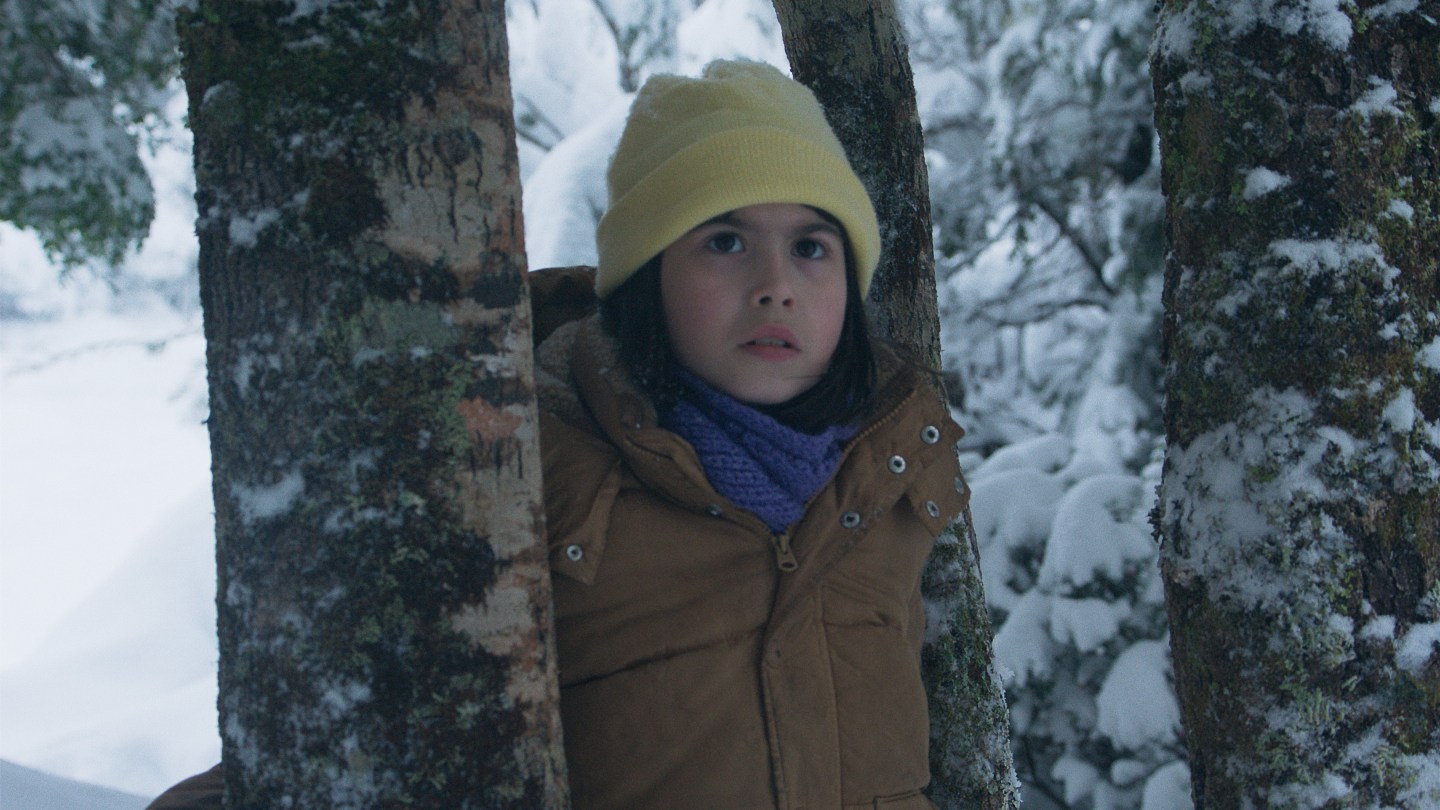
- Manuela Martelli’s The Meltdown premiered in Cannes’ Un Certain Regard sidebar at the 2026 festival
- The film follows a 9-year-old girl at a Chilean ski resort in 1992 whose teenage friend mysteriously vanishes
- Newcomer Maya O’Rourke stars alongside Saskia Rosendahl (Babylon Berlin) as the missing girl’s desperate mother
- The film uses the mystery as an allegory for Chile’s collective silence in the aftermath of Pinochet’s dictatorship
- It is currently seeking U.S. distribution
The image that opens The Meltdown is one of the stranger true stories in recent history: grainy camcorder footage of a 60-ton Antarctic iceberg being hoisted out of a frosty sea, bound for Chile’s pavilion at the 1992 Universal Exposition in Seville. It was meant to announce a country reborn — modern, ambitious, free from the shadow of Augusto Pinochet, who had finally been voted out of power four years earlier. Director Manuela Martelli has a very different reading of that iceberg. For her, it’s a nation trying to separate its gleaming tip from the cold, dark mass of history still lurking just beneath the surface.
That’s the kind of film The Meltdown is: precise, layered, and quietly devastating in its implications. It premiered in the Un Certain Regard sidebar at the 2026 Cannes Film Festival, marking Martelli’s first appearance in the official selection after her debut, Chile ’76, launched from the Directors’ Fortnight in 2022. That earlier film — a taut, critically acclaimed thriller about a bourgeois housewife’s political awakening under the Pinochet regime — established Martelli as one of the most distinctive voices in Chilean cinema. Her follow-up is equally elegant, if somewhat more elusive.
A Child’s-Eye View of a Country Learning to Forget
The year is 1992. Two years have passed since Pinochet left the presidency, but he still commands the military, and the nation exists in a strange in-between — officially democratic, inwardly paralyzed. Inés (Maya O’Rourke), a watchful, precocious nine-year-old, is staying at her grandparents’ remote Andean ski lodge while her parents are abroad, part of Chile’s delegation at Expo ’92 in Seville. She has the run of the place: befriending the hotel dogs, sleeping in the rooms of staff members she’s grown fond of, hanging at the front desk with receptionist Sonia (Paula Zúñiga), trading hellos with bartender Genaro (Luis Uribe) — a man who goes quiet whenever someone mentions his missing brother, one of Chile’s desaparecidos. Inés barely bats an eye. She was born into a world of strange ellipses.
What she’s not prepared for is losing someone she actually knows.
That someone is Hanna (Maia Rae Domagala), a 15-year-old German skiing prodigy who has come to Chile to train. She’s the only girl on her team, gets bullied relentlessly by her male teammates, and receives a little too much attention from her coach, Alexander (Jakub Gierszal). Maybe that’s why she takes so quickly to Inés, despite the age gap — sharing her dark nail polish and broody music, letting the younger girl sleep in her room, confiding in her the way you confide in a diary. Hanna tells Inés that her mother is from East Germany, or as she puts it, “a country that doesn’t exist anymore.”
Then one morning, Hanna is gone.
The disappearance triggers a search, and soon Hanna’s mother Lina (Saskia Rosendahl, best known from Babylon Berlin) arrives — wild-eyed, ferocious, guilt-ridden, and absolutely unwilling to accept the official indifference around her. Rosendahl is extraordinary here, a former East German figure skating champion who channels every ounce of that competitive fury into finding her daughter. She and Inés form an unlikely alliance: a daughter who needs a mother, a mother who needs a daughter, with Inés serving as translator as Lina tears through the Andean resort demanding answers that nobody seems to want to give.
Inés, you see, knows something. She saw something, late one night, pretending to be asleep in Hanna’s room. And her grandmother Techa (Paulina Urrutia), a hyper-capitalistic woman laser-focused on selling a defunct military outpost on the mountain to a couple of Spanish investors and expanding the resort, has made it very clear: keep quiet, or the authorities will start asking questions about Inés’ teenage cousin Sebastián (Lautaro Cantillana), who also had an eventful evening with Hanna before she vanished.
What the Iceberg Really Means
Martelli, who is herself an accomplished actress, has spoken openly about drawing on her own childhood for this film. “I was 9 years old in 1992,” she told The Hollywood Reporter, describing a time “permeated by this transition in Chile, which was a very weird and complex moment. For me, it was interesting to overlap the transition of a kid and the transition of a country and the world as well.” The Berlin Wall had just fallen. The GDR was gone. Chile was, at least on paper, moving forward. And yet.
“The idea of horror was so present for me in this period of history, because there was something hidden there,” Martelli explained. “I had this idea of walking over dead bodies, because people disappeared, and you didn’t know where they were. They could be anywhere. I wanted everything to feel ambiguous. It’s not that it’s a horror movie, but it kind of flirts with that.”
That horror-adjacent quality comes through in Benjamín Echazarreta’s muted, evasive cinematography — light that seems to scurry away from the lens — and in María Portugal’s score, which swings between Bernard Herrmann-esque bursts of discordant strings and something more ominously quiet underneath. The production design by Nohemí González and Carolina Espina’s costumes are immaculate, period-perfect without ever feeling like a museum display. (One hand-stitched sweater Inés wears, reviewers have noted, is almost heartbreaking in its brightness.)
The snow globe-like setting does exactly what Martelli intends: the powder and the clouds are the same shade of white, earth and sky bleeding together, the world beyond the resort feeling almost impossible to imagine. It’s a hermetically sealed innocence that the film both celebrates and indicts. Inés has been raised to not ask certain questions. The hotel staff has learned to not mention certain names. The grandmother has learned to not discuss certain political figures. And now a girl is missing, and everyone’s instinct is still — silence.
Where the Film Stumbles
The parallels are genuinely powerful, and O’Rourke’s performance is a remarkable piece of work — watchful and uncertain and deeply felt, never cute, never precocious in the annoying way. Martelli raves about her young lead: “She has such a presence. I was really amazed. She had to act in English and Spanish; she had to act in the snow. It was really hard for her, but Maya was amazing. She’s a real warrior.”
But the film’s insistence on filtering everything through Inés’ deliberately limited perspective eventually becomes a constraint. Children do stress-test their realities — constantly, frustratingly — and The Meltdown increasingly has to sideline Inés entirely to keep the tension alive, because her passivity, while thematically intentional, creates a chilling drag on the story’s forward momentum. The adults around her, meanwhile, are mostly content to remain passive in their desire to sweep things under the rug, which is sinister in its own right but leaves the film with limited dramatic options.
A few directorial choices overreach. An opening sequence lingers on blood spiraling down a bathroom sink — from a lost baby tooth, as it turns out — in a way that feels like foreshadowing with the volume cranked too high. A later close-up of a shattered glass of milk lands as distraction rather than resonance. These are quibbles, but they’re symptomatic of a film that occasionally mistakes restraint for withholding.
The iceberg Chile shipped to Seville, it’s worth remembering, started melting before it even arrived. By the time the expo ended, only the main body remained — invisible to the naked eye, but hard as a fact. That’s the image Martelli leaves you with, really. The past doesn’t disappear. It just gets covered up, sometimes not even all that well.
The Meltdown is currently seeking U.S. distribution. It is produced by Ronda Cine, Cinema Inutile and Wood Producciones, with international sales handled by Les Films du Losange.
Filed in

Comments
0