
Bulgaria’s Dara Wins Eurovision 2026 With ‘Bangaranga’
Bulgarian singer Dara made history at the 70th Eurovision Song Contest in Vienna, winning with her infectious dance anthem ‘Bangaranga’ — a first for Bulgaria.
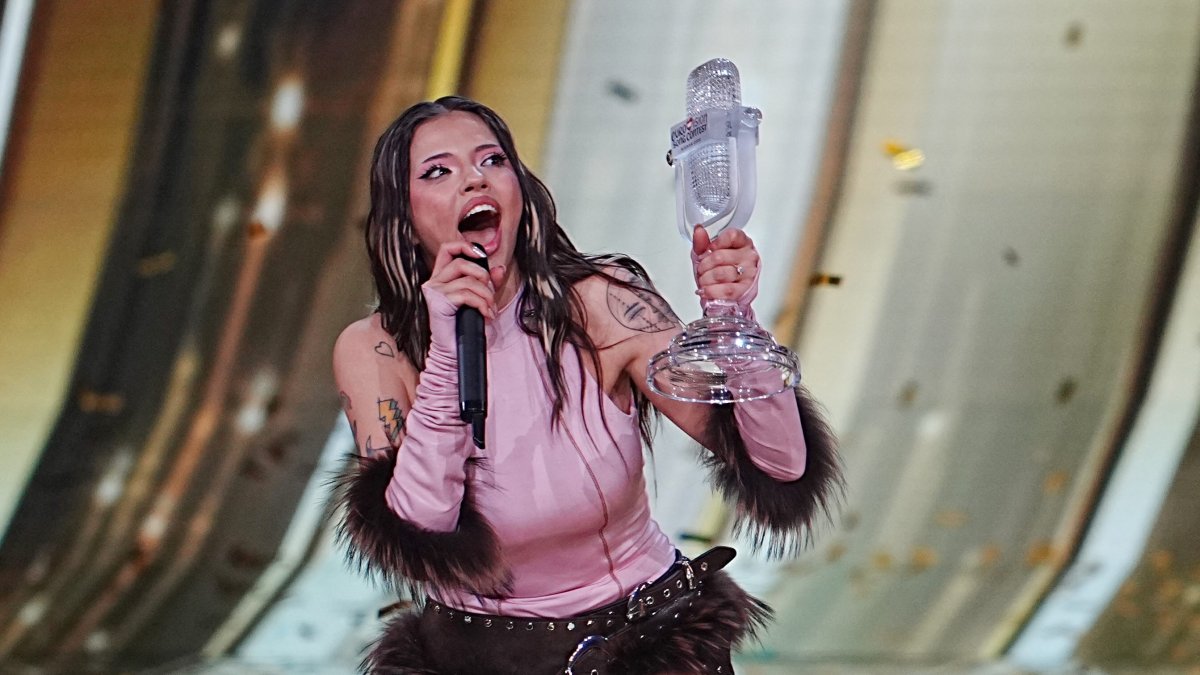
- Bulgaria’s Dara won the 70th Eurovision Song Contest in Vienna with her dance anthem “Bangaranga,” scoring 516 points — the country’s first-ever Eurovision win.
- Israel’s Noam Bettan finished second with 343 points despite protests, boycotts, and booing during the public vote announcement.
- Five countries — Spain, Ireland, the Netherlands, Slovenia, and Iceland — boycotted the contest over Israel’s inclusion amid the war in Gaza.
- “Bangaranga” is inspired by kukeri, an ancient Bulgarian ritual, and Dara describes the word as “a special energy that everyone has got in themselves.”
- The UK’s Look Mum No Computer finished last with zero points in the public vote, while Australia’s Delta Goodrem came in fourth.
Bulgaria made Eurovision history on Saturday night. Singer Dara, 27, swept to victory at the 70th Eurovision Song Contest in Vienna with her pulsating dance anthem “Bangaranga” — the country’s first-ever win in the competition, and by most accounts, one of the night’s most electric performances.
The song earned 516 points, with Israel’s Noam Bettan coming in second at 343. The moment Dara was announced as the winner, she launched straight back into “Bangaranga” for the crowd at Vienna’s Wiener Stadthalle — all 10,000 of them — and they were very much ready for it.
The win was described as an unexpected upset. Dara is a veteran pop performer in Bulgaria, but “Bangaranga” — described by its performer as “pop music with folklore bones” — was something different. The song is inspired by kukeri, an ancient Bulgarian ritual where men roam through villages in furry costumes with bells and animal masks. As for the title itself, that became one of the running jokes of the night. “Bangara is a special energy that everyone has got in themselves,” Dara explained, “a feeling that everything is possible.” The arena, it’s safe to say, felt it.
With an expected TV audience of over 100 million people, this was the third time Austria has hosted Eurovision — a consequence of operatically trained Austrian singer JJ winning last year with “Wasted Love.” The show opened with a nod to that: a filmed montage of Austria’s scenery featuring a paper boat making its way to Vienna, followed by JJ performing live before an Olympic-style flag parade of the 25 finalists. Hosts Michael Ostrowski, an Austrian actor known for German-language comedy films, and Victoria Swarovski — model, singer, TV presenter, and heir to the Swarovski crystal empire — guided the night from there.
A Night of Spectacle, From Goth Folk to Golden Pianos
The performances themselves were, as Eurovision tends to be, gloriously all over the map. Denmark’s Søren Torpegaard Lund opened the grand final with “Før Vi Går Hjem” — a staging that evoked queer clubbing culture, delivered by someone who has played Tony in West Side Story, Angel in Kinky Boots, and Romeo in Romeo & Juliet. Germany’s Sarah Engels followed with “Fire” and, naturally, pyrotechnics.
Croatia’s Lelek was one of the most talked-about acts of the night. Their goth-y folk entry “Andromeda” leaned into something ancient and powerful — stacked harmonies, dramatic staging, and markings on the women’s faces and bodies meant to evoke the sicanje folk tattooing custom historically used to prevent forced conversions during Ottoman rule. It was striking and deliberately so.
Finland had come in as a heavy favorite. “Liekinheitin” — or “Flamethrower” — paired violinist Linda Lampenius’ fiery fiddling with vocalist Pete Parkkonen’s anguished delivery, and featured the genuinely combustible combination of open flames and a flowing dress. The crowd loved it.
Australia’s Delta Goodrem made a strong case for herself with “Eclipse,” a dancy power ballad that culminated in the pop icon being lifted into the air on a platform extending from a glittering golden piano, surrounded by fire and wind machines. She finished fourth. Had she won, a European country would have been required to host on Australia’s behalf in 2027.
Sweden’s Felicia performed 20th with her EDM track “My System,” alternating between a face mask and sunglasses throughout. She’d told interviewers the song was deliberately retro: “It feels so nostalgic, like 2010 is coming back.” Lithuania’s Lion Ceccah — a prominent figure in the country’s drag scene — delivered one of the more intriguing entries with the trilingual “Sólo Quiero Más,” a synth-pop piece that played out like film noir. Moldova’s rapper Satoshi brought cheekily patriotic energy with “Viva, Moldova!” in a chorus so catchy it drew comparisons to Irish hip-hop trio Kneecap. And Austria closed the show with Cosmó’s disco-techno romp “Tanzschein” — an ode to clubbing that was, frankly, the ideal send-off.
The UK’s Look Mum No Computer — real name Sam Battle, a YouTube star known for building his own synthesizers — finished dead last. His entry “Eins, Zwei, Drei” earned zero points in the public vote, failing to crack the top ten in a single voting country. Belgium and Germany also received nul points from the public. It’s a painful result for the UK, which has struggled in the competition for years, aside from Sam Ryder’s second-place finish with “Space Man” in 2022.
Also notable by his absence from the grand final: Boy George of Culture Club, who had a cameo in San Marino’s entry “Superstar” by Senhit — but that act failed to qualify from the first semifinal.
The Politics That Shadowed the Party
For all the spectacle, the 70th Eurovision couldn’t fully escape the weight of what was happening outside the Wiener Stadthalle. Five countries — Spain, Ireland, the Netherlands, Slovenia, and Iceland — chose not to compete this year, all citing Israel’s continued participation in the context of the ongoing war in Gaza. It’s the largest coordinated boycott in the contest’s history.
The controversy didn’t stay outside. During Israel’s Noam Bettan’s performance of “Michelle” — a romantic pop song in Hebrew, French, and English about escaping a toxic relationship — Palestinian flags were waved in the crowd, and some audience members turned their backs. During the first semifinal on Tuesday, chants of “Stop the genocide!” were audible on the broadcast, and two protesters were forcibly removed. Israeli broadcaster KAN had also received a formal warning in the days before the final over videos encouraging people to “vote 10 times” for Israel — a concern that led organizers to reduce the maximum votes per fan from 20 to 10 this year.
When the public vote results for Israel were announced on Saturday, the arena filled with boos — largely in response to a group of fans chanting Israel’s name. Bettan has sought to stay above the fray throughout. He told NBC News he was aware of the disruption during the semifinal but said he looked “for the Israeli flags in the crowd, and I saw a lot of people cheering and I heard a lot of positive noise.” Born to a French Jewish family, he has said he’s competing to deliver a “good, positive message to the world.”
There was also a separate controversy involving KAN: the broadcaster was forced to apologize after mocking Croatia’s Lelek by comparing their traditional sicanje makeup to “henna tattoos in Eilat.” Lelek condemned the comments as a disrespectful slight against their culture and the history of oppressed women.
Outside the venue, several hundred protesters marched earlier Saturday, chanting “all of Vienna hates the ESC.” Police said around 2,000 people participated in demonstrations across the city. They were kept well away from the venue’s security cordon. Demonstrator Echo Vinasha Lex said it was “important to protest against that idea that the song contest is not political. The song contest is a very political event.”
Eurovision director Martin Green has pushed back on that framing throughout the week, urging viewers to “close the curtains to the outside world and dream that something else is possible.” He acknowledged the boycott but said he hopes those countries return. He’s also defended KAN’s participation by stressing the broadcaster’s independence from the Israeli government — though he drew scrutiny on Friday after appearing to suggest in an interview that Russia, banned since 2022 over its invasion of Ukraine, could theoretically return to the contest in the future on the same grounds. British lawmakers were quick to condemn the remarks.
“Here’s to the next 70 years,” Green said at a news conference. Whether those years look anything like this one remains an open question — five countries are still on the outside looking in, and the issue of Israel’s participation shows no sign of fading.
For now, though, Eurovision 2026 belongs to Bulgaria. And “Bangaranga” — whatever it means, exactly — is the song of the summer whether Europe is ready or not.
Filed in

Comments
0