
Julianne Moore Doesn’t Want Guns and Explosions Anymore
Julianne Moore sparked online backlash after saying she’s done with violent movies — but fans were quick to point out her own filmography.
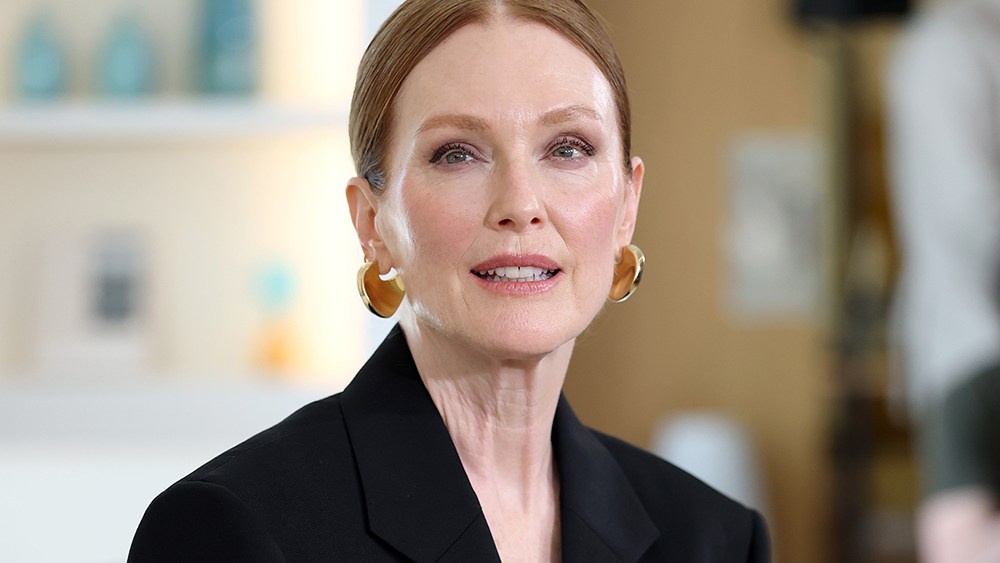
- Julianne Moore said she’s “less and less interested in tragedy” and doesn’t want to act in movies with “explosions and guns”
- The comments came during a Kering Women in Motion Talk at the Cannes Film Festival, where she was receiving an award
- Fans online pushed back, pointing out Moore has appeared in plenty of violent and dark films throughout her career
- Moore’s recent projects include Netflix dark comedy Sirens and Apple TV+ thriller Echo Valley opposite Sydney Sweeney
- She also spoke about female representation in Hollywood and called Meryl Streep “the gold standard”
Julianne Moore had a lot on her mind at Cannes this weekend — and not all of it landed the way she might have hoped. The Oscar-winning actress, in town to receive the prestigious Kering Women in Motion Award at the 79th Cannes Film Festival, sat down with Variety’s Angelique Jackson for a wide-ranging conversation about her career, her values, and the kinds of roles she wants to take on from here. It was one particular answer that got people talking.
“I’m less and less interested in tragedy, I would say,” Moore told the crowd. “Particularly now at a time when things are rough globally, it’s hard for me to invest in a story that I think is pretend, where I feel like the depth of the emotion doesn’t measure up to what’s happening in the world.”
Then came the line that set off the internet: “I don’t like someone being murdered. I don’t like explosions and guns. I don’t like histrionics. I don’t like things that raise the stakes without real feeling underneath. I mean, that actually bothers me because that’s like noise. I don’t know how to play it. I don’t want to watch it.”
The Internet Had Thoughts
A clip of the interview hit X, and the replies came fast. The sticking point for a lot of people? Moore’s own filmography. She played a porn actress in Boogie Nights. She starred opposite Anthony Hopkins in Hannibal — a film someone on X was quick to note featured a man having his skull removed and his brain eaten. She’s done thrillers, she’s done crime dramas, she’s done dark and disturbing material across a career spanning four decades.
“I’ve lost count how many movies she’s done with guns,” one person wrote. Another put it bluntly: “Funny how artists forget their own catalog until it’s time to virtue signal.” A third added, “That’s great! Now playback all the degenerate, violent entertainment Julianne has happily participated in throughout her career.”
Not everyone was piling on, though. Some fans understood exactly what she was getting at. “Julianne Moore choosing emotion over chaos is exactly why she’s respected worldwide,” one defender wrote. Another made a somewhat unexpected pivot: “I actually agree with her! We already have enough violence in the world! We need good family values in movies back!! That’s why The Devil Wears Prada was great.”
What She Actually Said — In Full Context
Reading the full conversation, Moore wasn’t declaring a crusade against action movies — she was talking about what excites her creatively at this point in her career. There’s a difference between the two, and it’s one the clip-and-react cycle tends to flatten.
She talked about how early in her career, there wasn’t much choice involved. “When you start out, you just do what comes your way. You don’t really have a lot of choices. You’re just like, ‘Great, I have a job, I’ll do it,’” she said. “Then slowly you gain a little more authority.” Now, at 65, with an Academy Award for Still Alice and nominations for Boogie Nights, The End of the Affair, The Hours, and Far from Heaven behind her, she can afford to be selective.
What she’s looking for, she explained, is point of view. “I want to be clear about whose story it is, how it’s being told, and whether or not it’s accurate. I often find that there are places that people will skip that step.” She also said she doesn’t believe in villains — “everybody’s always acting out what they believe is true and right” — which is a pretty clear statement about the kind of nuanced, character-driven work she gravitates toward.
Her most recent projects bear that out. She’s been doing Sirens, the Netflix dark comedy, and Echo Valley, the Apple TV+ thriller alongside Sydney Sweeney — neither of which is exactly a Marvel movie.
On Meryl, Women in Hollywood, and What Comes Next
The backlash overshadowed some genuinely compelling parts of the conversation. Moore spoke warmly about Meryl Streep, her co-star in The Hours, calling her flat-out “the gold standard.”
“She was the first woman that I saw who appeared to be touchable and untouchable at the same time,” Moore said. “There was something very human about her and something very modern. She was so precise in what she did and so modern and so accessible and yet glamorous and wonderful and brave all at the same time. So I feel like she kind of lit a fire under everybody in terms of how we wanted to be, in terms of what we felt we could achieve in our work.”
She also weighed in on a recent study showing that women in lead roles dropped to 37% among 2025’s highest-grossing films — a 10-point slide from the year before. Moore’s take was that the problem is bigger than Hollywood. “There’s not representation in C-suites, there’s not representation in media, there’s not representation in higher education. There are lots of places where we don’t have the representation we deserve,” she said. “And how do you change that? I don’t know. It’s like, how does a mouse get through a wall? One bite at a time.”
She also offered what she called “the secret sauce” for women in the industry: each other. “Women are each other’s greatest allies. We are the ones who have each other’s backs, we are the ones who hire each other, we are the ones that write stories about ourselves.”
As for the Kering award itself, Moore said receiving it gave her a rare moment of perspective on a long career spent moving from one job to the next. “As an actor, you’re part of a gig economy,” she said. “When you realize you’re being celebrated or asked to speak about what’s behind you, it’s like wow. This is something I created in my life.”
This isn’t the first time Moore has found herself in the middle of a controversy she didn’t exactly invite. When May December came out, Vili Fualaau — who became notorious for his relationship with his sixth-grade teacher in the late 1990s — called the film a “ripoff” of his life. Moore pushed back, maintaining that director Todd Haynes “was always very clear when we were working on this movie that this was an original story… a story about these characters.”
The guns-and-explosions moment will probably fade. But Moore’s broader point — that she’s done chasing artificial stakes, that she wants stories with real emotional weight behind them — is the kind of thing that tends to define a later-career chapter. Whether the internet agrees or not.
Filed in

Comments
0