
Is ‘Coward’ Lukas Dhont’s Best Film Yet?
Lukas Dhont’s WWI queer romance ‘Coward’ divides critics at Cannes — here’s what the film is about and why it’s generating buzz.
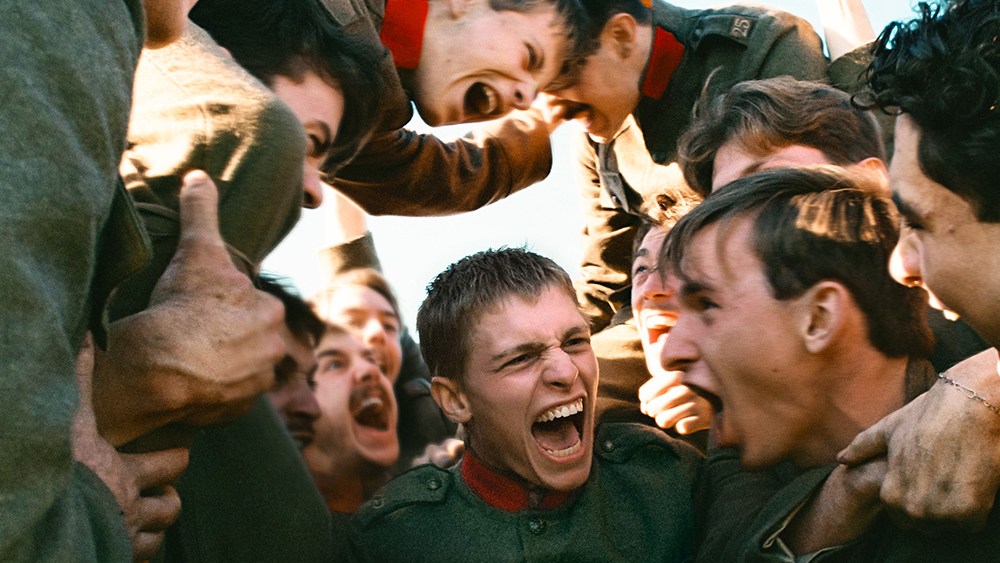
- Lukas Dhont’s third feature Coward premiered in competition at Cannes 2026, distributed by MUBI
- The WWI-set queer romance follows two Belgian soldiers — one stoic, one flamboyant — falling for each other behind the front lines
- Dhont was inspired by a real black-and-white photograph of a soldier cross-dressing in a sandbag skirt to perform for his unit
- Critics are split: Variety calls it his most mature film to date; The Hollywood Reporter says it’s hollow and emotionally fraudulent
- Leads Emmanuel Macchia and Valentin Campagne are making their major festival debuts in the film
Few directors working today generate quite as much passionate disagreement as Lukas Dhont. His first two films — Girl, about a trans teenager pursuing ballet, and Close, which earned him an Oscar nomination for Best International Feature — were both acclaimed and contested in roughly equal measure, with admirers praising his emotional precision and detractors accusing him of exploiting vulnerable subjects for maximum tearjerker effect. With Coward, his third feature and his most ambitious by a wide margin, that divide hasn’t closed. If anything, it’s gotten wider.
Premiering in competition at Cannes 2026, Coward is a World War I love story between two Belgian soldiers: Pierre (Emmanuel Macchia), a broad-shouldered farmboy who barely speaks and flings himself into the violence of the front with grim determination, and Francis (Valentin Campagne), a willowy, theatrical tailor who forms a performing troupe to boost his fellow soldiers’ morale — dressing in elaborate drag costumes made from hessian sacks and parachute cloth. The two are drawn together first through the stage, then in something much harder to name in 1914.
The film is being released by MUBI, and was co-written by Dhont and his longtime collaborator Angelo Tijssens.
Where the Idea Came From
Dhont, 34, has been sitting with this story for four years. The spark was a single photograph. “It’s based on a black-and-white photograph I found four years ago of a young man right behind the frontlines dressed up in a sandbag skirt performing for the other soldiers,” he told Deadline at Cannes. “And I thought that it was something so modern in that picture, even though it was black and white, but seeing this young man cross-dressed, smiling in front of all these other men really inspired me to create something.”
The history of soldiers entertaining their comrades in drag troupes is well-documented — a form of bravery hiding in plain sight inside the most aggressively masculine environment imaginable. That tension is exactly what drew Dhont in. “It’s a part of history that I hadn’t seen portrayed before,” he told Variety. “That got my ideas flowing. I thought, ‘Wow, it would be really special to see these men creating a theater piece while in the background, there are explosions and the war is still going on and there’s death all around them.’”
He’s also acutely aware of where he lives. “I live in Flanders, so I live on the soil on which the First World War was fought,” he said. “When I drive around, I go past the cemeteries filled with the bodies of young men who gave their lives in order to fight. Making this film was nearly a transcendental act of bringing those stories back to life.”
What the Film Is Actually About
The title is doing a lot of work. On its surface, Coward refers to the soldiers who desert — men so broken by the carnage that they flee the trenches, even knowing execution awaits if they’re caught. But Dhont is after something bigger than a verdict on those men. “I wanted to examine our notions of heroism,” he said. “In war films, masculinity is portrayed in a very narrow way. There’s this idea that fighting for our country is always a noble goal, and the fear of being a coward has broken a lot of people or led to their deaths.”
He’s also thinking about the present. With war ongoing in Ukraine and the Middle East, and conversations about national service requirements resurfacing across Europe, Dhont says the film’s questions feel uncomfortably current. “I’m talking about the past but there’s a sense that I’m telling a story about something in the present. It makes you think: What would you do? Would you fight for your country? Or would you try to resist that circle of violence?”
And then there’s the queerness of it — which, for Dhont, is inseparable from the film’s central argument. In an era when homosexuality was criminalized, Pierre and Francis might never have found each other at all without the war throwing them together. The extreme danger of the front strips away social convention in ways peacetime never could. “What’s really interesting is that in those darkest of times, they are more free than society allows them to be, or that they will be when the war ends,” Dhont said. “Heroism throughout history has often been linked to a man’s ability to be brutal. I wanted to turn that upside down and talk about the amount of courage it takes to love.”
At Cannes, he put it even more plainly: the film questions “what it actually means to be brave… in choosing the truest parts of ourselves; in choosing to express ourselves, even when the world around us expects us to behave or to act in a certain way.”
It was, he admits, the hardest thing he’s ever made. “I was making a war film, but I needed to find a way to keep the intimacy that I love from my previous work,” he said. “It was an exercise in trying to create a scale and a world, which is much more ambitious in its production elements, but try to keep it truthful to the emotions of the characters.”
What the Critics Are Saying
Here’s where it gets complicated. The reviews out of Cannes are genuinely polarized in a way that feels almost designed to illustrate the ongoing Dhont debate.
Variety’s Guy Lodge is firmly in the admirer camp, calling Coward “pleasingly like a step forward” and “his most satisfying film to date” — notably because it pulls back from the battering-ram tragedy tactics that made Girl and Close so divisive. Lodge singles out a first kiss between Pierre and Francis as “among the most purely romantic gestures the movies have seen in a minute,” shot with “rapt, blissed-out, time-stopping intensity.” He praises Dhont’s “rich, tactile sense of how men — queer men especially, but not exclusively — watch other men,” and argues the film “thrives on that understanding.”
He also has warm words for the two leads. Macchia — making his screen debut — is described as “a gently stoic, aptly unformed presence with a stolid sadness in his trudging gait, who can go from boy to man with a slight shift in the light.” Campagne, Lodge writes, is “far more vocal” and “focus-pulling,” and the chemistry between them is “visible almost entirely in the different ways their bodies move and balance each other: one still, one quicksilver; one molded by the men around him, one brazenly opposing that physicality.”
The Hollywood Reporter’s David Rooney lands in a very different place. He calls Coward a film that “reeks of manneristic affectation and phoniness,” and says Dhont “strains for lofty emotional peaks in moments that instead come off as hollow and artificial.” Where Lodge sees a swooning love story, Rooney sees leads with “minimal chemistry” — one inexpressive, one “archly theatrical” — and a director so enamored of his own formal elegance that the film never generates genuine heat. “I found this movie obstinately unaffecting,” he writes.
Rooney is particularly pointed about the film’s performance sequences, which he describes as escalating to the point of exhaustion — “Oh no, another f**king song?” — and notes that the WWI setting feels underpopulated and cramped, rarely conveying the true scale of the conflict. He compares it unfavorably to recent queer military films like Oliver Hermanus’ Moffie and Elegance Bratton’s The Inspection, as well as Hermanus’ recent The History of Sound, which also uses WWI to frame a queer love story.
Both reviewers, at least, agree on the visual quality of the film. Cinematographer Frank van den Eeden — Dhont’s regular collaborator — shoots the trench sequences in crisp, wheaten daylight and the performance numbers in floaty, powdery pastels that feel deliberately otherworldly, a visual shorthand for the suspension of normal life that the stage represents for these men.
The Bigger Picture
Whether Coward is a triumph or a misfire, it’s clearly the film where Dhont makes his play for a larger stage. The production is bigger, the historical canvas is wider, and the love story is front and center in a way his previous work never quite allowed. That MUBI is distributing suggests a path to audiences who followed Close to its Oscar nomination — and to a new generation of viewers drawn to queer cinema that doesn’t shy away from either the sensuality or the stakes.
Whatever the final verdict, Dhont’s ambition here is not in question. “[‘Coward’] was the most challenging film I’ve ever made,” he said simply. The Cannes competition will have a say in how that challenge is judged.
Filed in

Comments
0