
Cannes 2026: ‘Parallel Tales’ Reviews Are In
Asghar Farhadi’s Isabelle Huppert-led Cannes entry is dividing critics — here’s what they’re saying about the voyeuristic French thriller.
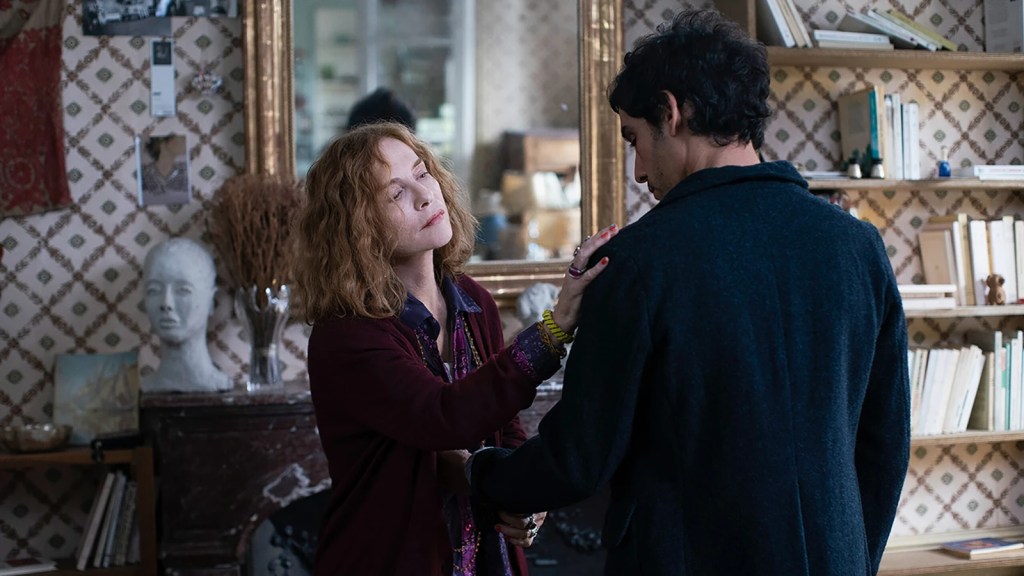
- Asghar Farhadi’s Parallel Tales premiered in Competition at Cannes 2026 — his fifth time competing for the Palme d’Or
- The film stars Isabelle Huppert, Vincent Cassel, Virginie Efira, Pierre Niney, and Adam Bessa, with a cameo from Catherine Deneuve
- It’s loosely inspired by Krzysztof Kieślowski’s Dekalog episode six, reimagined as a story about creativity, voyeurism, and fiction bleeding into real life
- Critics are split — some calling it Farhadi’s best work since A Separation, others finding it overlong and dramatically inert
- The film is currently seeking U.S. distribution; Memento is handling French release
Asghar Farhadi has returned to Cannes with what may be his most ambitious film yet — and critics can’t quite agree on what to make of it. Parallel Tales (Histoires Parallèles), the two-time Oscar winner’s first feature in five years, premiered Thursday in Competition at the 2026 Cannes Film Festival, and the reviews landing out of the Croisette range from rapturous to genuinely scathing. One thing nobody is disputing: this is a filmmaker swinging big.
Set in Paris, the film follows Sylvie (Isabelle Huppert), a reclusive novelist who uses a telescope to spy on a trio of sound engineers working in an apartment across the street — Nicolas (Vincent Cassel), his brother Théo (Pierre Niney), and their colleague Nita (Virginie Efira). Unable to hear them, only watch, she invents a torrid love triangle involving the three and begins writing it as her new novel. The fiction spirals further into reality when Adam (Adam Bessa), a young man with no fixed home who’s brought in to help Sylvie pack up her book-crammed, mouse-infested apartment, gets his hands on the manuscript and starts inserting himself directly into the lives of the people across the street.
The film is freely inspired by Kieślowski’s Dekalog — specifically Episode Six, later expanded into A Short Film About Love — but Farhadi has transplanted the premise into an entirely different thematic register. Where Kieślowski’s version was a love story, Parallel Tales is about the act of creation itself, and what happens when imagined lives start to reshape real ones.
Farhadi, who has been living outside Iran since 2023, told Reuters ahead of the premiere that making this film required him to break his own rules. “There is a more formal playfulness and things that I hadn’t done in my other films,” he said. “Things that were previously a red line for me. I wouldn’t do them at all. But here, in the structure of the film, I did them. From this perspective, it was a very valuable experience.”
What the Critics Are Saying
For some, those broken rules paid off handsomely. Deadline called it “wickedly entertaining” and “a crackerjack story with great characters that grabs you right from the start and doesn’t let go for a minute,” going so far as to say it may be Farhadi’s finest work since A Separation — the 2011 film that won him both the Golden Bear at Berlin and the first-ever Oscar for Best Foreign Language Film awarded to an Iranian production. The same review drew comparisons to Hitchcock’s Rear Window, a touch of Claude Chabrol, and even the 1964 Audrey Hepburn comedy Paris When It Sizzles, in which a screenwriter acts out scenes as he writes them.
The Wrap landed somewhere in the middle — impressed by the performances and the thematic richness, but noting the film’s uneven pacing. “Despite being impressively acted and thematically compelling, it avoids wholehearted recommendation due to its uneven repetition of sequences and ideas that make this feel more lugubrious than cohesive,” their critic wrote. Still, the review praised Farhadi’s underlying ideas, particularly his parallel between sound design and fiction writing — both crafts, the film suggests, involve taking raw material from the world and reassembling it into something that passes for truth.
IndieWire was the sharpest dissenter, calling it “cramped and tedious” and accusing Farhadi of forfeiting “the sordid humanity of Kieślowski’s masterpiece in exchange for the soapy meta-fiction of a meandering daydream.” Their critic took particular aim at Huppert’s role, arguing that the film gives her almost nothing to do beyond scowling and shuffling around her apartment, and described Adam Bessa’s character as “a dime-store Patricia Highsmith sociopath” who flattens every story he enters. The one bright spot they acknowledged: the film’s treatment of sound, which they said gives the movie its only genuine spark of life.
The Cast and the Craft
Even the more skeptical reviews haven’t had much to say against the ensemble. The film’s structure requires Huppert, Cassel, Efira, and Niney to each play two roles — their real characters and the fictional versions Sylvie invents for them — and by most accounts they handle the dual duties seamlessly. Efira is particularly noted, especially impressive given she has a second film in Competition this year: Hamaguchi Ryusuke’s Soudain. Niney, fresh off The Count of Monte Cristo, brings an edgy energy to Théo. And Cassel, per Deadline, “has never been better.”
The most talked-about performance may actually be Bessa’s. His Adam — described in the Reuters piece as a thief whose good deed lands him inside Sylvie’s world — is the character who sets everything in motion, and the one most critics agree is the film’s most unpredictable presence. Pierre Niney recalled on set that Farhadi’s precision was something else entirely: “We were expecting a master, and he was really impressive the way he was according so much attention to every detail,” Niney told Reuters. “He put drops of water on the costumes himself to ensure they looked as wet as he wanted. And that was like this during the whole process. He had such a precise idea of what he wanted.”
Catherine Deneuve appears in a single scene as Sylvie’s publisher — a cameo that, depending on which review you read, is either a lovely grace note or a blink-and-you’ll-miss-it drive-by. Her character’s verdict on Sylvie’s manuscript is blunt: it’s not working. “My stories are from another time,” Sylvie laments.
On the technical side, cinematographer Guillaume Deffontaine’s rain-soaked Paris photography draws consistent praise, as does production designer Emmanuelle Duplay’s meticulously cluttered interiors. The score comes from Zbigniew Preisner — a Kieślowski regular, which feels like a deliberate and meaningful choice. And the sound team, led by designer Pierre Mertens with editors Paul Heymans and Mathieu Michaux and mixer Thomas Gauder, has been highlighted across reviews as doing work that’s integral to what the film is actually about. With the 100th anniversary of the first talking picture arriving in 2027, there’s something quietly poetic about a film this obsessed with what we hear — and what we only imagine we hear.
Parallel Tales is produced by Alexandre Mallet-Guy, Farhadi himself, and David Levine. Memento is handling French distribution. A U.S. deal has not yet been announced — which means awards season conversations are still very much open.
Filed in

Comments
0