
Harvey Weinstein Rape Retrial Ends in Mistrial
A Manhattan jury deadlocked for the second time on Jessica Mann’s rape allegations against Harvey Weinstein. Prosecutors have 30 days to decide on a fourth trial.
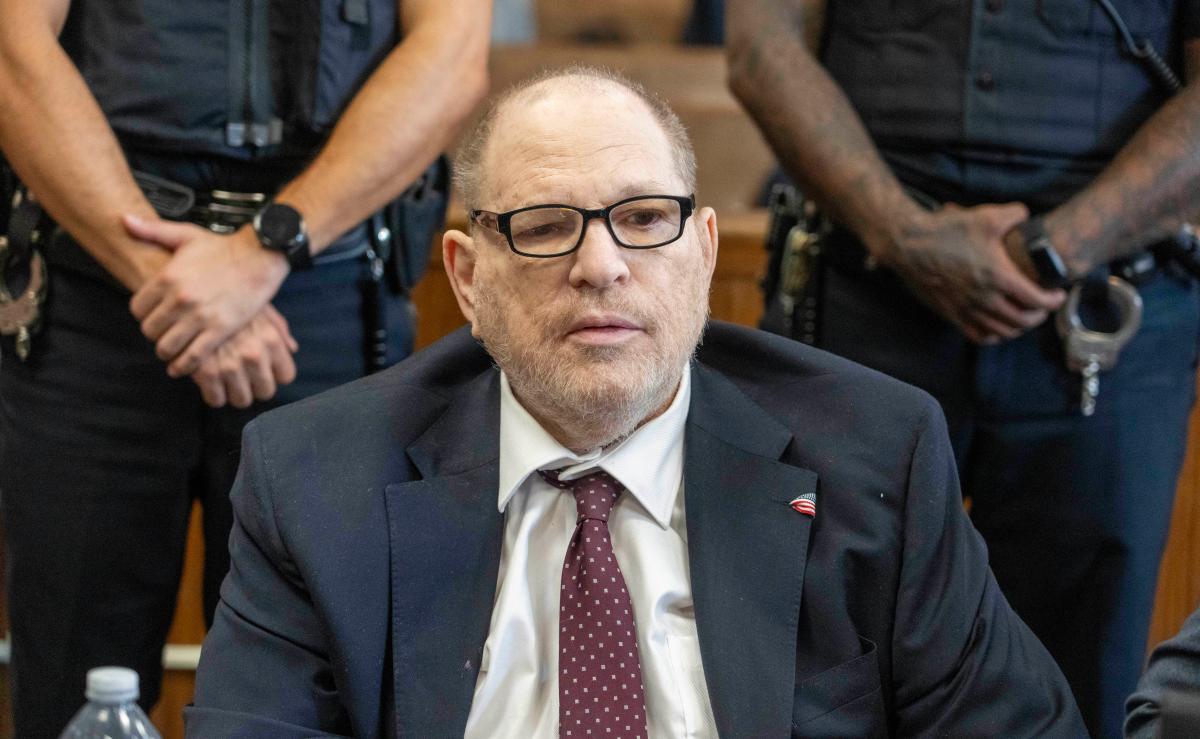
- A Manhattan judge declared a mistrial Friday after the jury deadlocked in Harvey Weinstein’s rape retrial — the third time he’s faced trial on these charges.
- The jury, which was majority-male, could not unanimously decide whether Weinstein raped Jessica Mann at a Manhattan hotel in March 2013.
- Prosecutors have 30 days to decide whether to pursue a fourth trial on the single count of third-degree rape.
- Weinstein, 74, remains incarcerated and still faces sentencing on his 2025 conviction for sexually assaulting Miriam Haley.
- He is also less than halfway through a separate 16-year prison sentence from his 2022 Los Angeles rape conviction.
Harvey Weinstein’s rape retrial ended in a mistrial Friday after a Manhattan jury deadlocked for the second time on the same charge — leaving Jessica Mann’s rape allegation unresolved after three separate trials and years of grueling courtroom testimony.
Judge Curtis Farber declared the mistrial just after 1 p.m., following roughly nine hours of total deliberations spread across three days. The jury, composed of seven men and five women, had sent multiple notes to the judge signaling they were stuck. The final one, sent around the lunch break, was unambiguous: “We feel no one is going to change where they stand.”
Before that, the jurors had written: “We the jury request to let the judge know that the members of the jury have concluded that we cannot reach a unanimous decision.” When that first note arrived, Farber had issued an Allen charge — a standard instruction urging the panel to keep trying. “When this trial began, many prospective jurors were called and questioned,” the judge told them. “You, ladies and gentlemen, were selected to serve. That means of all the prospective jurors called in this case, you were the ones in whom both sides expressed confidence.” He ended the charge by asking jurors to apply “common sense and good judgement.”
One juror, described as a young man, appeared visibly frustrated during the charge — closing his eyes and rubbing his forehead as the judge spoke. Not long after, the panel sent its second note, and Weinstein’s attorney Marc Agnifilo moved for a mistrial. The judge granted it.
Three Trials, No Verdict on Mann’s Allegations
The road to this moment has been extraordinarily long. Weinstein was first convicted in 2020 on charges that included Mann’s rape allegation, but the New York Court of Appeals overturned that conviction in 2024, ruling that the original trial judge had improperly allowed testimony about allegations not directly tied to the case. At a retrial last year, the jury convicted Weinstein of a first-degree criminal sexual act for forcibly performing oral sex on former Project Runway production assistant Miriam Haley in 2006 — but deadlocked on Mann’s count, forcing this third trial. He was acquitted in that same retrial on charges involving former model Kaja Sokola.
Now, after this second deadlock on Mann’s allegation alone, Judge Farber has given prosecutors 30 days to decide whether to try the case a fourth time.
The charge is a single count of third-degree rape. It stems from what Mann, now 40, says happened at the DoubleTree hotel in Midtown Manhattan on March 18, 2013 — a day she has recounted in detail across three separate trials. This time, she testified for five full days out of a nearly four-week proceeding. Weinstein did not take the stand.
What Mann Told the Jury
Mann’s testimony was emotional and, by all accounts, consistent across every trial she has faced. She broke down multiple times on the stand, telling jurors how Weinstein allegedly pinned both of her wrists above her head. “I said, ‘No’ over and over and I tried to leave,” she said through sobs, at one point demonstrating the alleged position for the jury.
She acknowledged that she did have a consensual relationship with Weinstein at certain points, explaining that she had hoped it might grow into something real — a “loving relationship.” She also testified that she was fully aware of his power in Hollywood. “Essentially, his friends go very far and his enemies don’t step foot in this town,” she said, recounting what Weinstein had told her about his industry clout.
Mann said Weinstein had told her he was in an “open relationship” with his then-wife, designer Georgina Chapman, when they began their involvement. She also testified that Weinstein allegedly raped her at a Los Angeles hotel later in 2013, though he is not charged for that incident.
The defense leaned heavily on the complicated aftermath of the alleged assault. Weinstein’s attorney Teny Geragos pressed Mann during a multi-day cross-examination about a handwritten note she sent to Weinstein just two days after the alleged attack — introduced for the first time at any trial. In it, Mann wrote: “Do I love him or the idea of him? With him — easy. The idea of expanding that — fulfilling.” There was no mention of an assault. Geragos also highlighted warm messages Mann sent Weinstein over time, including notes saying things like “Miss you, big guy” and “Appreciate all you do for me.”
Mann has consistently said she was mired in complicated feelings — about Weinstein, about herself, and about what had happened. Her perspective shifted in 2017, when a wave of sexual misconduct allegations against the Oscar-winning producer became a catalyst for the #MeToo movement.
In closing arguments, Manhattan Assistant District Attorney Nicole Blumberg urged jurors to understand how power distorts everything. “She missed the red flags, she missed the manipulation, the power, the control. She rationalized in her own mind the unwanted sex in the beginning,” Blumberg told the panel. Weinstein’s attorney Marc Agnifilo, meanwhile, attacked Mann’s credibility and pointed to her mental state at the time, arguing she was lying on the witness stand.
Where Weinstein Stands Now
Despite the mistrial, Weinstein isn’t going anywhere. The 74-year-old former Miramax boss has been behind bars since 2020 and remains there, his health visibly declining in recent years. He was diagnosed with bone marrow cancer in 2024 and has used a wheelchair for years. During deliberations this week, he was briefly sidelined after reporting chest pains in a courthouse holding area — he looked pale but said he felt “good, fine” when he returned the following day.
He still awaits sentencing in New York for his 2025 conviction on the first-degree criminal sexual act charge involving Haley — a conviction that could carry up to 25 years. Judge Farber has held off on that sentencing until the Mann count is resolved. Weinstein is also less than halfway through a 16-year prison sentence from his separate 2022 Los Angeles conviction for raping and sexually assaulting Italian model and actor Evgeniya Chernyshova — a verdict currently on appeal. He is expected to be returned to California before serving any New York time.
Weinstein has maintained throughout all of this that he “acted wrongly” but never assaulted anyone.
For Jessica Mann, who has now faced her alleged attacker in a courtroom three times and told the same devastating story to three different juries, the question of what comes next rests with the Manhattan DA’s office. The day after last year’s mixed verdict, Manhattan District Attorney Alvin L. Bragg said his office was “ready to go forward to trial again, after conferring with Jessica Mann.” Whether they’ll make that call a second time — putting Mann through a fourth trial — is now the decision that looms.
Filed in

Comments
0