
The Fashion Heist Film You Need to See This Summer
Boots Riley’s ‘I Love Boosters’ stars Keke Palmer and Demi Moore in a neon-soaked, politically charged fashion heist comedy that’s stealing all the attention.
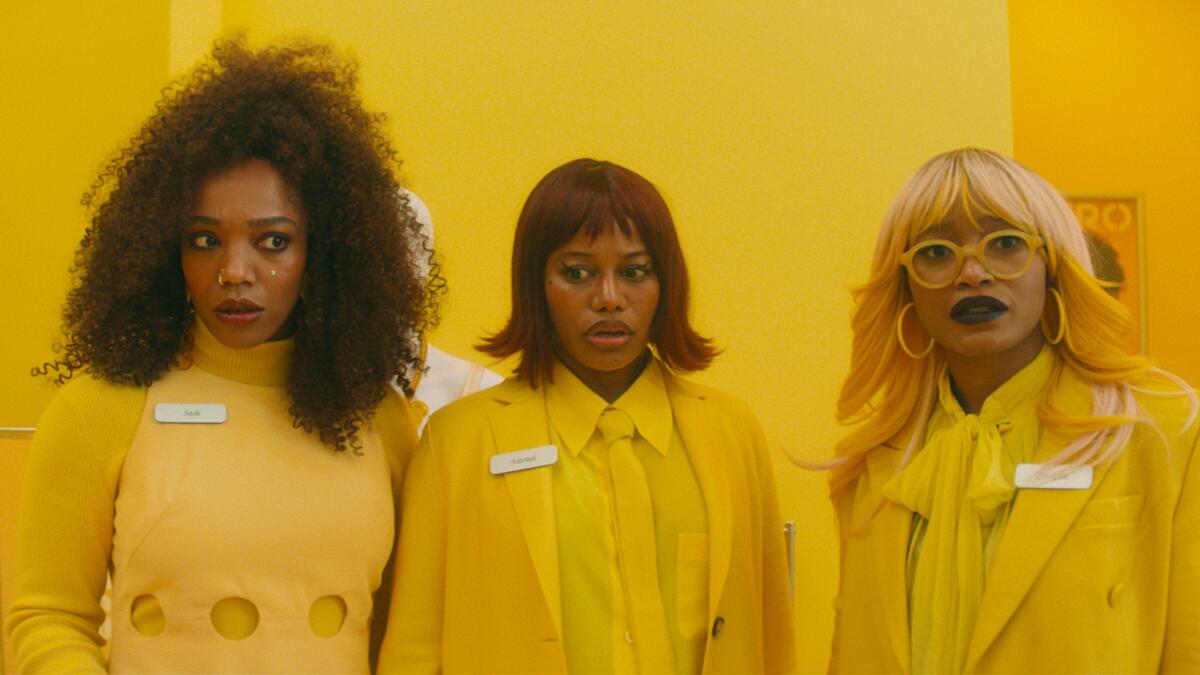
- Boots Riley’s sophomore feature I Love Boosters stars Keke Palmer, Naomi Ackie, Taylour Paige, and Demi Moore in a fashion-world heist comedy with sharp political teeth.
- Oscar-nominated costume designer Shirley Kurata sourced looks from thrift stores, SCAD students, and indie designers to build the film’s vibrant, maximalist wardrobe.
- The film opened May 22 via Neon and premiered at South by Southwest, making it one of the studio’s most expensive productions at an estimated $20 million.
- Riley’s signature blend of social satire and surreal comedy takes aim at fast fashion, labor exploitation, and wealth inequality.
- Demi Moore plays the villain Christie Smith — and reportedly went shopping herself to find the perfect character-coded pieces.
Boots Riley doesn’t make movies so much as detonate them. His latest, I Love Boosters, arrives in theaters like a paint bomb thrown at a department store window — loud, colorful, and very much on purpose.
The film follows the Velvet Gang, a trio of girlfriends who steal and resell — or “boost” — clothing to survive in a Bay Area economy that has very little interest in their survival. Corvette (Keke Palmer) is the ringleader, an aspiring fashion designer who’s been locked out of every door the industry has to offer. Sade (Naomi Ackie) is a single mom trying to hold it together. Mariah (Taylour Paige) is, as the LA Times puts it, “airhead-ish comic relief and fabulous at it.” Together, they set their sights on Christie Smith (Demi Moore), the imperious founder of Metro Designer — a fast-fashion empire built, it turns out, on stolen ideas and exploited labor.
The setup sounds like a caper. It plays like a carnival. And underneath all the neon and noise, it’s one of the sharpest things Riley has made.
A World Built in Color — and Chaos
From the moment the film opens, color does the heavy lifting. Each Metro Designer store shifts its monochromatic palette almost scene to scene — a visual metaphor for the trend cycle’s endless churn — while the Velvet Gang exists in explosive opposition: furry cropped bomber jackets, remixed sports jerseys, neon-highlighted wigs, and oversized acrylic accessories that feel like they were assembled with joy and a very limited budget.
That wardrobe is the work of Oscar-nominated costume designer Shirley Kurata, whose credits include the 2023 Best Picture winner Everything Everywhere All at Once. When Riley came to her with this script, she didn’t hesitate.
“It was kind of my dream script to be asked to work on,” Kurata said. “I could really do all the fun fashion that I’ve always wanted to do but haven’t had the chance.”
The constraints were real. Shooting ran through fall and winter — not exactly peak season for the yellows and bright greens the story demanded. Prep time was tight. Kurata leaned into it. “We didn’t have a ton of prep time either and a lot was done last minute — but sometimes it works well that way because then you’re not overthinking things,” she explained.
To source the sheer volume of clothing the film required, Kurata scoured thrift stores from LA to Atlanta, pulled loans from young student designers at the Savannah College of Art and Design in Georgia, and tapped a roster of indie labels — a jumpsuit with Stegosaurus spikes from LA casual wear brand Big Bud Press, a coat covered in lenticular blinking eyeballs by surrealist LA designer Leeann Huang, a jacket covered in coin purses by London designer Alina Ispas, and a red water spout neckerchief by emerging London designer Selina Kwong. She also drew inspiration from the iconic Japanese street style book Fruits, the Oakland arts scene, and the Instagram account UpNextDesigner.
“I’m a champion for any aspiring designer,” Kurata told The Wrap. “Their work is so fun. You can’t always use them, but this movie I was able to.”
Two Closets Per Character
Building the Velvet Gang’s wardrobe meant building two distinct wardrobes for each member — who they are in the real world, and who they become when they’re pulling a job.
“For Corvette and Sade and Mariah, I had to create what they would wear in the real world, but then also, what they looked like when they were disguised,” Kurata said. “I almost had to create separate closets for each of the characters.”
For Corvette specifically, the clothes needed to feel like something she might have made herself. “There also had to be a resourceful element,” Kurata explained. “One of the tops she wears is made from athletic tube socks, and in the opening scene you don’t get to see much of her bottom half, but she’s wearing a skirt made of a bunch of men’s ties.”
Mariah got a more punk-inflected look, reflective of the Oakland art scene. Sade leaned streetwear — with the suggestion that she might be wearing some of Corvette’s own designs. The group disguises, where all four boosters coordinate their outfits, were where Kurata had the most fun. “There were florals and animal prints and anime raver looks,” she said. “We wanted to do an all polka-dotted theme but we ran out of time.”
The men’s suiting throughout the film does its own storytelling. Will Poulter’s store manager Grayson wears something sharp enough to signal authority but clearly off-the-rack — merchandise he probably bought from his own employer. LaKeith Stanfield’s mysterious character (billed only as “Pinky Ring Guy”) wears zoot suit pants and vintage blazers from the ’80s and ’90s, a deliberate collision of decades that reflects how unknowable he is. “Because you’re not entirely sure what world he comes from we mixed the decades with him,” Kurata said.
Demi Moore Goes Shopping
Christie Smith is the film’s fashion villain, and Kurata built her look as a deliberate inversion of everything around her. Where the Velvet Gang explodes with color, Christie is entirely devoid of it — platinum bob, aviator reading glasses, and architectural power suiting with a slight wrongness to it. A jacket with three sleeves. Asymmetrical cuts. Shapes that feel just slightly off-kilter.
“I studied a lot of prominent female fashion designers and how they dressed,” Kurata said. “Like when you think about a Jenna Lyons for instance — you think of the statement glasses, but there’s also a uniform and a utilitarian-ness to the way they dress. And when you go to fashion shows there’s a lot of people dressed in black and I thought it would be so Christie to be devoid of color, she wouldn’t be caught dead wearing it. There’s something off-kilter about her, so I wanted her attire to be a little bit off-kilter too.”
Moore threw herself into it. According to Kurata, the actress actually went shopping during filming to find pieces she felt were right for Christie. “She got some pieces that she thought were very Christie. They were great,” Kurata said.
On screen, Moore is doing something genuinely special — a villainous victory lap that builds on her career-reviving turn in The Substance. Her Christie Smith is haughty and deluded in equal measure, at one point dismissing the Velvet Gang as “low-class urban bitches” while simultaneously taking pride in the fact that thieves want her clothes. Shoplifting, in her mind, is the sincerest form of flattery.
The Boots Riley Cinematic Universe
Riley’s fingerprints are all over every frame. The filmmaker — rapper, activist, self-described “Marx brother” in a recent New Yorker profile — has built a body of work that consistently finds surrealist ways into serious political territory. His 2018 debut Sorry to Bother You starred LaKeith Stanfield as a telemarketer who discovers his boss is literally turning workers into half-human, half-horse creatures. His 2023 Prime Video series I’m a Virgo followed a 13-foot-tall Black teenager in an alternate-reality Oakland policed by superheroes.
I Love Boosters fits squarely in that lineage. The film’s central MacGuffin — a “magic bag” that functions as either a “situational accelerator” or a “deconstructor” — arrives from a Chinese sweatshop as part of a scheme to circumvent global shipping costs. It’s a sci-fi device that also happens to be a pointed metaphor. The Situational Accelerator transforms its target into a heightened, hyperbolic version of itself. The Deconstructor strips things to their barest essence. Riley, it seems, wants to do both to the fashion industry simultaneously.
The production design leans into the absurdism: Christie’s office building tilts at a 45-degree angle that only she can navigate without stumbling. A giant ball of unpaid bills and parking tickets chases Corvette through the streets like the boulder from Raiders of the Lost Ark. Car chases are staged with unabashed miniatures. Stop-motion influencer ghouls — skinless, gun-wielding — appear without apology. The score, by Tune-Yards, is a cacophony of circus oompahs, mouth harps, and kazoos.
“Boosters is agit-prop that prioritizes entertaining the crowd,” the LA Times wrote. “It roils with observations about teamwork, inequality and success, but presents as a spangled, stoner-comedy extravaganza with the moxie to give a Monty Python-esque raspberry to realism.”
Palmer, for her part, is the film’s beating heart. She plays Corvette as a great physical comedian — all graceful flailing and barely-contained ambition — and the camera loves her for it. Eiza González gets one of the film’s most memorable scenes, delivering a dissertation on Karl Marx while vaping. Don Cheadle shows up in prosthetics so thorough he’s genuinely unrecognizable, playing a pyramid scheme huckster named Dr. Jack who has rebranded exploitation as “Friends Being Friends.” Stanfield, meanwhile, smolders like Rudolph Valentino in what starts as a cameo and becomes something considerably stranger.
Fashion as the Message
The timing of the film’s release feels almost engineered. The week I Love Boosters opened, news broke that sustainable fashion brand Everlane was being acquired by ultra fast-fashion giant Shein — a real-world collision of idealism and corporate appetite that could have been lifted straight from Riley’s script.
The film doesn’t shy away from the industry’s ugliest truths: the plagiarism of smaller designers’ intellectual property, the life-threatening factory conditions faced by garment workers, the way fashion that originates in working-class communities gets absorbed and sold back at prices those same communities can’t afford.
“Fashion that happens in our neighborhood is absorbed by the fashion industry, then sold back to us at very high prices — so people figure out how to get the stuff they want with much less money,” Riley said in the film’s production notes. “I was thinking about the economy of that and how fashion and art manifests; how people make and consume art while they’re struggling and how communities work together.”
Kurata sees it the same way. “There is responsibility that we as consumers and we as designers, need to take into consideration. That involves workers’ rights, equal pay, the importance of over-consumption, the environment,” she said. “There’s this widening division of sort of the haves and the have-nots and the one percentile and the rest of the world and it’s only become worse.”
She hopes the film does something about that — or at least starts the conversation. “In a time where they are trying to push AI on us, I hope this showcases human creativity and using real objects and just making it work,” she said. Boots Riley, she added, gave her total freedom — and one particular directive that stuck: “Boots even said it’s OK if it’s a little janky.”
They even had a dress-like-Boots day on set. “But you can’t compete with the legend himself,” Kurata laughed.
I Love Boosters is in theaters now via Neon. It is, emphatically, not for the faint of heart — or the faint of color palette. But for anyone who’s ever felt like the fashion industry was stealing from them, it might feel like the most satisfying two hours they’ve spent in a theater all year.
Filed in

Comments
0