
Keke Palmer Steals the Season in ‘I Love Boosters’
Boots Riley’s wild fashion heist comedy starring Keke Palmer, Demi Moore & an all-star cast is in theaters now. Here’s what critics are saying.
- Boots Riley’s I Love Boosters opens in theaters Friday from distributor Neon, rated R and running 115 minutes
- Keke Palmer leads an ensemble that includes Demi Moore, Naomi Ackie, Taylour Paige, Eiza González, Poppy Liu, LaKeith Stanfield and Don Cheadle
- The $20 million film — the largest production investment in Neon’s history — premiered at South by Southwest in March before a Bay Area premiere at Oakland’s Grand Lake Theater
- Reviews are split: some critics call it irresistible summer fun, others find the comedy doesn’t always land and the third act goes off the rails
- Riley, a self-described communist for 30+ years, made the film as an explicit Marxist satire about fast fashion, workers’ rights and corporate greed
There is no one else making movies like Boots Riley right now. That much, at least, every critic agrees on. His follow-up to the 2018 cult hit Sorry to Bother You is a candy-colored, teleportation-powered, Marxist fashion heist comedy starring Keke Palmer — and it is exactly as wild as that sounds. I Love Boosters, which opens in theaters Friday via Neon, has been making audiences laugh so loudly at screenings that they drown out lines of dialogue. Whether it fully sticks the landing is another conversation. But as a piece of sheer cinematic ambition, it’s pretty hard to look away.
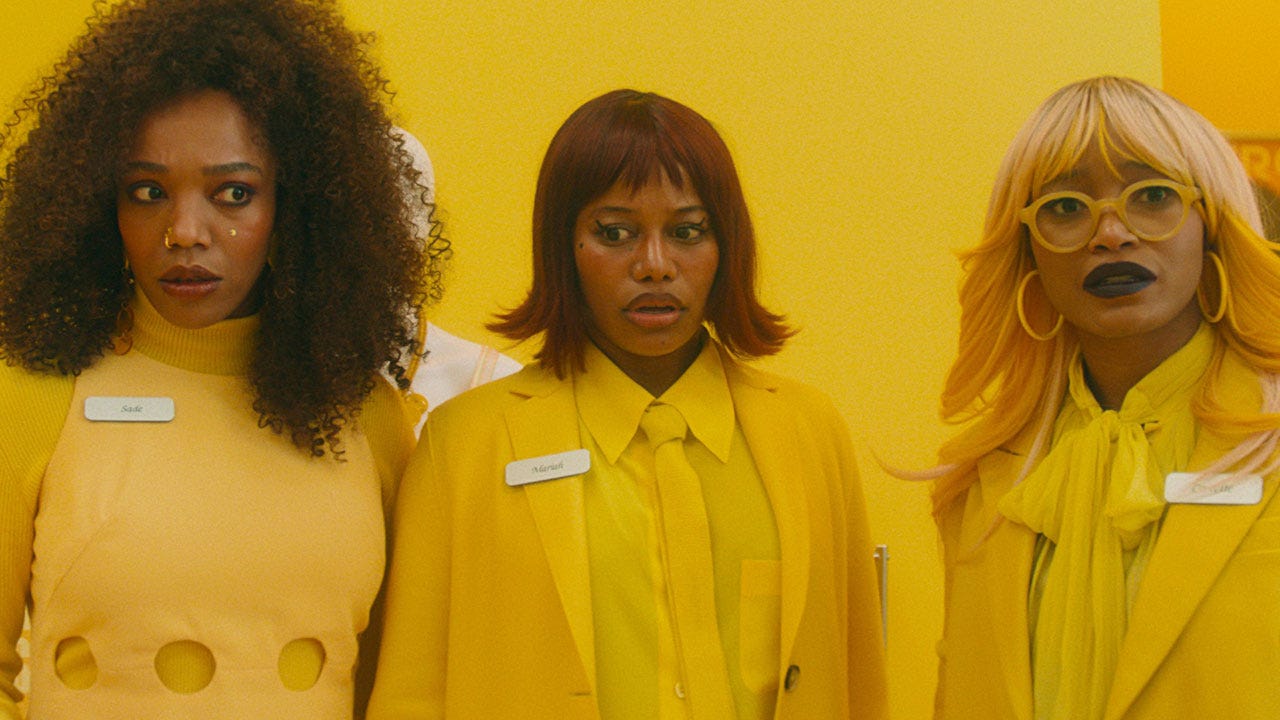
Palmer plays Corvette, a struggling Bay Area fashion designer who supports herself by boosting — stealing designer clothes from boutiques and selling them cheap to people who couldn’t otherwise afford them. She and her crew, the Velvet Gang — Sade (Naomi Ackie) and Mariah (Taylour Paige) — have built a whole operation around it. Mariah calls it “Triple F”: Fashion Forward Filanthropy. “She knows how to spell philanthropy,” she deadpans. “This is branding.”
Their target is Christie Smith, a billionaire fashion mogul played by a gloriously self-absorbed Demi Moore, who has not only stolen one of Corvette’s designs but runs an empire built on underpaid factory workers getting sick from sandblasting denim. (These are, as the film pointedly notes, all real things.) When Poppy Liu’s Jianhu — a Chinese factory worker who teleports herself to the Bay Area — joins the crew, the film’s second half kicks into a revenge caper that zips through time, space and dialectical materialism with gleeful abandon.
The ensemble also pulls in Eiza González as a vaping, revolutionary-minded retail worker named Violeta, who is literally forced to buy her own uniform out of her paycheck. Don Cheadle, buried under prosthetics and practically unrecognizable, plays a potbellied life coach. Will Poulter is magnificently fussy as a catty store manager. And LaKeith Stanfield — who first worked with Riley on Sorry to Bother You — plays a mysterious figure described variously as a discount brand model with a strange accent and a hypnotizing stare, and, in the Detroit News’s more colorful assessment, a sex demon. Stanfield says Riley pitched him the character before the script was even written: “He just said that it’s going to be a character unlike any character you played, which is true. And that it’s someone that is trying to find a way to connect to others. And this guy has been alive since the beginning of time. And I was like, ‘Oh, this is very interesting.’”
A Feast for the Eyes
Whatever you think of the story, the movie is a visual knockout. Costume designer Shirley Kurata — who brought her Oscar-winning imagination to Everything Everywhere All at Once — goes full maximalist here, decking the Velvet Gang in feathers, satins, silks and avant-garde color while Christie’s boutiques enforce a single color per month (the entire cast garbed in pea-soup green for one memorable sequence). Production designer Christopher Glass (Ms. Marvel, The Jungle Book) and set decorator Lizbeth Ayala (Civil War, Atlanta) round out a below-the-line team clearly operating at the top of their game.
The sight gags are something. Christie’s trendy atelier has a dramatically sloped floor — for aesthetics, presumably — which the designer navigates gamely but Corvette, who’s snuck in, cannot get out of without hilariously sliding backward. Store employees are given exactly 30 seconds for a lunch break, so they sprint from starting blocks. And Corvette, leaving a boutique after boosting a mountain of clothing stuffed under her tracksuit, hobbles out looking like an inflatable parade float on incongruously tiny heels. There’s also a teleportation device powered by Marxist dialectics, villains rendered in stop-motion animation, and a miniature car chase. Riley worked with cinematographer Natasha Braier (The Neon Demon) to make every frame feel as handmade and specific as possible. “For me, I’m heightening contradictions,” Riley says. “That’s also something I bring from music. You can talk all the time about what technically should work, but what matters is making you feel a certain thing.”
The score, by music duo Tune-Yards, punctuates the comedy with an eclectic pluckiness that fits Riley’s world perfectly.
The Man Behind the Movie
Riley, 55, has been calling himself a communist for more than 30 years without apology. He grew up in Oakland, got into activism young, and spent years as a musician — his long-running rap group the Coup released a song literally called “I Love Boosters” on their 2006 album Pick a Bigger Weapon, with lines like “Most of it was made by children in Asia / The stores make money off of very low wages.” The film isn’t a direct adaptation, he says, but they come from the same place.
At $20 million, I Love Boosters is the biggest production investment Neon has ever made. Riley is clear-eyed about what he wants from it. “The world that I hope to see created is one in which the people democratically control the wealth that they create with their labor,” he said during a recent interview, conducted while he was driving from his Oakland home to a San Francisco hotel for a full press day. “Now, why do I want that? That has to do with people. I like people and I think there’s a way that we can get there in order to counter those in power just doing whatever they want to do.”
He’s also been running a college promotional tour since the film’s South by Southwest premiere in March, and figures he’s seen it with audiences more than 25 times. “It’s always like a rock show,” he says. “I’ve been taking it back to the indie music days and just beating the cement.”
The film has drawn some online scrutiny over Riley’s collaboration with producer Megan Ellison, daughter of tech billionaire Larry Ellison. Riley doesn’t flinch. “So there’s no getting out of it. And also, that’s not my goal. That never was part of my goal. My goal is to help create class struggle and help to create this mass militant, radical labor movement.” He’s also been showing up to press events in a rotating collection of oversized hats — six of them, sourced from London shop Uptown Yardie — a habit he picked up around 2022 and briefly considered retiring before reconsidering. “I read a thing with Godard talking about how he had to make himself this character to sell his movies,” Riley says. “And you don’t think about Godard thinking about marketing. And so for me, I was like, ‘I gotta sell this movie. Let me bring the hat back out.’”
What Critics Think
Reviews have landed all over the map, which is probably exactly what Riley expected. The Seattle Times calls it “just the thing for summer” — funny, raunchy, and dressed in a rainbow-bright array of costumes, praising Palmer’s “wise and endearing” Corvette and Moore’s amusingly self-absorbed villain. (One particular highlight: the way Christie hands her chewed gum to her assistant like it’s a gift.) IGN goes further, calling the film “the cinematic equivalent of a song of the summer” and praising it as an improvement on Sorry to Bother You, with Palmer’s performance keeping the wackiness grounded when it needs to be.
The Associated Press is more measured, giving it two and a half out of four stars. That review admires Riley’s imagination and the film’s genuine style-and-substance combination but finds the laughs don’t quite land — “amusing and clever” rather than genuinely funny — and the climax more mind-numbing than rousing. The Houston Chronicle lands somewhere in between: a long, strange trip that’s about 15 minutes too long but still fuses pointed humor with a bold sense of the absurd. The Detroit News gives it a B, calling Palmer “a perfect fit for Riley’s world” and Stanfield’s mysterious energy another layer of bizarro fun.
The consensus thread, even among the more skeptical reviews: this is a film with something to say and a genuinely original way of saying it. In a marketplace full of franchises and IP, that counts for something.
https://youtube.com/watch?v=cO3MrHffZDA%3Fsi%3DFpq6M1QWOEo_P8nc
Palmer, for her part, is the reason almost everyone agrees the film works as well as it does. Her comedic timing, her delivery of throwaway lines like “Now is not the time for nuance, Sade!” — she makes Corvette feel real inside a world that is anything but. Riley himself has described her as feeling like she’s “from the future.” After watching her carry a Marxist fashion heist comedy on her back with this much charisma, it’s hard to argue.
Filed in

Comments
0