
‘Is God Is’ Review: One of the Best Films of 2026
Aleshea Harris’ debut feature ‘Is God Is’ is a scorching revenge thriller with Kara Young, Mallori Johnson, Sterling K. Brown, and Vivica A. Fox. In theaters May 15.
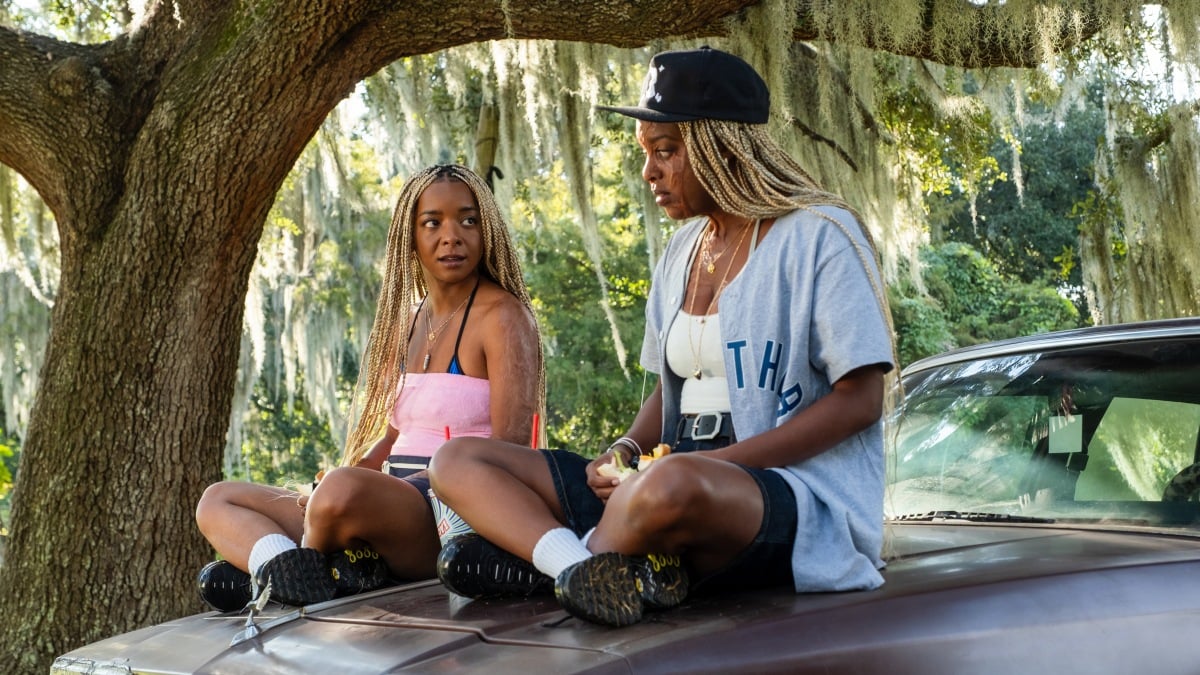
- Is God Is, adapted from Aleshea Harris’ Obie Award-winning 2018 Off Broadway play, opens in theaters May 15 via Amazon MGM Studios.
- The film stars Kara Young and Mallori Johnson as twin sisters on a revenge mission, with Sterling K. Brown, Vivica A. Fox, Janelle Monáe, and Erika Alexander in supporting roles.
- Tessa Thompson and Janicza Bravo produced the film, and cinematographer Alexander Dynan shot it with what critics are calling an “icy daylight severity.”
- Early reviews are calling it one of the best films of 2026 and a major breakout vehicle for its two leads.
Let’s skip the hedging. Is God Is — playwright-turned-filmmaker Aleshea Harris’ feature directorial debut — is one of the best movies of 2026. Not “impressive for a first film.” Not “promising.” One of the best, full stop.
A Southern-fried road trip thriller drawing from Greek tragedy, 1970s Blaxploitation, Quentin Tarantino’s pulpy lyricism, the structural cool of spaghetti westerns, and — at a literary level — the rugged vernacular of Toni Morrison, Is God Is is the kind of film that arrives fully formed and completely its own. It opens in theaters on May 15, distributed by Amazon MGM Studios, and it has the feel of something people are going to be talking about for a long time.
Harris adapted the screenplay from her own celebrated play, which debuted Off Broadway at Soho Rep in 2018, ran for five weeks, and won three Obie Awards — including Playwriting for Harris herself. Two years before that, the play had won the American Playwriting Foundation’s Relentless Award, accompanied by a $45,000 prize that allowed Harris to stage readings around the world. All of that pedigree is visible on screen. But so is something rarer: a filmmaker who has completely shed the constraints of her source material and made something that lives and breathes as cinema.
What Is God Is Is Actually About
Racine the Rough One (Kara Young) and Anaia the Quiet One (Mallori Johnson) are Black twin sisters in their early twenties, both physically and psychologically scarred from a fire set in their childhood home by their father. Racine carries burn marks on her hand, arm, and neck; Anaia’s scars cover her face, making her the target of casual cruelty from strangers. The fire, they’ve long believed, killed their mother. It did not.
When the sisters receive a letter from Ruby — their mother, played by Vivica A. Fox under four hours of prosthetic burn makeup made elegant with lace bandages and pearls — it turns their world upside down. Ruby, attended to by three women braiding her hair in focused silence, is God to her daughters, and Harris frames her that way: a vision of female wrath and resilience holding court from her sickbed. Her ask is simple and enormous. Their father (Sterling K. Brown, credited only as “Man” or “Monster”) set that fire deliberately. He’s moved on. Started new families. And Ruby wants him dead. “Make your daddy dead — real dead,” she tells them, handing the film its irresistible tagline.
Racine accepts this divine mission without flinching. “She made us,” she shrugs, as if that settles it. Anaia is less certain — “We ain’t killers,” she pleads, and Racine’s response is two words: “I am.” But her devotion to her sister wins out, and the two set off across America, following their father’s messy trail from the hard-up Bible Belt to nouveau riche California.
What they find along the way is a gallery of people shaped, broken, or discarded by the same man. Erika Alexander plays Divine, a self-made evangelical preacher radiating authority in a white gown — both frightening and desperately sad, still waiting on a man who abandoned her long ago. Mykelti Williamson is the sketchy lawyer who got the Monster off, now haunted by his own near-fatal encounter with him, functioning in the story like a horror movie oracle. And Janelle Monáe has a brittle, sharp cameo as a trophy wife who makes the mistake of flaunting her wealth in front of two women with nothing left to lose.
Harris rarely uses the characters’ names — a deliberate choice, keeping the audience from getting too comfortable rooting for anyone, since most of them are operating somewhere outside of easy moral categories. This is not a film interested in girlboss feminism or tidy justice. It’s interested in something messier and more honest: the way violence ripples across generations, how a man who wanted to kill their mother raised daughters who want to kill him, and what that inheritance costs everyone it touches. “We come from a man who wanted to kill our mama,” Racine says matter-of-factly, “and a mama who wants to kill that man.”
The Cast Is Extraordinary, Start to Finish
Young and Johnson are the engine of this film, and they are sublime. Young plays Racine with a ruthless, unapologetic rage — the kind women, and especially Black women, are constantly pressured to suppress. Watching her explode with a blunt object in hand is cathartic in a way that’s uncomfortable to admit, which is exactly the point. Johnson, working largely through expression and physicality beneath her facial scar prosthetics, conveys Anaia’s deep hurt and hard-won resilience without a word. Together they’re a beautifully calibrated hot-and-cold double act, and this should be a major breakout for both of them.
What’s even more impressive is that they hold their own opposite a cast stacked with far more established names. Fox is spellbinding as the wounded God. Alexander is beguiling. Williamson brings a dark, haggard humor to the lawyer. Monáe makes every second of her limited screen time count. But Harris saves the best for last.
Sterling K. Brown, for most of his screen time, exists only in fragments: a pair of grasping hands, a set of fleeing feet, a smile — big, white, and menacing. The effect is mythic, building the Monster into something larger than life, a demon the twins have to slay rather than a man they once knew. By the time he’s fully revealed, sitting in his sprawling ranch house making a sandwich and speaking in a soft voice, the restraint is more terrifying than any snarl could be. It’s a masterclass in how to weaponize charm.
Harris the Filmmaker Is the Real Revelation
Harris didn’t direct her play when it ran Off Broadway — that was Taibi Magar. So her confidence behind the camera here is all the more striking. Shot by Alexander Dynan (whose credits include First Reformed and The History of Sound) with what Variety describes as “icy daylight severity” that tips into comic book noir at key moments, and cut to a crisp 99 minutes by editors Blair McClendon (Aftersun) and Jay Rabinowitz (Requiem for a Dream), the film moves with complete authority.
The road movie structure never feels stagey — remarkable given the material’s origins. The twins’ journey through sweltering Southern landscapes, a humble church, a deserted highway, and finally that beige-walled California ranch house feels genuinely cinematic. Harris uses decay in the frame during fight scenes to reflect the grubby reality of what revenge actually costs. A soundtrack of funky percussion, flute, and guitar scores the chaos. And the twin-speak — the telepathic communication between Racine and Anaia, rendered with subtitles popping up over sharp glances — is a clever theatrical holdover that translates beautifully to screen.
Produced by Tessa Thompson (who recently starred in Hedda) and Janicza Bravo (director of Zola), Is God Is arrives with serious artistic credibility behind it. That pedigree shows in every frame.
The film doesn’t offer easy resolution or moral comfort. It ends as it lives — on its own terms, in the space between what’s right and what’s righteous. But sitting with it in the days after, what lingers isn’t the violence. It’s those two sisters, looking at each other across everything that’s been done to them, deciding who they’re going to be. Harris has made something mythic out of that question. And she does not let you go.
Filed in

Comments
0